
[Paper Review] Millimeter Observations of the Type II SN2023ixf: Constraints on the Proximate Circumstellar Medium
This study presents millimeter observations of the nearby Type II supernova SN 2023ixf using the Submillimeter Array (SMA), detecting no emission at 1.3 mm (230 GHz) within 18.6 days post-explosion. The non-detections constrain the circumstellar medium (CSM) mass-loss rate to $< 10^{-6}$ M$_\odot$ yr$^{-1}$ or $> 10^{-2}$ M$_\odot$ yr$^{-1}$, consistent with optical spectroscopy but in tension with X-ray-based estimates, suggesting a non-homogeneous, confined CSM may reconcile the discrepancy.
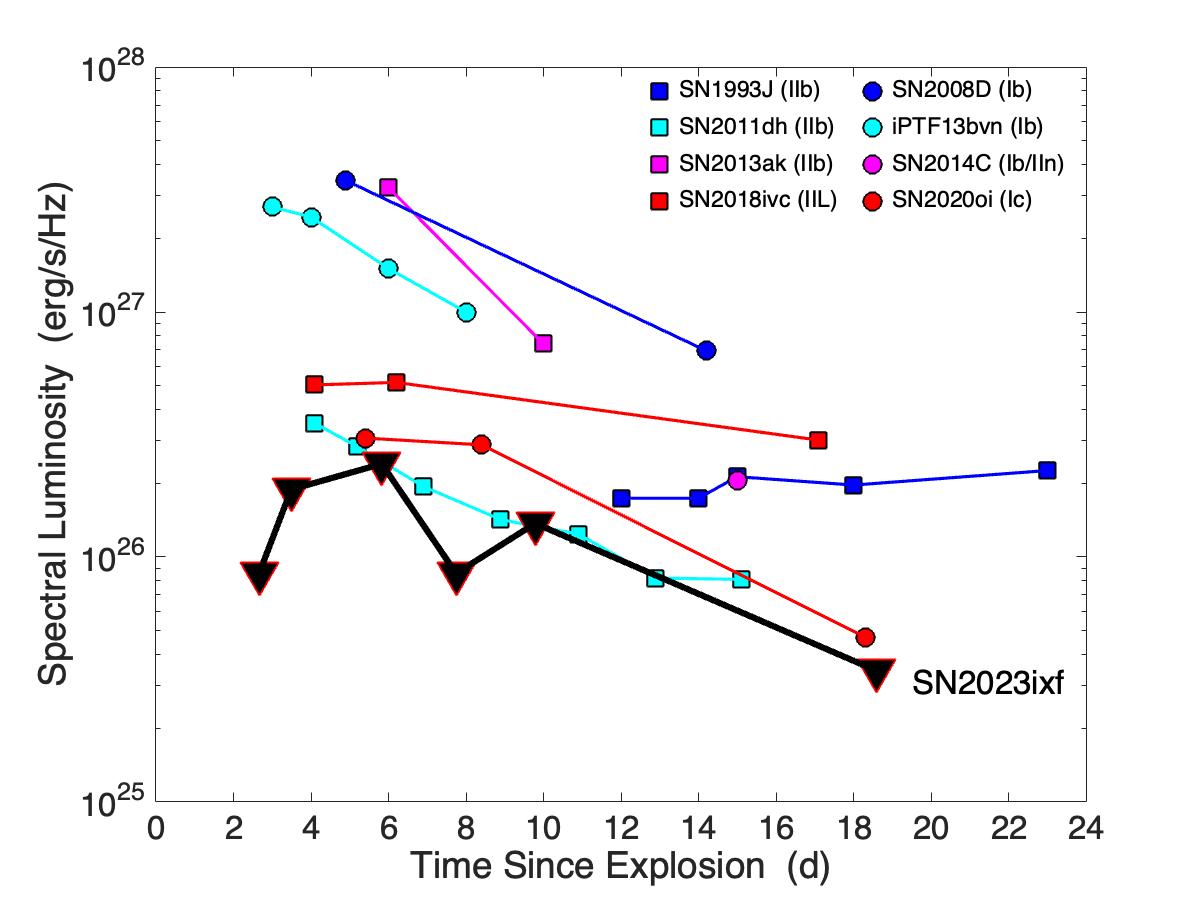
We present 1.3 mm (230 GHz) observations of the recent and nearby Type II supernova, SN2023ixf, obtained with the Submillimeter Array (SMA) at 2.6-18.6 days after explosion. The observations were obtained as part the SMA Large Program POETS (Pursuit of Extragalactic Transients with the SMA). We do not detect any emission at the location of SN2023ixf, with the deepest limits of $L_ν(230\,{ m GHz})\lesssim 8.6 imes 10^{25}$ erg s$^{-1}$ Hz$^{-1}$ at 2.7 and 7.7 days, and $L_ν(230\,{ m GHz})\lesssim 3.4 imes 10^{25}$ erg s$^{-1}$ Hz$^{-1}$ at 18.6 days. These limits are about a factor of 2 times dimmer than the mm emission from SN2011dh (IIb), about an order of magnitude dimmer compared to SN1993J (IIb) and SN2018ivc (IIL), and about 30 times dimmer than the most luminous non-relativistic SNe in the mm-band (Type IIb/Ib/Ic). Using these limits in the context of analytical models that include synchrotron self-absorption and free-free absorption we place constraints on the proximate circumstellar medium around the progenitor star, to a scale of $\sim 2 imes 10^{15}$ cm, excluding the range $\dot{M}\sim { m few} imes 10^{-6}-10^{-2}$ M$_\odot$ yr$^{-1}$ (for a wind velocity, $v_w=115$ km s$^{-1}$, and ejecta velocity, $v_{ m eje}\sim (1-2) imes 10^4$ km s$^{-1}$). These results are consistent with an inference of the mass loss rate based on optical spectroscopy ($\sim 2 imes 10^{-2}$ M$_\odot$ yr$^{-1}$ for $v_w=115$ km s$^{-1}$), but are in tension with the inference from hard X-rays ($\sim 7 imes 10^{-4}$ M$_\odot$ yr$^{-1}$ for $v_w=115$ km s$^{-1}$). This tension may be alleviated by a non-homogeneous and confined CSM, consistent with results from high-resolution optical spectroscopy.
Motivation & Objective
- To constrain the density and mass-loss rate of the circumstellar medium (CSM) around the progenitor of SN 2023ixf using early millimeter observations.
- To compare mm-band constraints with existing optical and X-ray measurements of the CSM to assess consistency across multi-wavelength diagnostics.
- To investigate whether discrepancies between X-ray and mm-band inferred mass-loss rates can be resolved by non-spherical or confined CSM geometries.
- To test the robustness of analytical models incorporating synchrotron self-absorption and free-free absorption in interpreting non-detections.
- To establish the utility of early millimeter observations as an independent probe of CSM properties in nearby core-collapse supernovae.
Proposed method
- Conducted 1.3 mm (230 GHz) observations of SN 2023ixf with the Submillimeter Array (SMA) over 2.6–18.6 days after explosion as part of the POETS Large Program.
- Used SMA data calibrated with standard calibrators (3C454.3, Ceres, J1419+543, J1506+426) and applied imaging and deconvolution techniques to produce deep continuum maps.
- Applied analytical models of synchrotron self-absorption and free-free absorption to interpret non-detections, deriving upper limits on luminosity and CSM mass-loss rate.
- Incorporated constraints on electron energy fraction ($\epsilon_{\rm e}$) and magnetic field energy fraction ($\epsilon_{\rm B}$) from prior SN studies to bound model degeneracy.
- Compared model predictions with multi-wavelength data, including optical flash spectroscopy and hard X-ray observations, to assess consistency across diagnostics.
- Used radial scale $\sim 2 \times 10^{15}$ cm as the maximum distance probed, consistent with optical and X-ray diagnostics.
Experimental results
Research questions
- RQ1What are the upper limits on millimeter luminosity from SN 2023ixf at 2.7, 7.7, and 18.6 days post-explosion?
- RQ2How do these mm-band non-detections constrain the mass-loss rate of the progenitor’s circumstellar medium?
- RQ3To what extent do the mm-band constraints agree with those derived from early optical spectroscopy and hard X-ray observations?
- RQ4Can a non-homogeneous or confined CSM geometry reconcile the tension between X-ray and mm-band estimates of the CSM density?
- RQ5What is the role of synchrotron self-absorption and free-free absorption in shaping the observed mm-band emission from core-collapse supernovae?
Key findings
- No emission was detected at the location of SN 2023ixf at 1.3 mm, with upper limits of $L_{\nu}(230\,{\rm GHz}) \lesssim 8.6 \times 10^{25}$ erg s$^{-1}$ Hz$^{-1}$ at 2.7 and 7.7 days, and $\lesssim 3.4 \times 10^{25}$ erg s$^{-1}$ Hz$^{-1}$ at 18.6 days.
- These mm-band luminosity limits are about a factor of 2 fainter than SN 2011dh (IIb), an order of magnitude fainter than SN 1993J (IIb) and SN 2018ivc (IIL), and about 30 times fainter than the most luminous non-relativistic SNe in the mm band.
- The non-detections constrain the circumstellar mass-loss rate to $\dot{M} \lesssim 10^{-6}$ M$_\odot$ yr$^{-1}$ (via synchrotron self-absorption) or $\dot{M} \gtrsim 10^{-2}$ M$_\odot$ yr$^{-1}$ (via free-free absorption), excluding the range $\sim$ few $\times 10^{-6} - 10^{-2}$ M$_\odot$ yr$^{-1}$ for $v_w = 115$ km s$^{-1}$.
- The mm-band constraints are consistent with the optical spectroscopy-based estimate of $\dot{M} \sim 2 \times 10^{-2}$ M$_\odot$ yr$^{-1}$ (Jacobson-Galan et al., 2023), but in tension with the X-ray-based estimate of $\dot{M} \sim 7 \times 10^{-4}$ M$_\odot$ yr$^{-1}$ (Grefenstette et al., 2023).
- The tension between X-ray and mm-band estimates may be resolved by a non-homogeneous, radially confined CSM, as suggested by high-resolution optical spectroscopy (Smith et al., 2023), which could lead to X-ray emission from lower-density regions while mm emission is absorbed in dense, confined shells.
- The study demonstrates that early mm-band observations provide an independent, complementary probe of CSM properties on scales of $\sim 10^{15}$ cm, with different modeling assumptions than optical or X-ray diagnostics.
Read this paper
Open the full text in the Nubint reader and ask about any passage as you read.
Read this paper on NubintThis review was generated by AI from the original paper. Please check the paper before citing it.