
[Paper Review] Missing Values and Imputation in Healthcare Data: Can Interpretable Machine Learning Help?
This paper proposes using interpretable machine learning, specifically Explainable Boosting Machines (EBMs), to diagnose missingness mechanisms and detect harmful imputations in healthcare data. By analyzing shape functions and feature interactions, EBMs reveal that advanced imputation methods like MissForest and KNN can systematically underestimate critical values (e.g., P/F ratio), leading to dangerous underestimation of patient risk—problems invisible to black-box models but detectable via interpretability.
Missing values are a fundamental problem in data science. Many datasets have missing values that must be properly handled because the way missing values are treated can have large impact on the resulting machine learning model. In medical applications, the consequences may affect healthcare decisions. There are many methods in the literature for dealing with missing values, including state-of-the-art methods which often depend on black-box models for imputation. In this work, we show how recent advances in interpretable machine learning provide a new perspective for understanding and tackling the missing value problem. We propose methods based on high-accuracy glass-box Explainable Boosting Machines (EBMs) that can help users (1) gain new insights on missingness mechanisms and better understand the causes of missingness, and (2) detect -- or even alleviate -- potential risks introduced by imputation algorithms. Experiments on real-world medical datasets illustrate the effectiveness of the proposed methods.
Motivation & Objective
- To address the critical challenge of missing values in healthcare data, where improper handling can lead to life-altering clinical decisions.
- To investigate how interpretable machine learning can uncover hidden biases and flaws in common imputation techniques.
- To develop methods that detect when imputation introduces systematic errors, especially in high-stakes medical applications.
- To provide clinicians and data scientists with tools to understand *why* values are missing and how imputation affects model behavior.
- To demonstrate that EBM-based interpretability can reveal anomalies in imputed data that standard models miss.
Proposed method
- Using Explainable Boosting Machines (EBMs), a glass-box, high-accuracy model, to analyze feature distributions and detect patterns in missingness.
- Applying EBM shape functions to visualize how imputed values affect model predictions across feature ranges.
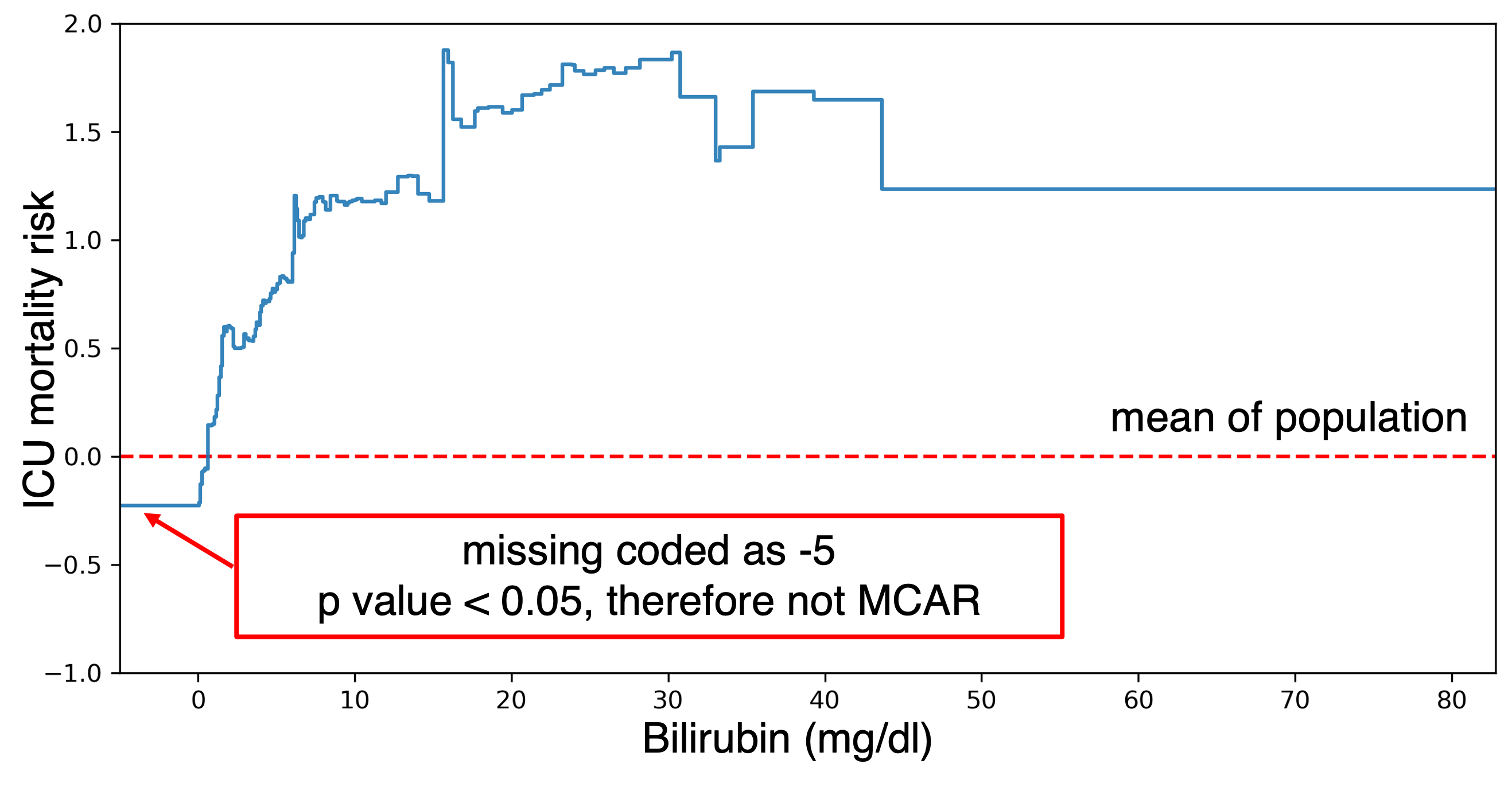
- Testing for Missing Completely at at Random (MCAR) by comparing observed and imputed distributions using EBM-based statistical checks.
- Building models to predict missingness from other features, leveraging EBM interpretability to reveal relationships between variables and missingness.
- Using EBM shape function anomalies—such as spiky or counterintuitive patterns—to flag potentially harmful imputation behaviors.
- Comparing multiple imputation methods (mean, MissForest, KNN) on real-world medical datasets and assessing their impact via EBM diagnostics.
Experimental results
Research questions
- RQ1Can interpretable machine learning help identify the underlying mechanisms of missingness in healthcare datasets?
- RQ2Do advanced imputation methods like MissForest and KNN introduce systematic biases that compromise clinical model performance?
- RQ3Can EBM shape functions detect harmful imputation patterns that are invisible to black-box models?
- RQ4How can interpretability tools help clinicians and data scientists assess the risks of imputation before model deployment?
- RQ5Can EBM-based diagnostics reveal when imputation leads to underestimation of patient risk, especially for critical variables like P/F ratio?
Key findings
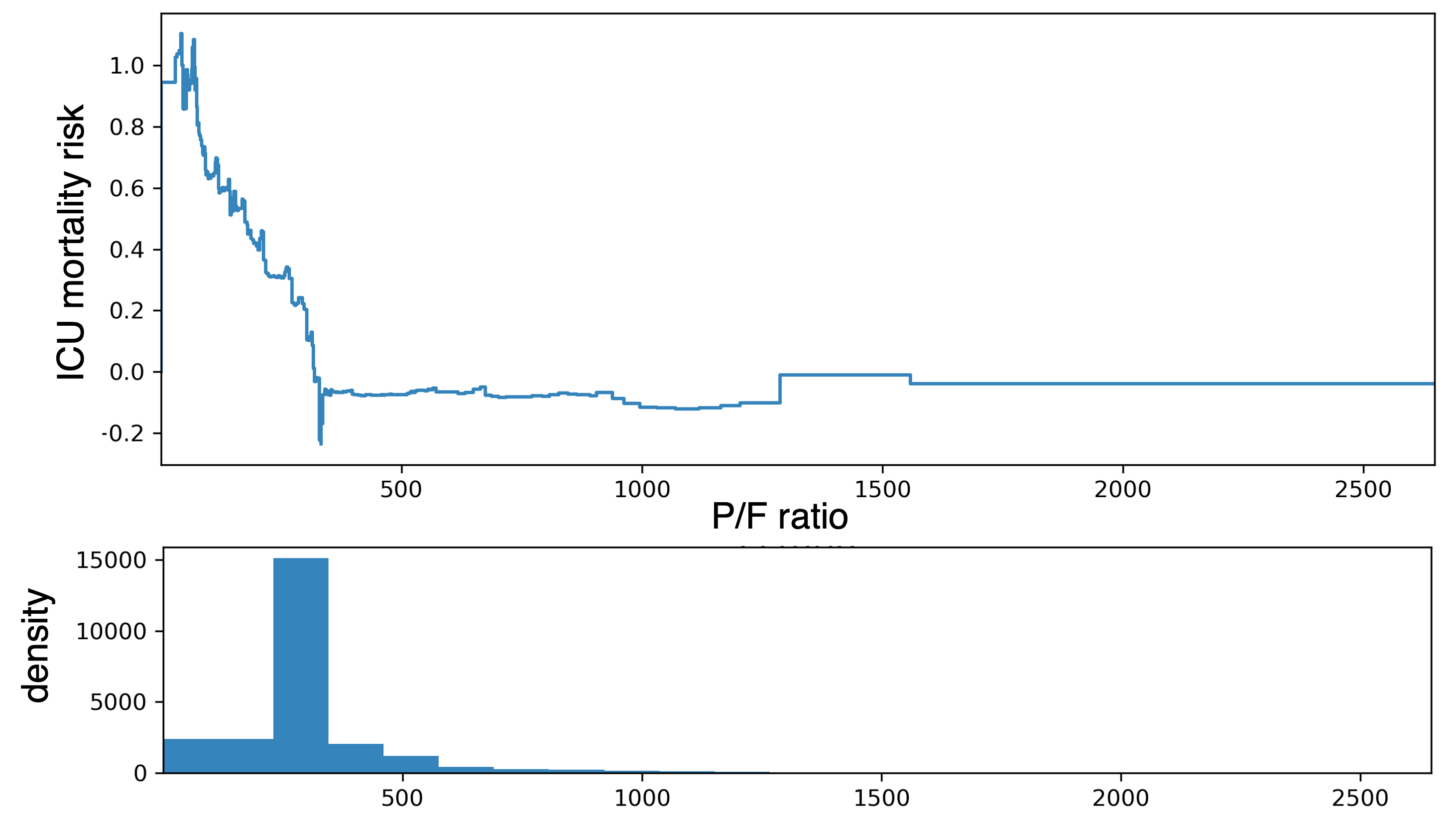
- MissForest and KNN imputation systematically imputed lower P/F ratio values than expected, suggesting they underestimate patient risk—especially for patients with already low P/F ratios.
- The EBM shape functions revealed spiky, non-smooth patterns in predictions when using advanced imputation, indicating unstable and potentially harmful model behavior.
- Mean imputation, while simpler, caused less widespread distortion than MissForest and KNN, which affected a broader range of patients with P/F ratios between 0 and 800.
- EBM-based diagnostics successfully detected that missing P/F ratios were likely due to clinical assumption of normalcy (i.e., values near 1000), a pattern not visible through standard analysis.
- The method identified that imputation could introduce local fluctuations in model predictions, which are particularly dangerous in clinical settings where small errors can have large consequences.
- Model editing tools were shown to be effective in correcting harmful imputation effects with minimal impact on overall accuracy, highlighting the practical utility of interpretable models.
Read this paper
Open the full text in the Nubint reader and ask about any passage as you read.
Read this paper on NubintThis review was generated by AI from the original paper. Please check the paper before citing it.