
[Paper Review] MLHOps: Machine Learning for Healthcare Operations
This paper introduces MLHOps, a framework for the reliable, ethical, and efficient deployment and maintenance of machine learning models in healthcare. It outlines a comprehensive MLOps pipeline—from data preparation and model training to monitoring, updating, and addressing bias, fairness, and privacy—supported by practical guidelines and open-source tools for clinicians and developers.
Machine Learning Health Operations (MLHOps) is the combination of processes for reliable, efficient, usable, and ethical deployment and maintenance of machine learning models in healthcare settings. This paper provides both a survey of work in this area and guidelines for developers and clinicians to deploy and maintain their own models in clinical practice. We cover the foundational concepts of general machine learning operations, describe the initial setup of MLHOps pipelines (including data sources, preparation, engineering, and tools). We then describe long-term monitoring and updating (including data distribution shifts and model updating) and ethical considerations (including bias, fairness, interpretability, and privacy). This work therefore provides guidance across the full pipeline of MLHOps from conception to initial and ongoing deployment.
Motivation & Objective
- To address the growing gap between ML research in healthcare and real-world clinical deployment by establishing a standardized operational framework.
- To identify and systematize the key challenges in deploying ML models in clinical settings, including data standardization, model monitoring, and ethical risks.
- To provide a practical, end-to-end guide for clinicians and developers on implementing MLHOps pipelines in real healthcare environments.
- To integrate ethical considerations—such as bias, fairness, interpretability, and privacy—into every stage of the ML lifecycle in healthcare.
Proposed method
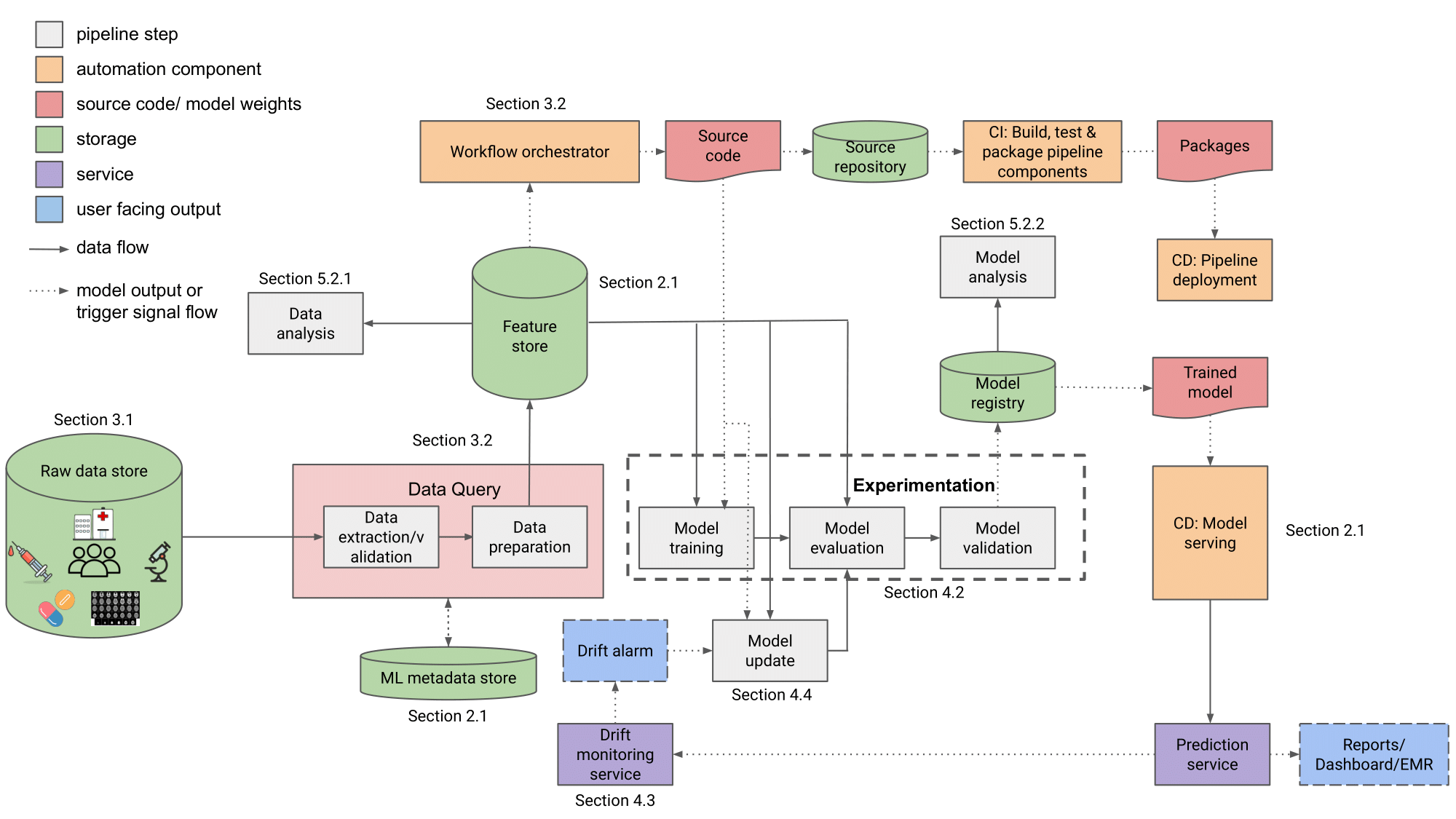
- Proposes a structured MLOps pipeline with defined components: data stores, feature stores, metadata stores, and model registries for centralized management.
- Introduces a multi-role team structure (e.g., data scientists, ML engineers, clinicians, DevOps) to ensure collaboration across technical and clinical domains.
- Outlines a phased MLHOps lifecycle: data ingestion and preprocessing, model training and validation, deployment, monitoring, and continuous updating.
- Emphasizes the use of automated, orchestrated pipelines to ensure reproducibility, version control, and CI/CD practices in clinical ML systems.
- Integrates ethical AI practices through systematic evaluation of fairness, bias, and privacy using open-source tools like AIF360, Fairlearn, and What-If Tool.
- Recommends continuous monitoring of data drift and model performance using tools such as Fairness Indicators and CERTIFAI for ongoing model governance.
Experimental results
Research questions
- RQ1How can machine learning models be reliably and efficiently deployed in clinical settings while maintaining performance and safety?
- RQ2What are the key operational and ethical challenges in sustaining ML models over time in healthcare environments?
- RQ3How can data quality, model fairness, and interpretability be systematically addressed throughout the ML lifecycle in healthcare?
- RQ4What tools and frameworks support the monitoring, updating, and auditing of ML models in real-world clinical workflows?
Key findings
- MLHOps pipelines significantly improve the reliability and maintainability of ML models in healthcare by standardizing data handling, model deployment, and monitoring processes.
- The integration of ethical AI tools such as AIF360, Fairlearn, and What-If Tool enables systematic detection and mitigation of bias and fairness issues in clinical ML systems.
- Continuous monitoring of data distribution shifts and model performance is essential to maintain model validity and clinical safety over time.
- The use of feature stores and metadata stores enhances model reproducibility, collaboration, and scalability across clinical teams and institutions.
- Open-source toolkits like FairMLHealth and Responsibly provide actionable support for auditing and improving fairness and robustness in healthcare ML applications.
- A multidisciplinary team structure—including clinicians, data scientists, and DevOps engineers—is critical for successful and responsible ML deployment in healthcare.
Read this paper
Open the full text in the Nubint reader and ask about any passage as you read.
Read this paper on NubintThis review was generated by AI from the original paper. Please check the paper before citing it.