
[Paper Review] Modelling repetition in zDM: a single population of repeating fast radio bursts can explain CHIME data
This paper demonstrates that a single population of repeating fast radio bursts (FRBs), with a power-law distribution of repetition rates (γₐ = −2.2⁺⁰.⁶₋₀.⁸), can quantitatively explain CHIME's observed data on repeat and once-off FRBs. It shows that repeating sources in the nearby Universe significantly bias population models, and that 50–100% of CHIME’s single FRBs are likely due to repeaters with peak rates >0.75 day⁻¹.
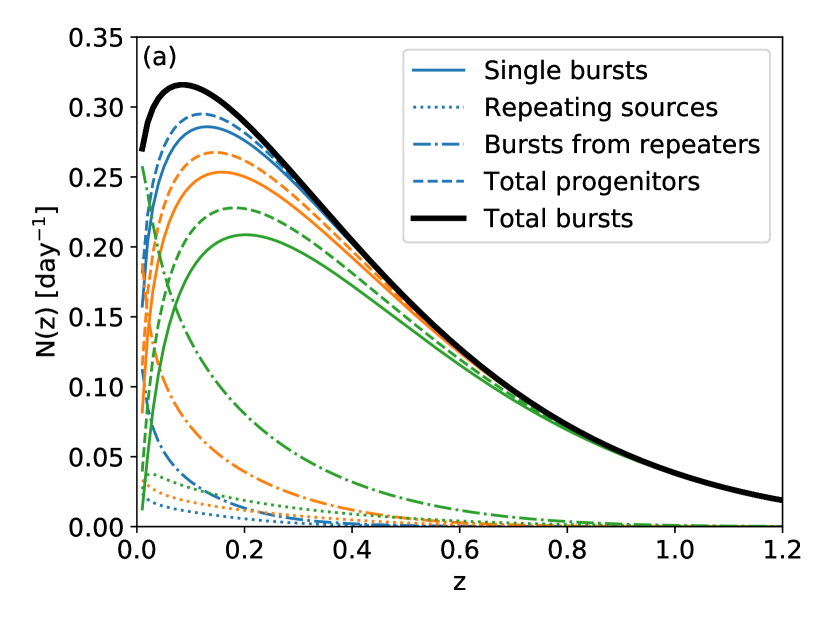
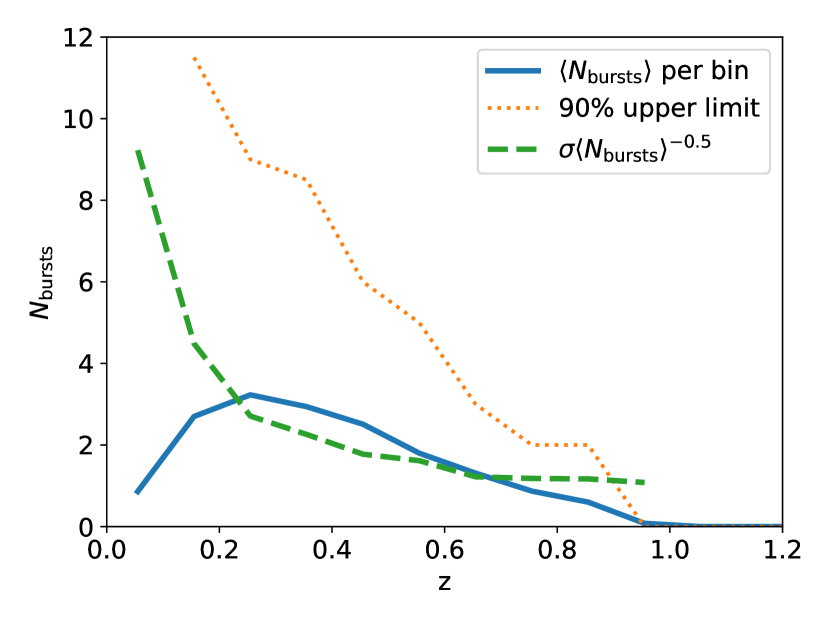
Regardless of whether or not all fast radio bursts (FRBs) repeat, those that do form a population with a distribution of rates. This work considers a power-law model of this population, with rate distribution $Φ_r \sim R^{γ_r}$ between $R_{ m min}$ and $R_{ m max}$. The zDM code is used to model the probability of detecting this population as either apparently once-off or repeat events as a function of redshift, $z$, and dispersion measure, DM. I demonstrate that in the nearby Universe, repeating sources can contribute significantly to the total burst rate. This causes an apparent deficit in the total number of observed sources (once-off and repeaters) relative to the distant Universe that will cause a bias in FRB population models. Thus instruments with long exposure times should explicitly take repetition into account when fitting the FRB population. I then fit data from The Canadian Hydrogen Intensity Mapping Experiment (CHIME). The relative number of repeat and apparently once-off FRBs, and their DM, declination, and burst rate distributions, can be well-explained by 50--100\% of CHIME single FRBs being due to repeaters, with $R_{ m max} > 0.75$ day$^{-1}$ above $10^{39}$ erg, and ${γ_r} = -2.2_{-0.8}^{+0.6}$. This result is surprisingly consistent with follow-up studies of FRBs detected by the Australian Square Kilometre Array Pathfinder (ASKAP). Thus the evidence suggests that CHIME and ASKAP view the same repeating FRB population, which is responsible not just for repeating FRBs, but the majority of apparently once-off bursts. For greater quantitative accuracy, non-Poissonian arrival times, second-order effects in the CHIME response, and a simultaneous fit to the total FRB population parameters, should be treated in more detail in future studies.
Motivation & Objective
- To resolve the apparent deficit in observed FRB rates in the nearby Universe, which arises because repeating sources contribute disproportionately to the total burst rate.
- To test whether a single population of repeating FRBs, with a broad distribution of repetition rates, can explain the observed distributions of CHIME FRBs in terms of DM, declination, burst rate, and repeat status.
- To quantify the impact of repetition on FRB population modeling, particularly the bias introduced by preferential detection of nearby repeaters.
- To assess the consistency of CHIME’s FRB population with follow-up results from ASKAP, suggesting a common underlying population.
Proposed method
- Uses the zDM code to model the detection probability of FRBs as a function of redshift (z) and dispersion measure (DM), accounting for instrumental sensitivity and beam response.
- Applies a power-law rate distribution Φᵣ ∼ Rᵞʳ between Rₘᵢₙ and Rₘₐₓ to represent the population of repeating FRBs.
- Compares three methods for calculating the effective exposure time T(B): a single effective value (Tₑff), frequency-averaged beam sensitivity T(B̄), and time-averaged sensitivity across frequency bins T̄(B), with T(B̄) adopted as the default due to broadband burst characteristics.
- Incorporates declination-dependent exposure by binning CHIME’s observing time into six declination bins, validating results with a 30-bin comparison to assess systematic error.
- Fits the model to CHIME Catalog 1 data, including repeat and once-off FRB counts, DM distributions, declination, and burst rate distributions.
- Uses a modified sensitivity weighting scheme to account for non-Poissonian burst arrival times and second-order effects in the CHIME response.
Experimental results
Research questions
- RQ1Can a single population of repeating FRBs with a power-law distribution of repetition rates explain the observed mix of repeat and once-off FRBs in CHIME data?
- RQ2To what extent do nearby repeating FRBs bias the apparent total FRB rate and lead to an apparent deficit in the nearby Universe?
- RQ3What is the inferred distribution of repetition rates (γᵣ) and maximum rate (Rₘₐₓ) that best fits CHIME’s observed FRB population?
- RQ4How consistent is the inferred repeating FRB population with follow-up observations from ASKAP?
- RQ5Does the choice of beam sensitivity parameterization (Tₑff vs. T(B̄) vs. T̄(B)) significantly affect the predicted burst rates and model fits?
Key findings
- A single population of repeating FRBs with a power-law rate distribution γᵣ = −2.2⁺⁰.⁶₋₀.⁸ provides a good fit to CHIME’s observed data on repeat and once-off FRBs.
- Repeating sources in the nearby Universe contribute significantly to the total burst rate, causing an apparent deficit in the number of observed sources relative to the distant Universe.
- Between 50% and 100% of CHIME’s single FRBs are likely due to repeaters, with a maximum repetition rate Rₘₐₓ > 0.75 day⁻¹ above 10³⁹ erg.
- The model's predictions are consistent with follow-up studies of FRBs detected by ASKAP, suggesting CHIME and ASKAP observe the same underlying repeating FRB population.
- Using a single effective sensitivity value (Tₑff) over-predicts burst rates at high redshift and under-predicts them at low redshift, highlighting the need for frequency-resolved beam modeling.
- The frequency-averaged beam sensitivity T(B̄) provides a better fit than Tₑff, and the time-averaged method T̄(B) is more accurate for band-limited bursts, though T(B̄) is adopted as the default due to the broadband nature of most FRBs.
Read this paper
Open the full text in the Nubint reader and ask about any passage as you read.
Read this paper on NubintThis review was generated by AI from the original paper. Please check the paper before citing it.