
[Paper Review] Multi-Encoder-Decoder Transformer for Code-Switching Speech Recognition
This paper proposes a Multi-Encoder-Decoder (MED) Transformer architecture with two symmetric, language-specific encoders and corresponding multi-head attention modules in the decoder to improve code-switching speech recognition. Pre-trained on large monolingual corpora and fine-tuned on limited code-switching data using CTC and KL divergence, the MED model achieves 10.2% and 10.8% relative error rate reductions on Mandarin- and English-matrix code-switching evaluations, respectively.
Code-switching (CS) occurs when a speaker alternates words of two or more languages within a single sentence or across sentences. Automatic speech recognition (ASR) of CS speech has to deal with two or more languages at the same time. In this study, we propose a Transformer-based architecture with two symmetric language-specific encoders to capture the individual language attributes, that improve the acoustic representation of each language. These representations are combined using a language-specific multi-head attention mechanism in the decoder module. Each encoder and its corresponding attention module in the decoder are pre-trained using a large monolingual corpus aiming to alleviate the impact of limited CS training data. We call such a network a multi-encoder-decoder (MED) architecture. Experiments on the SEAME corpus show that the proposed MED architecture achieves 10.2% and 10.8% relative error rate reduction on the CS evaluation sets with Mandarin and English as the matrix language respectively.
Motivation & Objective
- To address the challenge of low-resource code-switching speech recognition due to limited training data.
- To improve language discrimination in code-switched speech by modeling language-specific acoustic and linguistic features separately.
- To leverage pre-training on large monolingual corpora to initialize language-specific components and mitigate data scarcity.
- To unify decoding through a shared decoder while preserving language-specific representation learning via dual encoders and attention modules.
Proposed method
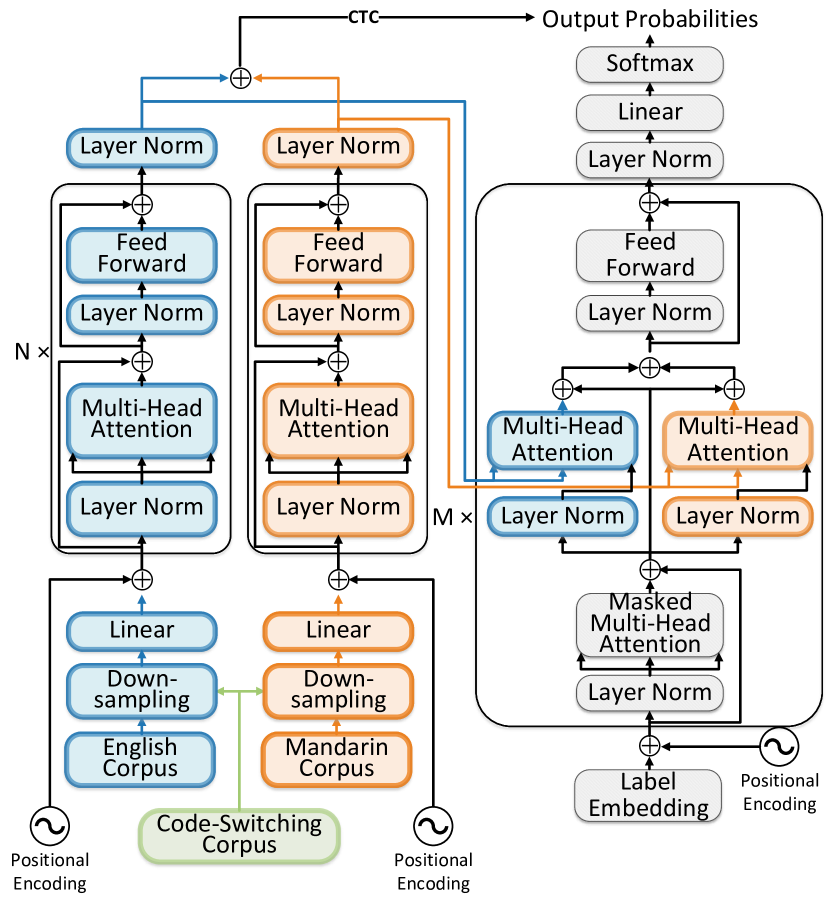
- The MED-Transformer employs two symmetric, language-specific encoders to learn distinct acoustic representations for Mandarin and English.
- Each encoder is pre-trained on a large monolingual speech corpus to improve initialization and representation quality.
- The decoder uses two language-specific multi-head attention (MHA) modules that attend to the respective encoder outputs.
- The complete model is fine-tuned on code-switching data using Connectionist Temporal Classification (CTC) and Kullback-Leibler divergence loss.
- The architecture enables joint modeling of acoustic and language information while maintaining language-specific invariance in representation learning.
- The model uses scaled dot-product attention in both encoders and decoders, with multi-head attention enabling multi-subspace attention learning.
Experimental results
Research questions
- RQ1Can a dual-encoder architecture with language-specific pre-training improve code-switching ASR performance compared to a single-encoder baseline?
- RQ2Does the use of language-specific multi-head attention in the decoder enhance discrimination between mixed languages?
- RQ3To what extent can pre-training on monolingual data alleviate the data scarcity problem in code-switching ASR?
- RQ4How do the individual encoders respond to monolingual and code-switched inputs, and does this reflect effective language discrimination?
Key findings
- The MED-Transformer achieved a 10.2% relative error rate reduction on the Mandarin-matrix evaluation set (eval man) compared to the baseline.
- A 10.8% relative error rate reduction was observed on the English-matrix evaluation set (eval sge), demonstrating robust performance across matrix languages.
- The model achieved 12.8% and 12.1% relative error rate reductions on English words in the eval man and eval sge sets, respectively.
- The model achieved 8.6% and 6.2% relative error rate reductions on Mandarin characters in the eval man and eval sge sets, respectively.
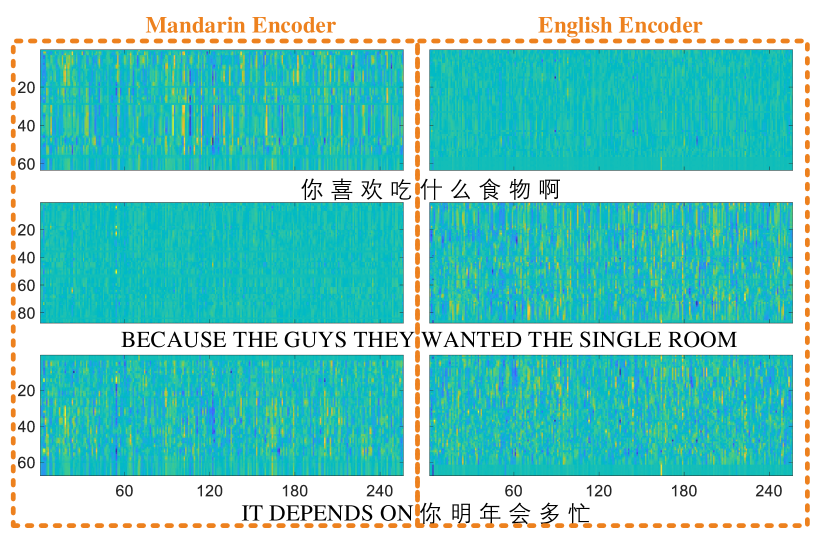
- The language-specific encoders showed distinct activation patterns: Mandarin encoder responded strongly to Mandarin speech, while English encoder responded to English, confirming effective language discrimination.
- The model with only language-specific MHA in the decoder (M-De) did not improve performance, indicating that encoder-specific modeling is more critical than decoder-specific attention for this task.
Read this paper
Open the full text in the Nubint reader and ask about any passage as you read.
Read this paper on NubintThis review was generated by AI from the original paper. Please check the paper before citing it.