
[Paper Review] Multi-Scale Dynamics of the Interaction Between Waves and Mean Flows: From Nonlinear WKB Theory to Gravity-Wave Parameterizations in Weather and Climate Models
This paper presents a nonlinear WKB-based multi-scale theory for wave-mean flow interactions, enabling a more realistic gravity wave parameterization in weather and climate models by capturing large-amplitude wave dynamics and spectral behavior without caustic instabilities. The approach improves realism over classic schemes while remaining computationally efficient compared to full GW-resolving simulations.
The interaction between small-scale waves and a larger-scale flow can be described by a multi-scale theory that forms the basis for a new class of parameterizations of subgrid-scale gravity waves (GW) in weather and climate models. The development of this theory is reviewed here. It applies to all interesting regimes of atmospheric stratification, i.e. also to moderately strong stratification as occurring in the middle atmosphere, and thereby extends classic assumptions for the derivation of quasi-geostrophic theory. At strong wave amplitudes a fully nonlinear theory arises that is complemented by a quasilinear theory for weak GW amplitudes. The latter allows the extension to a spectral description that forms the basis of numerical implementations that avoid instabilities due to caustics, e.g. from GW reflection. Conservation properties are discussed, for energy and potential vorticity, as well as conditions under which a GW impact on the larger-scale flow is possible. The numerical implementation of the theory for GW parameterizations in atmospheric models is described, and the consequences of the approach are discussed, as compared to classic GW parameterizations. Although more costly than the latter, it exhibits significantly enhanced realism, while being considerably more efficient than an approach where all relevant GWs are to be resolved. The reported theory and its implementation might be of interest also for the efficient and conceptually insightful description of other wave-mean interactions, including those where the formation of caustics presents a special challenge.
Motivation & Objective
- To develop a theoretical framework for wave-mean flow interactions that extends beyond quasi-geostrophic and linear approximations, especially for moderately strong and strong stratification.
- To address the limitations of classic gravity wave parameterizations, which often fail to capture nonlinear wave dynamics and suffer from numerical instabilities due to caustics.
- To enable a spectral representation of weak-amplitude gravity waves that avoids instabilities from wave reflection and nonlinear wave interactions.
- To derive conservation laws for energy and potential vorticity in the context of wave-mean flow interaction, clarifying conditions under which waves can significantly alter the large-scale flow.
- To implement the theory into atmospheric models, demonstrating improved realism and efficiency compared to both classic parameterizations and full GW-resolving simulations.
Proposed method
- Formulates a multi-scale asymptotic theory using a small parameter ε to separate synoptic-scale and wave-scale dynamics, with ε representing the Rossby number and scale separation.
- Applies a fully nonlinear WKB approach for large-amplitude, locally monochromatic gravity waves, allowing analysis of wave-induced static instability and wave breaking.
- Develops a quasilinear theory for weak-amplitude waves, enabling a spectral description of wave fields and avoiding numerical instabilities from caustics.
- Derives conservation laws for wave energy and potential vorticity, identifying conditions under which wave forcing alters the mean flow.
- Integrates the theory into numerical models via a parameterization scheme that computes wave forcing without resolving individual waves, ensuring stability and accuracy.
- Validates the approach against known physical regimes and compares it to classic parameterizations and GW-permitting simulations in terms of computational cost and physical fidelity.
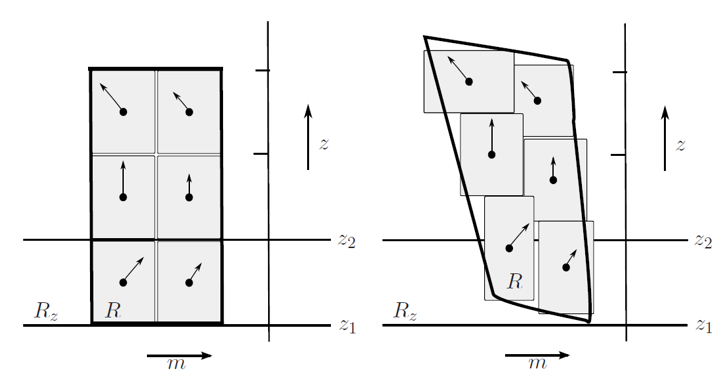
Experimental results
Research questions
- RQ1How can a nonlinear, multi-scale theory describe the interaction between small-scale gravity waves and large-scale mean flows across varying atmospheric stratification regimes, including moderately strong stratification?
- RQ2What are the conditions under which gravity waves can significantly alter the large-scale flow, and how can these be captured in a conservative and stable parameterization?
- RQ3How can spectral representations of weak-amplitude gravity waves be constructed to avoid numerical instabilities from wave reflection and caustic formation?
- RQ4What are the conservation properties of energy and potential vorticity in the wave-mean flow interaction, and how do they constrain the parameterization?
- RQ5How does the proposed parameterization compare in realism and efficiency to both classic parameterizations and full gravity wave-resolving simulations?
Key findings
- The nonlinear WKB theory successfully describes wave-mean flow interactions across a wide range of stratification, including the middle atmosphere, extending beyond the limitations of quasi-geostrophic theory.
- The quasilinear spectral approach enables stable numerical implementation of gravity wave parameterizations by avoiding instabilities associated with caustics, such as those from wave reflection.
- The theory establishes clear conditions under which gravity waves can exert a significant force on the mean flow, particularly when wave amplitudes are large enough to induce static instability.
- Conservation of wave energy and potential vorticity is rigorously maintained in the formulation, providing a physically consistent framework for wave forcing.
- The numerical implementation of the parameterization is significantly more realistic than classic schemes while being substantially more efficient than full gravity wave-resolving simulations.
- The approach is generalizable to other wave-mean flow interactions, including those involving tropical waves, and may offer new insights into caustic formation in fields such as acoustics, plasma physics, and general relativity.
Read this paper
Open the full text in the Nubint reader and ask about any passage as you read.
Read this paper on NubintThis review was generated by AI from the original paper. Please check the paper before citing it.