
[Paper Review] Multi-view Clustering via Deep Matrix Factorization and Partition Alignment
This paper proposes MVC-DMF-PA, a novel multi-view clustering method that combines deep matrix factorization with partition alignment to jointly learn view-specific representations and a consensus clustering partition. By alternately optimizing deep semi-NMF and partition alignment via optimal permutations, the method achieves state-of-the-art performance on six benchmark datasets with fast convergence and robustness to hyperparameters.
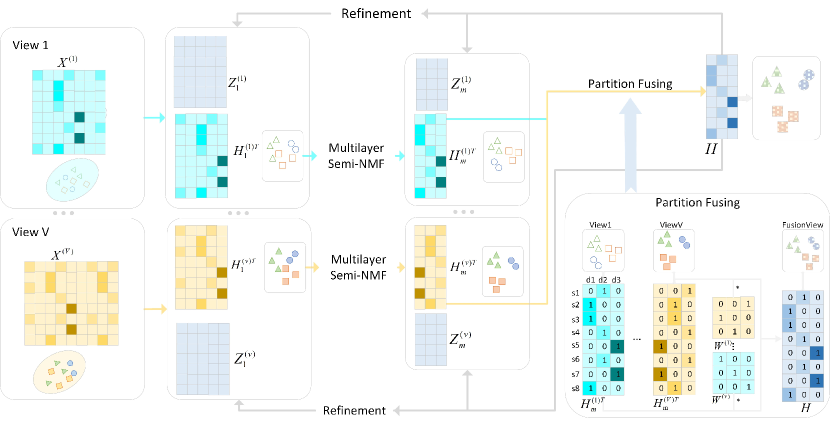
Multi-view clustering (MVC) has been extensively studied to collect multiple source information in recent years. One typical type of MVC methods is based on matrix factorization to effectively perform dimension reduction and clustering. However, the existing approaches can be further improved with following considerations: i) The current one-layer matrix factorization framework cannot fully exploit the useful data representations. ii) Most algorithms only focus on the shared information while ignore the view-specific structure leading to suboptimal solutions. iii) The partition level information has not been utilized in existing work. To solve the above issues, we propose a novel multi-view clustering algorithm via deep matrix decomposition and partition alignment. To be specific, the partition representations of each view are obtained through deep matrix decomposition, and then are jointly utilized with the optimal partition representation for fusing multi-view information. Finally, an alternating optimization algorithm is developed to solve the optimization problem with proven convergence. The comprehensive experimental results conducted on six benchmark multi-view datasets clearly demonstrates the effectiveness of the proposed algorithm against the SOTA methods.
Motivation & Objective
- To address limitations in existing multi-view clustering methods, particularly the underutilization of hierarchical data representations and view-specific structures.
- To improve fusion strategies by incorporating partition-level information, which is often neglected in prior work.
- To jointly optimize deep matrix decomposition and consensus partition learning for enhanced clustering performance.
Proposed method
- Deep semi-NMF is applied to each view to learn hierarchical, low-dimensional base partition matrices that capture view-specific and shared structures.
- A consensus partition matrix is learned by maximizing alignment with a uniformly weighted base partition matrix through optimal permutation of cluster assignments.
- An alternating optimization algorithm is designed to iteratively refine both the deep matrix decomposition and the consensus partition, ensuring convergence.
- The framework integrates late fusion by unifying base partition learning and consensus matrix optimization into a single, end-to-end trainable pipeline.
- Regularization terms, including $L_{21}$ norm and manifold regularization, are incorporated to improve robustness to outliers and preserve local geometric structure.
- The method dynamically adapts view-specific weights during optimization, enhancing clustering accuracy by emphasizing informative views.
Experimental results
Research questions
- RQ1Can deep matrix factorization effectively extract hierarchical and discriminative representations from multi-view data while preserving view-specific structures?
- RQ2How can partition-level alignment between multiple views improve consensus clustering beyond traditional feature-level fusion?
- RQ3Does integrating deep decomposition with late fusion via alternating optimization lead to faster convergence and better clustering performance?
- RQ4How sensitive is the proposed method to hyperparameters such as layer depth and hidden dimensionality?
- RQ5Can the proposed framework outperform state-of-the-art methods on diverse benchmark multi-view datasets?
Key findings
- The proposed MVC-DMF-PA achieves state-of-the-art performance on six benchmark datasets, with improvements of up to 11.68% in ACC, 15.55% in NMI, and 3.47% in PUR over the second-best method.
- The algorithm converges rapidly, reaching convergence within 20 iterations and stabilizing after 60 iterations, as shown in convergence curves on all datasets.
- The ablation study confirms that deeper network depth (three layers) yields the best performance, with a 10.6% improvement in ACC on BBCSport compared to single-layer models.
- Parameter sensitivity analysis shows optimal performance at $l_2 = 4k$ and variable $l_1$, indicating that intermediate layer dimensions significantly affect clustering quality.
- Visualization of the consensus matrix $\mathbf{H}$ demonstrates progressive improvement in cluster structure clarity across iterations, confirming effective learning of coherent partitions.
- The method shows robustness to hyperparameter variations, with minimal performance degradation across different settings of $l_1$ and $l_2$.

Read this paper
Open the full text in the Nubint reader and ask about any passage as you read.
Read this paper on NubintThis review was generated by AI from the original paper. Please check the paper before citing it.