
[Paper Review] Multimass modelling of Milky Way globular clusters -- II. present-day black hole populations
This study uses multimass distribution function models to infer present-day black hole (BH) populations in 34 Milky Way globular clusters, leveraging multi-observable constraints (kinematics, density, mass functions). It finds BH mass fractions range from 0–1% in most clusters, with ω Cen being the exception at ~5%, and reveals anti-correlation between BH content and mass segregation, along with a correlation between remnant mass fraction and dynamical age.
Populations of stellar-mass black holes (BHs) in globular clusters (GCs) influence their dynamical evolution and have important implications on one of the main formation channels for gravitational wave sources. Inferring the size of these populations remains difficult, however. In this work, multimass models of 34 Milky Way GCs, first presented in Dickson et al., are used to explore the present-day BH populations. Direct constraints on both the total and visible mass components provided by several observables allow these models to accurately determine the distribution of the dark mass (including BHs) within clusters, as we demonstrate in a proof-of-concept fitting of the models to mock observations extracted from Monte Carlo cluster models. New constraints on the BH population retained to the present-day in each cluster are inferred from our models. We find that BH mass fractions ranging from 0 to 1 per cent of the total mass are typically required to explain the observations, except for Omega Cen, for which we infer a mass fraction above 5 per cent, in agreement with previous works. Relationships between the dark remnant populations and other cluster parameters are examined, demonstrating a clear anti-correlation between the amount of BHs and mass segregation between visible stars, as well as a correlation between remnant mass fractions and the dynamical age of clusters. Our inferred BH populations are in good agreement overall with other recent studies using different methodologies, but with notable discrepancies for individual clusters.
Motivation & Objective
- To infer the present-day black hole (BH) populations in a large sample of Milky Way globular clusters (GCs) using multimass dynamical models.
- To constrain the distribution and total mass of dark remnants, particularly stellar-mass black holes, by combining multiple observables including proper motions, line-of-sight velocities, surface densities, and mass functions.
- To investigate the relationship between BH content and cluster dynamical properties such as mass segregation and dynamical age.
- To test whether observed kinematic and structural data require the presence of intermediate-mass black holes (IMBHs) in clusters with previous IMBH claims.
- To compare model-inferred BH populations with results from other methodologies and assess consistency across the sample.
Proposed method
- Utilizes multimass distribution function (DF) models that simultaneously fit multiple observables—proper motions, line-of-sight velocities, surface brightness profiles, and mass functions—across 34 Milky Way globular clusters.
- Employs Bayesian inference with nested sampling (via dynesty) to explore posterior probability distributions of model parameters, including total BH mass, number, and mass fraction.
- Incorporates constraints on the stellar initial mass function (IMF), particularly in the high-mass regime (>1 M⊙), and accounts for metallicity dependence.
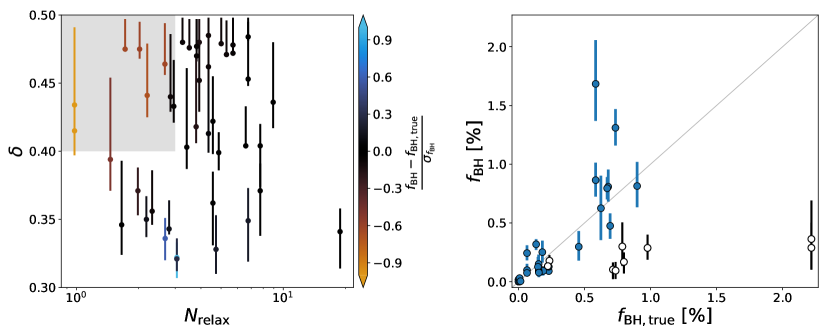
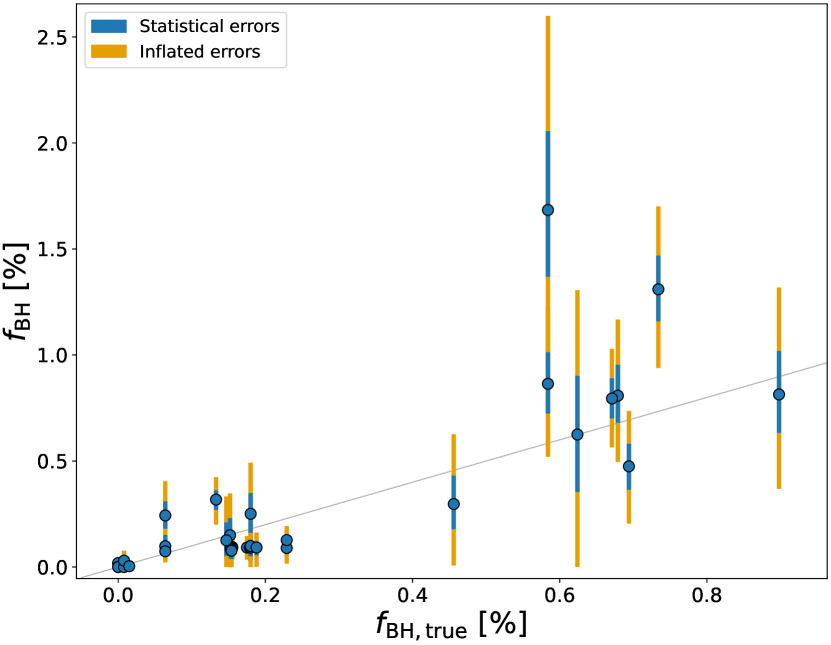
- Validates the modeling framework using mock observations extracted from Monte Carlo cluster simulations, demonstrating robustness in recovering dark mass distributions.
- Uses the inferred dark mass distribution to disentangle contributions from black holes, neutron stars, and white dwarfs, with BHs modeled as a distinct, massive component.
- Applies statistical fitting techniques to reconcile model predictions with observed kinematic and structural data, minimizing residuals across all datasets.
Experimental results
Research questions
- RQ1What is the present-day black hole mass fraction in each of the 34 Milky Way globular clusters studied?
- RQ2How does the presence of black holes correlate with observable dynamical properties such as mass segregation (quantified by the δ parameter) and cluster dynamical age?
- RQ3To what extent do the observed kinematic and structural data require the presence of intermediate-mass black holes (IMBHs) in clusters with previous IMBH claims?
- RQ4How do the inferred BH populations compare with results from other methodologies, such as Jeans modeling or N-body/Monte Carlo simulations?
- RQ5What is the relationship between the total remnant mass fraction and the evolutionary state of the cluster, particularly in terms of dynamical evolution and mass segregation?
Key findings
- The inferred black hole mass fractions in most Milky Way globular clusters range from 0% to 1% of the total cluster mass, with the exception of ω Cen, which requires a mass fraction of approximately 5%.
- A clear anti-correlation is found between the BH mass fraction and the δ parameter, indicating that clusters with more significant BH populations exhibit reduced mass segregation among visible stars.
- The most dynamically evolved clusters in the sample have remnant mass fractions (including BHs, neutron stars, and white dwarfs) of up to ~70% by mass, with BHs contributing significantly to this dark mass.
- The model results show good agreement with other recent studies using different methods, though notable discrepancies exist for individual clusters, particularly in systems with small or large BH populations.
- No evidence is found for intermediate-mass black holes (IMBHs) in clusters previously suggested to host them; the data are well explained by a population of stellar-mass black holes alone.
- The model's posterior distributions indicate a total BH mass of ~80 M⊙ (with 90% credible interval 50–130 M⊙) in M15, consistent with previous estimates but slightly lower than some Jeans modeling results, though in agreement with matching CMC simulations.
Read this paper
Open the full text in the Nubint reader and ask about any passage as you read.
Read this paper on NubintThis review was generated by AI from the original paper. Please check the paper before citing it.