
[Paper Review] Multimodal Learning for Hateful Memes Detection
This paper proposes a novel triplet-relation network (TRN) that integrates image captioning, object detection, and OCR text to improve hateful memes detection by modeling cross-modal relationships between visual regions, image captions, and textual content. The method achieves state-of-the-art performance, ranking 13th out of 276 teams in the Hateful Memes Challenge Phase 2, with a test F1 score of 74.80% using visual and language features with generated captions.
Memes are used for spreading ideas through social networks. Although most memes are created for humor, some memes become hateful under the combination of pictures and text. Automatically detecting the hateful memes can help reduce their harmful social impact. Unlike the conventional multimodal tasks, where the visual and textual information is semantically aligned, the challenge of hateful memes detection lies in its unique multimodal information. The image and text in memes are weakly aligned or even irrelevant, which requires the model to understand the content and perform reasoning over multiple modalities. In this paper, we focus on multimodal hateful memes detection and propose a novel method that incorporates the image captioning process into the memes detection process. We conduct extensive experiments on multimodal meme datasets and illustrated the effectiveness of our approach. Our model achieves promising results on the Hateful Memes Detection Challenge.
Motivation & Objective
- To address the challenge of detecting hateful memes where textual and visual content are weakly aligned or semantically irrelevant.
- To improve multimodal reasoning in hateful memes detection by incorporating generated image captions as an additional modality.
- To model complex cross-modal relationships between visual regions, OCR text, and image captions for more accurate classification.
- To evaluate the effectiveness of image captioning and language augmentation in enhancing multimodal representation learning for hateful meme detection.
Proposed method
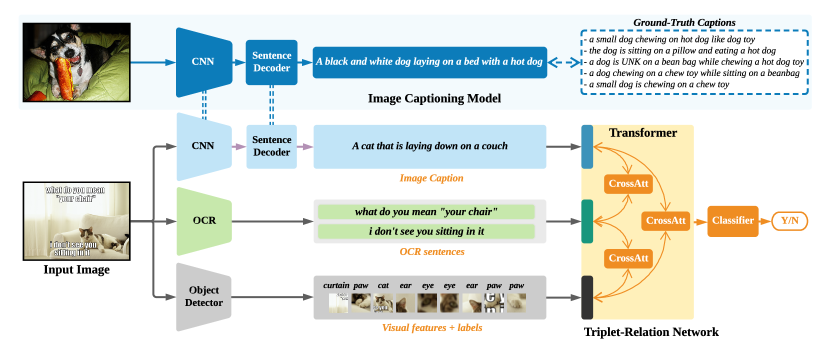
- Integrates an image captioner to generate descriptive captions for memes, providing additional semantic context for multimodal reasoning.
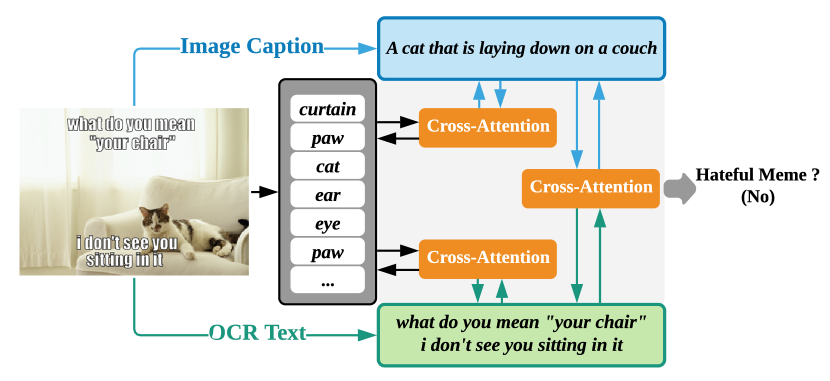
- Uses an object detector to extract visual region features (RoIs) and combines them with OCR-extracted text and generated captions.
- Employs a triplet-relation network (TRN) that models relationships among three inputs—image caption, detected objects, and OCR text—using cross-attention mechanisms.
- Applies a two-stream (V&L) and one-stream (V+L) transformer-based architecture to encode visual and textual features separately before fusion.
- Utilizes back-translation for data augmentation to improve robustness in the textual modality, especially in the two-stream setting.
- Treats object labels as linguistic tokens and concatenates them with OCR text and captions to strengthen cross-modal alignment.
Experimental results
Research questions
- RQ1Can generated image captions improve the performance of hateful memes detection models by providing additional semantic context?
- RQ2How effective is the triplet-relation network in modeling relationships between image captions, detected objects, and OCR text in memes?
- RQ3Does language data augmentation via back-translation improve model generalization, particularly in the two-stream architecture?
- RQ4To what extent do object labels enhance cross-modal alignment when combined with captions and OCR text?
- RQ5How does the proposed method compare to existing multimodal fusion approaches on the hateful memes detection benchmark?
Key findings
- The proposed method with image captioning and multimodal fusion achieved a test F1 score of 74.80%, ranking 13th out of 276 teams in the Hateful Memes Challenge Phase 2.
- The V&L model with image captioning outperformed all other V&L baselines, demonstrating the effectiveness of generated captions in improving cross-modal reasoning.
- Back-translation improved performance in the two-stream (V&L) model but not in the one-stream (V+L) model, indicating that separate modality modeling benefits more from augmented text.
- Object labels significantly improved both V+L and V&L models, serving as effective anchors between visual regions and textual features.
- The triplet-relation network effectively captured implicit relationships between image content, captions, and text, enabling correct classification even when OCR text and image were semantically misaligned.
- Qualitative results showed the model could correctly detect hateful intent in memes with non-aligned or ironic text by leveraging generated image captions.
Read this paper
Open the full text in the Nubint reader and ask about any passage as you read.
Read this paper on NubintThis review was generated by AI from the original paper. Please check the paper before citing it.