
[Paper Review] Multispecies Animal Re-ID Using a Large Community-Curated Dataset
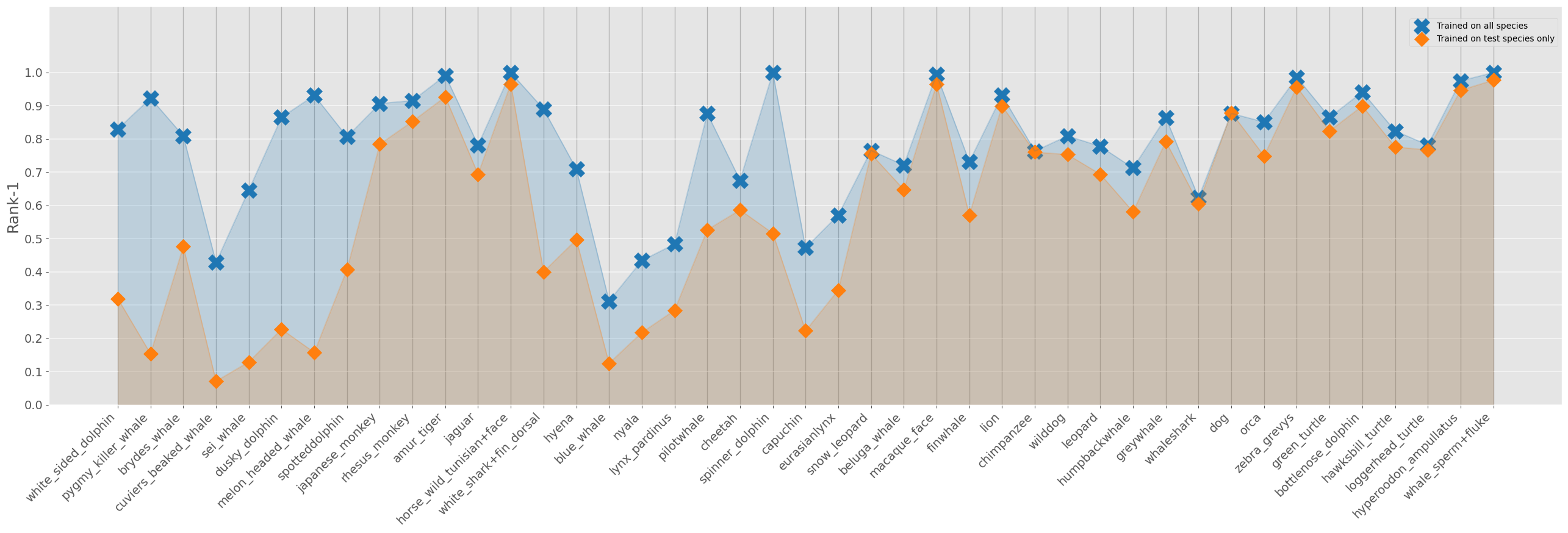
This paper proposes MiewID, a multispecies animal re-identification model trained on a large, community-curated dataset of 49 species, 37,138 individuals, and 225,374 images using an EfficientNetV2 backbone and sub-center ArcFace loss with dynamic margins. The model achieves a 12.5% average top-1 accuracy gain over single-species models and significantly outperforms MegaDescriptor on unseen species, with a 19.2% average top-1 improvement across 33 species.
Recent work has established the ecological importance of developing algorithms for identifying animals individually from images. Typically, a separate algorithm is trained for each species, a natural step but one that creates significant barriers to wide-spread use: (1) each effort is expensive, requiring data collection, data curation, and model training, deployment, and maintenance, (2) there is little training data for many species, and (3) commonalities in appearance across species are not exploited. We propose an alternative approach focused on training multi-species individual identification (re-id) models. We construct a dataset that includes 49 species, 37K individual animals, and 225K images, using this data to train a single embedding network for all species. Our model employs an EfficientNetV2 backbone and a sub-center ArcFace loss function with dynamic margins. We evaluate the performance of this multispecies model in several ways. Most notably, we demonstrate that it consistently outperforms models trained separately on each species, achieving an average gain of 12.5% in top-1 accuracy. Furthermore, the model demonstrates strong zero-shot performance and fine-tuning capabilities for new species with limited training data, enabling effective curation of new species through both incremental addition of data to the training set and fine-tuning without the original data. Additionally, our model surpasses the recent MegaDescriptor on unseen species, averaging an 19.2% top-1 improvement per species and showing gains across all 33 species tested. The fully-featured code repository is publicly available on GitHub, and the feature extractor model can be accessed on HuggingFace for seamless integration with wildlife re-identification pipelines. The model is already in production use for 60+ species in a large-scale wildlife monitoring system.
Motivation & Objective
- To address the high cost and scalability barriers of training separate re-identification models for each animal species, especially for data-scarce species.
- To explore whether training a single model on multiple species improves performance compared to species-specific models.
- To evaluate the model's zero-shot generalization and fine-tuning capabilities on new, unseen species with limited training data.
- To enable efficient, large-scale wildlife monitoring by reducing the need for per-species model retraining and deployment.
Proposed method
- Constructed a large-scale, community-curated multispecies dataset comprising 49 species, 37,138 individuals, and 225,374 annotated images from 59 diverse datasets.
- Trained a single embedding network using an EfficientNetV2-M backbone and a sub-center ArcFace loss with dynamic margins to improve inter-class and intra-class discrimination.
- Evaluated model performance via zero-shot inference on unseen species and fine-tuning on new species with limited data, comparing to single-species training baselines.
- Compared performance against the recent MegaDescriptor model on 33 unseen species to assess generalization and robustness.
- Explored backbone efficiency by comparing EfficientNetV2-M with SwinV2-Base, finding EfficientNetV2-M superior in this task.
- Released the full codebase on GitHub and model weights on HuggingFace for integration into wildlife monitoring pipelines.
Experimental results
Research questions
- RQ1Does training a single model on multiple species yield better performance than training separate models per species?
- RQ2How well does a multispecies model generalize to species not seen during training, especially with minimal data?
- RQ3Can the model be effectively fine-tuned on new species with only a small number of annotated images?
- RQ4Does incorporating new species data into the existing multispecies model outperform fine-tuning or retraining from scratch?
- RQ5How does the choice of backbone architecture (e.g., EfficientNetV2 vs. Vision Transformer) affect performance in multispecies animal re-identification?
Key findings
- The multispecies MiewID model achieved a 12.5% average top-1 accuracy gain over single-species models, with per-species gains ranging from -0.2% to 77.3%.
- On 33 unseen species, MiewID outperformed MegaDescriptor by an average of 19.2% in top-1 accuracy, demonstrating strong zero-shot generalization.
- Fine-tuning MiewID on new species with limited data (e.g., 25–200 images) yielded performance comparable or superior to single-species training, especially for small datasets.
- Incorporating new species data directly into the multispecies training set consistently produced better results than fine-tuning alone.
- The EfficientNetV2-M backbone outperformed SwinV2-Base by 4.5% average top-1 accuracy, indicating better feature learning for this task.
- The model is already in production use for over 60 species in the Wildbook wildlife monitoring system, demonstrating real-world scalability and utility.

Read this paper
Open the full text in the Nubint reader and ask about any passage as you read.
Read this paper on NubintThis review was generated by AI from the original paper. Please check the paper before citing it.