
[Paper Review] NAPA: Intermediate-level Variational Native-pulse Ansatz for Variational Quantum Algorithms
NAPA proposes a native-pulse ansatz generator for variational quantum algorithms that directly optimizes pulse amplitudes and frequencies instead of relying on gate decompositions, reducing circuit latency by 86% on average while achieving up to 99.895% accuracy in VQE tasks. By using non-gradient optimizers and progressive ansatz growth, it improves Hilbert space exploration and noise resilience on NISQ devices.
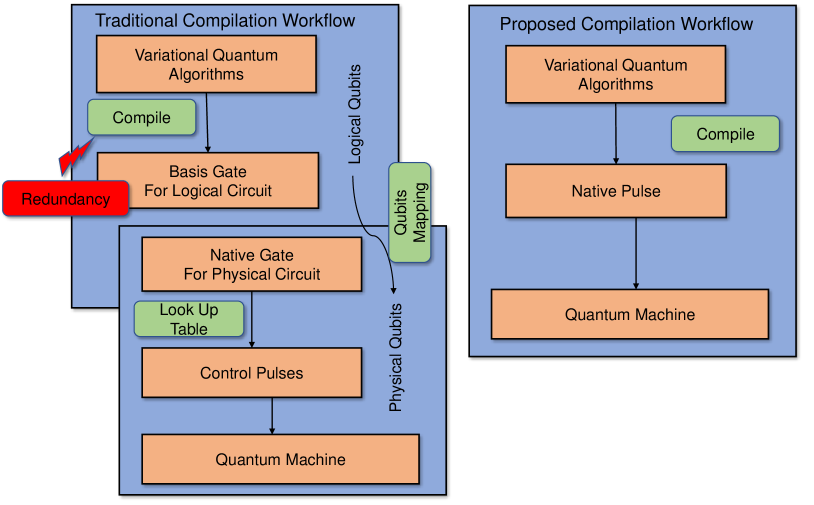
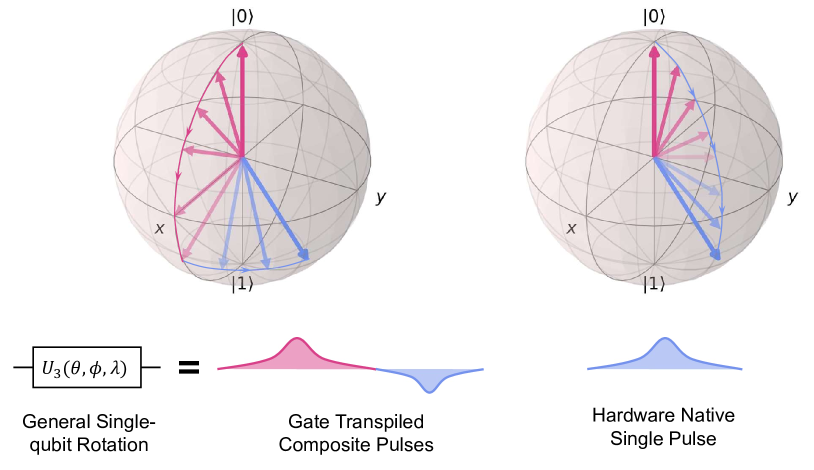
Variational quantum algorithms (VQAs) have demonstrated great potentials in the Noisy Intermediate Scale Quantum (NISQ) era. In the workflow of VQA, the parameters of ansatz are iteratively updated to approximate the desired quantum states. We have seen various efforts to draft better ansatz with less gates. Some works consider the physical meaning of the underlying circuits, while others adopt the ideas of neural architecture search (NAS) for ansatz generator. However, these designs do not exploit the full advantages of VQAs. Because most techniques target gate ansatz, and the parameters are usually rotation angles of the gates. In quantum computers, the gate ansatz will eventually be transformed into control signals such as microwave pulses on superconducting qubits. These control pulses need elaborate calibrations to minimize the errors such as over-rotation and under-rotation. In the case of VQAs, this procedure will introduce redundancy, but the variational properties of VQAs can naturally handle problems of over-rotation and under-rotation by updating the amplitude and frequency parameters. Therefore, we propose NAPA, a native-pulse ansatz generator framework for VQAs. We generate native-pulse ansatz with trainable parameters for amplitudes and frequencies. In our proposed NAPA, we are tuning parametric pulses, which are natively supported on NISQ computers. Given the limited availability of gradient-based optimizers for pulse-level quantum programs, we choose to deploy non-gradient optimizers in our framework. To constrain the number of parameters sent to the optimizer, we adopt a progressive way to generate our native-pulse ansatz. Experiments are conducted on both simulators and quantum devices for Variational Quantum Eigensolver (VQE) tasks to evaluate our methods.
Motivation & Objective
- To address the latency and redundancy introduced by gate-based compilation in VQAs on NISQ devices.
- To exploit the inherent noise resilience of VQAs by directly tuning pulse-level parameters (amplitude and frequency) instead of gate angles.
- To reduce the number of parameters sent to the optimizer through a progressive ansatz generation strategy.
- To demonstrate improved performance and reduced circuit duration on real NISQ hardware for quantum chemistry and optimization tasks.
- To enable direct integration of pulse-level control in VQA workflows, bypassing the gate abstraction layer.
Proposed method
- Proposes NAPA, a framework that generates native-pulse ansatz with trainable amplitude and frequency parameters directly on NISQ hardware.
- Uses non-gradient optimizers due to limited availability of gradient-based methods for pulse-level programs.
- Employs a progressive learning strategy to grow the ansatz gradually, improving optimization stability and Hilbert space coverage.
- Maps variational parameters directly to microwave pulse control signals on superconducting qubits, eliminating gate decomposition overhead.
- Validates the ansatz on both simulators and real quantum devices (e.g., ibmq_montreal, ibmq_jakarta) for VQE and maxcut tasks.
- Uses pulse detuning experiments to verify that parameter variation spans the full energy landscape, ensuring convergence to ground state.
Experimental results
Research questions
- RQ1Can direct optimization of pulse-level parameters (amplitude and frequency) outperform gate-based ansatz in VQA performance and latency on NISQ devices?
- RQ2How does progressive ansatz generation improve optimization convergence and Hilbert space exploration in pulse-based VQAs?
- RQ3To what extent can native-pulse ansatz reduce circuit duration and improve accuracy in quantum chemistry and optimization tasks on real hardware?
- RQ4Does pulse-level tuning naturally mitigate over-rotation and under-rotation errors in NISQ devices through variational learning?
- RQ5Can NAPA generalize across diverse VQA applications, including VQE and maxcut, under realistic noise conditions?
Key findings
- NAPA reduced average circuit latency by 86% on NISQ devices when compared to gate-based counterparts.
- For the H2 molecule, NAPA achieved 96.482% accuracy in VQE tasks, while HeH+ reached 99.336% accuracy.
- On medium-sized quantum chemistry tasks (CO2, H2O, NaH), NAPA achieved an average accuracy of 97.27%.
- For the three-regular six-node maxcut problem, NAPA improved the approximation ratio by 3.4% compared to a gate-level TwoLocal ansatz.
- In experiments with pulse detuning, energy estimation showed broad and responsive variation, confirming effective coverage of the Hilbert space.
- The progressive learning approach reduced deviation from FCI energy values by approximately 40% on average, with 24% and 48% improvements observed for H2 and HeH+ respectively.
Read this paper
Open the full text in the Nubint reader and ask about any passage as you read.
Read this paper on NubintThis review was generated by AI from the original paper. Please check the paper before citing it.