
[Paper Review] Near-Field Communications: A Degree-of-Freedom Perspective
This paper analyzes the degree of freedom (DoF) in near-field MIMO systems, comparing spatially discrete antennas (SPD) and continuous aperture antennas (CAP), and introduces multiple DoF-related metrics with numerical results showing NFC's DoF advantage over far-field communications.
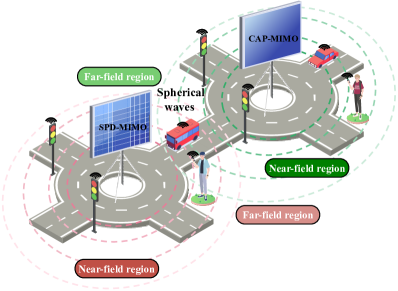
Multiple-antenna technologies are advancing towards large-scale aperture sizes and extremely high frequencies, leading to the emergence of near-field communications (NFC) in future wireless systems. To this context, we investigate the degree of freedom (DoF) in near-field multiple-input multiple-output (MIMO) systems. We consider both spatially discrete (SPD) antennas and continuous aperture (CAP) antennas. Additionally, we explore three important DoF-related performance metrics and examine their relationships with the classic DoF. Numerical results demonstrate the benefits of NFC over far-field communications (FFC) in terms of providing increased spatial DoFs. We also identify promising research directions for NFC from a DoF perspective.
Motivation & Objective
- Motivate the study of near-field communications (NFC) as wireless systems adopt large apertures and high frequencies.
- Characterize the DoF obtainable in NFC under LoS conditions for SPD-MIMO and CAP-MIMO.
- Introduce and compare multiple DoF-related metrics (EDoF1, EDoF2, EDoF3) and relate them to classic DoF.
- Provide numerical results showing NFC's potential DoF gains over far-field communications (FFC).
- Discuss future research directions for DoF-based analysis and system design in NFC.
Proposed method
- Model NFC channels for SPD-MIMO and CAP-MIMO using Green’s function and channel matrices.
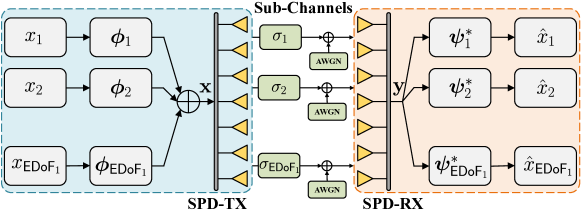
- Apply singular value decomposition (SVD) of H for SPD-MIMO to obtain DoF and EDoF1, and use Green’s function eigen-decomposition for CAP-MIMO DoF.
- Define and compare four DoF-related metrics: DoF, EDoF1, EDoF2, EDoF3, and discuss their physical meanings.
- Use analytical arguments and references (e.g., Miller, Dardari, Verdú) to relate DoF concepts to aperture, distance, and SNR regimes.
- Present numerical simulations in LoS scenarios to illustrate DoF and EDoF trends with antenna counts, aperture, and distance.
Experimental results
Research questions
- RQ1How many independent spatial channels (DoF) can NFC realize with SPD-MIMO and CAP-MIMO in near-field LoS conditions?
- RQ2How do EDoF1, EDoF2, and EDoF3 behave in NFC compared to FFC across different SNR regimes and geometries?
- RQ3How does near-field geometry (aperture size and distance) influence the upper limits of DoF/EDoF in SPD- and CAP-MIMO?
- RQ4What are the practical implications and limitations of CAP-MIMO for achieving high DoF in NFC?
Key findings
- Near-field MIMO NFC can achieve higher DoF than far-field MIMO due to spherical-wave effects, approaching min(Nr, Nt) under SPD when antennas are well separated.
- EDoF1 grows with transmitter/receiver aperture and decreases with distance, and reaches higher values in near-field LoS CAP-MIMO (proportional to AtAr, inversely to distance).
- EDoF2 provides a low-SNR performance metric and is not simply the number of sub-channels; its interpretation is nuanced and depends on channel gains.
- EDoF3 describes the number of equivalent SISO sub-channels at a given SNR; in near-field CAP-MIMO it can exceed 1, illustrating power-dependent utilization of non-dominant modes.
- Numerical results show NFC’s DoF/EDoF improvements across SPD and CAP, with near-field effects enhancing the DoF and EDoF relative to FFC, and shorter distances further boosting EDoF metrics.
- The CAP-MIMO framework suggests near-field DoF can be unbounded in theory (infinite modes) but practical EDoF1 remains finite and beamforming/eigenvalue analysis is required.
Read this paper
Open the full text in the Nubint reader and ask about any passage as you read.
Read this paper on NubintThis review was generated by AI from the original paper. Please check the paper before citing it.