
[Paper Review] Neuro-Symbolic World Models for Adapting to Open World Novelty
This paper proposes \sysname, a neuro-symbolic world model that enables fast, sample-efficient reinforcement learning adaptation to open-world novelties by learning symbolic rules of pre-novelty environment dynamics and using them to detect changes and simulate post-novelty transitions. The method achieves superior adaptation efficiency with fewer policy updates and environment interactions than neural-only baselines, including DreamerV2, by combining real interactions with imagination-based rollouts from the symbolic world model.
Open-world novelty--a sudden change in the mechanics or properties of an environment--is a common occurrence in the real world. Novelty adaptation is an agent's ability to improve its policy performance post-novelty. Most reinforcement learning (RL) methods assume that the world is a closed, fixed process. Consequentially, RL policies adapt inefficiently to novelties. To address this, we introduce WorldCloner, an end-to-end trainable neuro-symbolic world model for rapid novelty adaptation. WorldCloner learns an efficient symbolic representation of the pre-novelty environment transitions, and uses this transition model to detect novelty and efficiently adapt to novelty in a single-shot fashion. Additionally, WorldCloner augments the policy learning process using imagination-based adaptation, where the world model simulates transitions of the post-novelty environment to help the policy adapt. By blending ''imagined'' transitions with interactions in the post-novelty environment, performance can be recovered with fewer total environment interactions. Using environments designed for studying novelty in sequential decision-making problems, we show that the symbolic world model helps its neural policy adapt more efficiently than model-based and model-based neural-only reinforcement learning methods.
Motivation & Objective
- To address the challenge of open-world novelty in reinforcement learning, where environment dynamics change unexpectedly after deployment.
- To improve sample efficiency in post-novelty policy adaptation, reducing reliance on costly real environment interactions.
- To develop a world model that can rapidly detect novelties and simulate post-novelty transitions using symbolic representations.
- To integrate imagination-based adaptation with real-world interactions to accelerate policy convergence after novelty.
- To demonstrate that symbolic world models outperform purely neural world models in adaptation speed and efficiency.
Proposed method
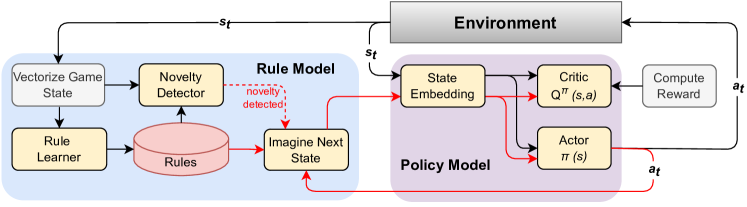
- The system learns a symbolic world model of pre-novelty environment transitions using a rule learner that updates from single post-novelty observations.
- Novelty detection is performed by comparing real environment transitions against predictions from the symbolic world model.
- After novelty detection, the world model generates imagined rollouts of the post-novelty environment to augment real interaction data.
- Policy adaptation uses a hybrid training loop that combines real environment interactions with imagined transitions from the symbolic world model.
- The policy is fine-tuned using backpropagation through both real and imagined trajectories, enabling fast convergence with fewer updates.
- The system is trained end-to-end, with the symbolic world model and policy jointly optimized via gradient descent.
Experimental results
Research questions
- RQ1Can a symbolic world model detect open-world novelties more efficiently than neural-only models?
- RQ2How does imagination-based adaptation using symbolic world models improve sample efficiency in post-novelty policy learning?
- RQ3Can symbolic world models enable faster convergence than state-of-the-art neural world models like DreamerV2?
- RQ4What is the impact of blending real and imagined data on policy update efficiency?
- RQ5How does the system perform across diverse novelty types, including those not on the original optimal path?
Key findings
- The symbolic world model converged to near-perfect prediction accuracy in approximately 2,000 training steps in the Empty MiniGrid environment, demonstrating rapid and sample-efficient learning.
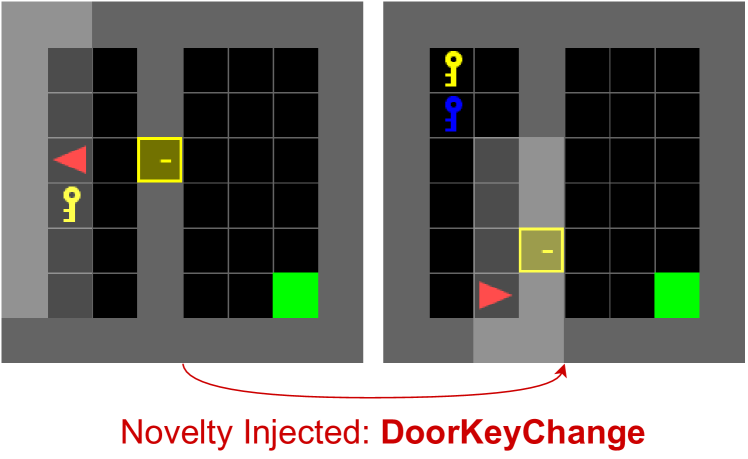
- In all tested novelties, \sysname required significantly fewer policy updates than PPO and DreamerV2, with the fewest updates in the LavaHurts and DoorKeyChange environments.
- With only 40% imagination injection, \sysname outperformed a neural policy without a world model in adaptation efficiency across all novelty types.
- The system achieved competitive adaptation efficiency compared to DreamerV2 while using far fewer policy updates, indicating superior sample efficiency.
- In cases like LavaHurts and DoorKeyChange, \sysname showed lower variance in convergence time than DreamerV2, suggesting more consistent adaptation.
- The results suggest that symbolic representations are a more effective complement to neural policies than purely neural world models for novelty adaptation.
Read this paper
Open the full text in the Nubint reader and ask about any passage as you read.
Read this paper on NubintThis review was generated by AI from the original paper. Please check the paper before citing it.