
[Paper Review] Noise-resistant Deep Metric Learning with Ranking-based Instance Selection
This paper proposes PRISM, a noise-resistant deep metric learning method that uses probabilistic ranking-based instance selection with a memory bank to identify and filter noisy labels during training. By leveraging feature similarities across multiple network snapshots, PRISM improves model robustness, achieving up to 6.06% higher Precision@1 than existing methods under label noise.
The existence of noisy labels in real-world data negatively impacts the performance of deep learning models. Although much research effort has been devoted to improving robustness to noisy labels in classification tasks, the problem of noisy labels in deep metric learning (DML) remains open. In this paper, we propose a noise-resistant training technique for DML, which we name Probabilistic Ranking-based Instance Selection with Memory (PRISM). PRISM identifies noisy data in a minibatch using average similarity against image features extracted by several previous versions of the neural network. These features are stored in and retrieved from a memory bank. To alleviate the high computational cost brought by the memory bank, we introduce an acceleration method that replaces individual data points with the class centers. In extensive comparisons with 12 existing approaches under both synthetic and real-world label noise, PRISM demonstrates superior performance of up to 6.06% in Precision@1.
Motivation & Objective
- Address the lack of robust methods for deep metric learning under label noise, a critical gap despite progress in noise-resistant classification.
- Develop a technique that identifies noisy training instances without relying on manual labeling or class transition matrices.
- Improve generalization in metric learning by filtering noisy samples using dynamic, history-aware similarity scoring from multiple network snapshots.
- Reduce computational cost of memory-based filtering through class-center approximation while preserving performance.
- Demonstrate effectiveness across synthetic, real-world, and open-set noise scenarios, including a novel Small Cluster noise model.
Proposed method
- PRISM computes the probability of a label being clean using the average similarity between a data point and other samples in the memory bank, derived from features of previous network weights.
- The method maintains a memory bank storing features from multiple past training iterations to enable comparison across model states.
- A probabilistic ranking function $ P_{\text{clean}}(i) $ ranks instances based on their similarity to other samples of the same class in the memory bank.
- The smooth top-R (sTRM) trick dynamically adjusts the threshold for identifying noisy instances using a sliding window over training iterations.
- An acceleration technique replaces individual data points with class centers in similarity calculations, reducing computation by up to 6.9× on the SOP dataset.
- The approach is compatible with both memory bank and class-center-based training, enabling flexibility and scalability.

Experimental results
Research questions
- RQ1Can a memory-augmented, similarity-based method effectively detect noisy labels in deep metric learning without relying on class transition matrices?
- RQ2How does the use of multiple past network weights improve the reliability of noisy label detection compared to single-iteration features?
- RQ3To what extent can replacing individual data points with class centers in the similarity computation reduce computational cost without sacrificing performance?
- RQ4How does PRISM perform under diverse noise settings, including symmetric noise, open-set noise, and real-world label noise?
- RQ5What is the optimal thresholding strategy for identifying noisy instances, and how does the sTRM trick improve robustness to noisy data?
Key findings
- PRISM achieves up to 6.06% higher Precision@1 compared to 12 existing DML and noise-resistant training methods under symmetric and real-world label noise.
- On the CARS dataset with 25% Small Cluster noise, PRISM achieves 75.40% Precision@1 and 17.40% MAP@R, outperforming baseline filtering strategies.
- The sTRM acceleration technique reduces training time by a factor of 6.9 on the SOP dataset while maintaining high performance.
- The optimal filtering rate $ R = 50\% $ for PRISM corresponds to an estimated 50% label noise rate in the CARS-98N dataset.
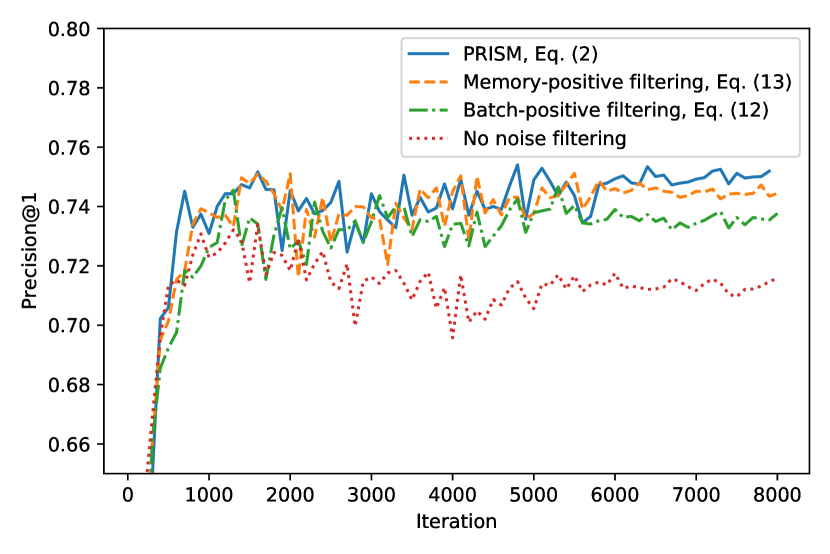
- The ablation study confirms that using the full memory bank (Memory-positive) is more effective than batch-only similarity (Batch-positive), and PRISM’s full formulation (Eq. 2) yields the best performance.
- Model performance under PRISM remains stable and improves over time, unlike baselines that overfit and degrade after 5,000 iterations under noisy conditions.
Read this paper
Open the full text in the Nubint reader and ask about any passage as you read.
Read this paper on NubintThis review was generated by AI from the original paper. Please check the paper before citing it.