
[論文レビュー] Non-Abelian transport distinguishes three usually equivalent notions of entropy production
本稿は、スピン成分などの非可換な保存量を有する量子系へ確率的熱力学を拡張する。三つの標準的エントロピー生成(SEP)定義(電荷ベース、驚異度ベース、経路ベース)を一般化し、非可換性がこれらの定義の等価性を破ることを示す。これにより、量子的文脈性を示す非実数のエントロピー生成が生じる。
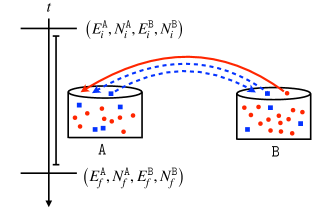
We extend entropy production to a deeply quantum regime involving noncommuting conserved quantities. Consider a unitary transporting conserved quantities ("charges") between two systems initialized in thermal states. Three common formulae model the entropy produced. They respectively cast entropy as an extensive thermodynamic variable, as an information-theoretic uncertainty measure, and as a quantifier of irreversibility. Often, the charges are assumed to commute with each other (e.g., energy and particle number). Yet quantum charges can fail to commute. Noncommutation invites generalizations, which we posit and justify, of the three formulae. Charges' noncommutation, we find, breaks the formulae's equivalence. Furthermore, different formulae quantify different physical effects of charges' noncommutation on entropy production. For instance, entropy production can signal contextuality - true nonclassicality - by becoming nonreal. This work opens up stochastic thermodynamics to noncommuting - and so particularly quantum - charges.
研究の動機と目的
- スピン成分などの非可換な保存量を有する量子系に確率的熱力学を拡張すること。
- 非可換性が三つの標準的エントロピー生成(SEP)定義(電荷ベース、驚異度ベース、経路ベース)の等価性に与える影響を調査すること。
- 非摂動的過程における電荷ラベルの基本的対称性を尊重するように、これらのSEP定義の対称化形式を確立すること。
- 非可換電荷の物理的結果、特に文脈性と不可逆性を、一般化されたエントロピー生成測度を通じて探求すること。
提案手法
- 電荷変化の期待値に基づく電荷ベース、デコherence写像との相対エントロピーに基づく驚異度ベース、弱値および擬似確率に基づく経路ベースの三つの一般化されたエントロピー生成定義を提案する。
- 非摂動的ダイナミクスと整合性を保つために、電荷ラベルの順序入れ替えに対する不変性を保証する、対称化されたキルクワッド=ディラック擬似確率(SKDQ)を導入する。
- すべての電荷順序の平均をとることで、各SEP定義の対称化版を導出し、周辺分布および物理的対称性を保存する。
- 弱測定および弱値を用いて経路ベースSEPを定義し、平均値に実部および虚部(位相)の両方の寄与を含む形式を採用する。
- 非アーベル的電荷を有する系、たとえば非可換な $\sigma_x, \sigma_y, \sigma_z$ 成分を有するスピン1/2系にこの形式を適用する。
- フラクチュエーション定理を導出し、相対エントロピーおよび弱値位相の観点から平均SEPを分析し、非可換性に依存する非自明な依存関係を示す。
実験結果
リサーチクエスチョン
- RQ1保存量が非可換である場合、三つの標準的エントロピー生成定義(電荷ベース、驚異度ベース、経路ベース)はどのように振る舞うか?
- RQ2非可換電荷の存在下で、これらのエントロピー生成定義の不等価性に物理的意味は何か?
- RQ3非可換性が非実数(複素数)のエントロピー生成を引き起こすことは可能か? これは量子的文脈性に何を意味するか?
- RQ4測定の干渉がない状況で、電荷順序の対称化が物理的整合性をどのように保つのか?
- RQ5弱値および擬似確率は、非アーベル的電荷の経路ベースエントロピー生成を定義する上で果たす役割は何か?
主な発見
- 電荷が非可換である場合、三つの標準的エントロピー生成定義(電荷ベース、驚異度ベース、経路ベース)は、非自明な順序効果および非可換性の影響により、等価性を失う。
- 対称化された経路ベースエントロピー生成には、弱値位相に起因する虚部が含まれており、実数のエントロピー生成の破綻を示し、非古典性を示唆する。
- 対称化された経路ベースSEPの平均値は、相対エントロピーおよび弱値位相差の和として表現され、ユニタリ変換および初期状態に非自明な依存関係を示す。
- 対称化された驚異度ベースSEPは、最終状態とそのデコherence版との間の相対エントロピーの平均として与えられ、電荷再ラベルに対して不変な形を取る。
- 電荷ベースSEPは実数であり、$\sum_{\alpha} \Delta\beta_{\alpha} \Delta\langle Q_{\alpha}\rangle$ として表現されるが、この定義はもはや完全な非可換ダイナミクスを捉えていない。
- 非可換性は非実数のエントロピー生成を引き起こす可能性があり、これは文脈性および真の量子的挙動の兆候であり、古典的確率的過程とは明確に区別される。
より良い研究を、今すぐ始めましょう
論文の読解から最終レビューまで、研究時間を劇的に削減しましょう。
クレジットカード登録不要
このレビューはAIが作成し、人間の編集者が確認しました。