
[Paper Review] Non-oscillating Early Dark Energy and Quintessence from Alpha-Attractors
This paper proposes a non-oscillating early dark energy (EDE) and late-time quintessence model unified via α-attractors, where a scalar field unfreezes near matter-radiation equality to provide a transient EDE component, then redshifts away faster than radiation, later reactivating as late-time dark energy. The model resolves the Hubble tension with a narrow but viable parameter space, offering a non-oscillatory alternative with improved observational consistency.
Early dark energy (EDE) is one of the most promising possibilities in order to resolve the Hubble tension: the discrepancy between early and late-Universe measurements of the Hubble constant. In this paper we propose a model of a scalar field which can explain both EDE and late Dark Energy (DE) in a joined manner without additional fine-tuning. The field features kinetic poles as with alpha-attractors. Our model provides an injection of EDE near matter-radiation equality, and redshifts away shortly after via free-fall, later refreezing to become late-time DE at the present day. Using reasonable estimates of the current constraints on EDE from the literature, we find that the parameter space is narrow but viable. As such our model is readily falsifiable. In contrast to other work in EDE, our model is non-oscillatory, which causes its decay to be faster than that of the usual oscillatory EDE, thereby achieving better agreement with observations.
Motivation & Objective
- To resolve the Hubble tension by introducing a unified early and late dark energy model that avoids oscillatory scalar field behavior.
- To explore whether a non-oscillatory scalar field in α-attractor framework can provide a transient EDE component that enhances H₀ without disrupting CMB constraints.
- To demonstrate that the field redshifts away faster than radiation after unfreezing, reducing observational tension.
- To unify early dark energy, late-time quintessence, and inflation within a single scalar field framework using modified α-attractor potentials.
- To assess the model’s viability under current observational constraints, particularly on H₀ and the tensor-to-scalar ratio r.
Proposed method
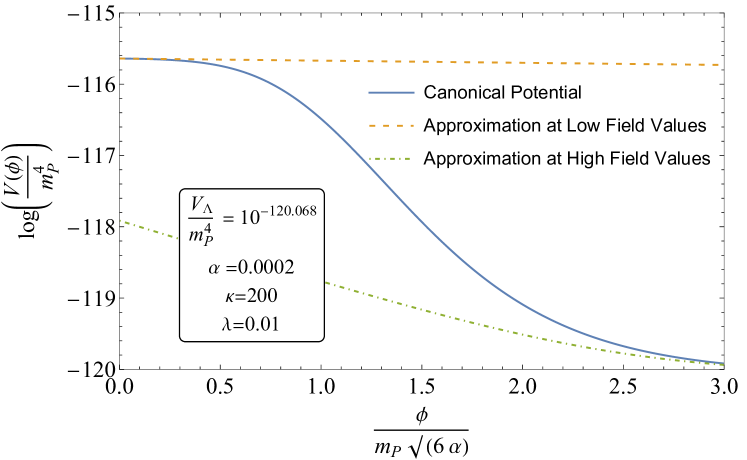
- The model employs a scalar field φ in the α-attractor framework, with a potential modified to include an exponential form near the false vacuum, ensuring rapid redshifting post-unfreezing.
- The field is initially frozen at the negative pole, corresponding to an inflationary plateau, and unfreezes near matter-radiation equality due to a metastable minimum (ESP) at φ = Φ.
- The potential is constructed as V(φ̃) = V_X exp{−2λ sinh[κ(φ̃ − Φ)/m_P]}, which reduces to the standard α-attractor form near the positive pole.
- The field evolves via free-fall after unfreezing, leading to faster decay than radiation, thus avoiding oscillatory behavior common in other EDE models.
- The model is tested numerically using constraints from CMB (Planck), BAO, and SH0ES for H₀, with parameter space scanned for viability.
- Inflationary predictions are derived from α-attractor formalism: n_s ≈ 1 − 2/N and r ≈ 12α̃/N², with N ≈ 60–65, ensuring consistency with CMB observations.
Experimental results
Research questions
- RQ1Can a non-oscillatory scalar field in the α-attractor framework provide a transient early dark energy component that raises H₀ without disrupting CMB constraints?
- RQ2Does the field’s rapid redshifting after unfreezing—faster than radiation—improve agreement with observations compared to oscillatory EDE models?
- RQ3Can the same scalar field simultaneously support quintessential late-time dark energy and inflation via a single potential structure?
- RQ4What are the viable parameter ranges for α, κ, λ, and Φ that satisfy current H₀, r, and n_s constraints?
- RQ5Is the model’s unified description of inflation, EDE, and late-time DE possible without excessive fine-tuning beyond ΛCDM?
Key findings
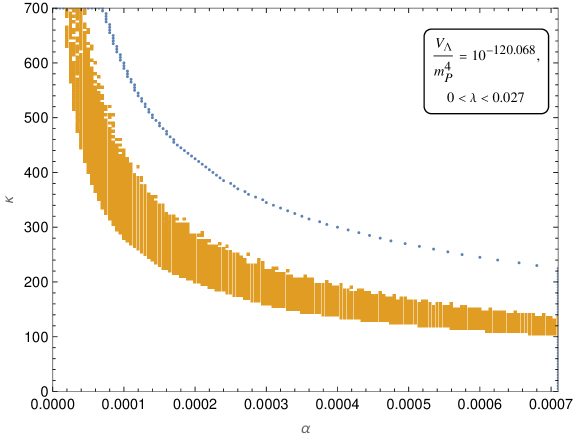
- The model achieves a viable parameter space for EDE that resolves the Hubble tension, with H₀ raised to ~73 km s⁻¹ Mpc⁻¹, consistent with SH0ES data.
- The scalar field redshifts away faster than radiation after unfreezing, avoiding oscillatory behavior and reducing potential observational imprints on CMB.
- The tensor-to-scalar ratio r ≈ 2.4 × 10⁻⁵ for N ≈ 60, satisfying the observational bound r < 0.036, with α̃ > 7.2 × 10⁻³.
- Inflationary predictions (n_s ≈ 0.967–0.969, r ≈ 12α̃/N²) are consistent with Planck data, assuming N ≈ 60–65.
- The model requires κ√(6α) > 1 and κΦ/m_P ≈ ½ ln(110 ln 10 / λ), with λ < 1.556 × 10⁻³ for α = 0.0006 and κ = 100, ensuring stability and correct potential behavior.
- The unified framework supports inflation, EDE, and late-time quintessence via a single scalar field with minimal additional tuning beyond ΛCDM.
Read this paper
Open the full text in the Nubint reader and ask about any passage as you read.
Read this paper on NubintThis review was generated by AI from the original paper. Please check the paper before citing it.