
[Paper Review] Non-Parametric Outlier Synthesis
This paper proposes Non-Parametric Outlier Synthesis (NPOS), a novel framework that generates artificial out-of-distribution (OOD) data without assuming a parametric distribution for in-distribution (ID) embeddings. By using non-parametric density estimation via k-NN distance to identify boundary ID embeddings and synthesizing outliers through Gaussian kernels with rejection sampling, NPOS achieves state-of-the-art OOD detection performance, reducing FPR95 from 41.87% to 5.76% under the same CLIP-B/16 setup.
Out-of-distribution (OOD) detection is indispensable for safely deploying machine learning models in the wild. One of the key challenges is that models lack supervision signals from unknown data, and as a result, can produce overconfident predictions on OOD data. Recent work on outlier synthesis modeled the feature space as parametric Gaussian distribution, a strong and restrictive assumption that might not hold in reality. In this paper, we propose a novel framework, Non-Parametric Outlier Synthesis (NPOS), which generates artificial OOD training data and facilitates learning a reliable decision boundary between ID and OOD data. Importantly, our proposed synthesis approach does not make any distributional assumption on the ID embeddings, thereby offering strong flexibility and generality. We show that our synthesis approach can be mathematically interpreted as a rejection sampling framework. Extensive experiments show that NPOS can achieve superior OOD detection performance, outperforming the competitive rivals by a significant margin. Code is publicly available at https://github.com/deeplearning-wisc/npos.
Motivation & Objective
- To address the challenge of OOD detection in real-world ML deployment where models lack supervision on unknown data.
- To overcome the restrictive parametric Gaussian assumption in prior outlier synthesis methods like VOS.
- To develop a flexible, distribution-free framework that generates reliable synthetic OOD data for training.
- To improve model robustness by learning a compact decision boundary between ID and OOD data through uncertainty regularization.
- To enable effective OOD detection in large-scale and zero-shot settings using only ID data during training.
Proposed method
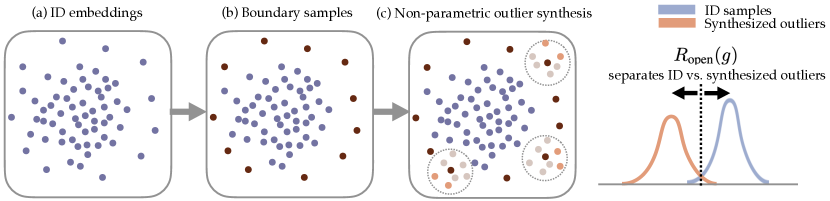
- Identify boundary ID embeddings using non-parametric k-NN density estimation based on nearest-neighbor distances.
- Synthesize artificial outliers by sampling from multivariate Gaussian kernels centered at the boundary ID embeddings.
- Apply rejection sampling to retain only synthesized outliers with low likelihood, ensuring they lie in the OOD region.
- Formulate the outlier synthesis process as a rejection sampling framework, mathematically approximating level-set estimation.
- Train the model end-to-end with a dual loss: one for ID classification and feature compactness, and another for OOD separation via uncertainty regularization.
- Optimize for highly distinguishable ID representations by pulling samples toward class centroids, enhancing the quality of density estimation.
Experimental results
Research questions
- RQ1Can non-parametric outlier synthesis outperform parametric methods in OOD detection without assuming a specific distribution for ID data?
- RQ2How does rejection sampling based on non-parametric density estimation improve decision boundary learning for OOD detection?
- RQ3To what extent can NPOS generalize across different model architectures and datasets, including ImageNet?
- RQ4Does NPOS significantly reduce overconfidence on OOD samples compared to standard fine-tuning with MSP scoring?
- RQ5How does the performance of NPOS compare to state-of-the-art methods like Fort et al. (2021) and VOS (Du et al., 2022c) under identical training and evaluation conditions?
Key findings
- NPOS reduces FPR95 from 41.87% (Fort et al., 2021) to 5.76% when fine-tuning CLIP-B/16 under identical settings, demonstrating a 36.11% improvement.
- NPOS outperforms the parametric VOS baseline by 13.40% in FPR95, confirming the advantage of non-parametric outlier synthesis.
- The method achieves strong performance on both zero-shot and fine-tuned models, including on ImageNet, showing scalability and robustness.
- Ablation studies confirm that non-parametric density estimation and rejection sampling are critical components for performance.
- The framework is end-to-end trainable and converges when both ID classification and OOD separation objectives are optimized.
- The code, datasets, and model checkpoints are publicly available at https://github.com/deeplearning-wisc/npos, ensuring reproducibility.
Read this paper
Open the full text in the Nubint reader and ask about any passage as you read.
Read this paper on NubintThis review was generated by AI from the original paper. Please check the paper before citing it.