
[Paper Review] Nonlinearities in Black Hole Ringdowns and the Quantization of Gravity
This paper proposes that nonlinearities in black hole ringdowns—specifically frequency-doubled gravitational wave modes—can serve as a probe for quantum gravity, as they are sensitive to the graviton number statistics and quantum correlations of gravitational wave states. Using effective field theory and quantum optics analogies, the authors show that quantum-enhanced gravitational wave detectors could measure these nonlinear signals to witness gravitational entanglement and test the quantum nature of gravity.
Einstein's theory of gravity admits a low energy effective quantum field description from which predictions beyond classical general relativity can be drawn. As gravitational wave detectors improve, one may ask whether non-classical features of such theory can be experimentally verified. Here we argue that nonlinear effects in black hole ringdowns can be sensitive to the graviton number statistics and other quantum properties of gravitational wave states. The prediction of ringdown signals, potentially measurable in the near future, might require the inclusion of quantum effects. This offers a new route to probing the quantum nature of gravity and gravitational wave entanglement.
Motivation & Objective
- To investigate whether nonlinear gravitational wave effects in black hole ringdowns can reveal quantum properties of gravity.
- To establish a connection between nonlinear ringdowns and quantum field theory predictions for gravitational waves.
- To propose a mechanism for detecting quantum gravitational effects using next-generation gravitational wave detectors.
- To demonstrate how quantum correlations in gravitational wave states can be probed through nonlinear mode generation.
- To provide a theoretical framework for witnessing gravitational entanglement via optical interferometry in quantum-enhanced detectors.
Proposed method
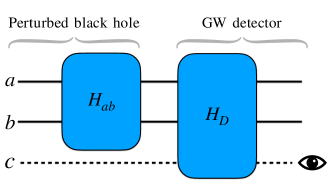
- Adapts quantum optics formalism—specifically parametric amplification and squeezing—to model nonlinear gravitational wave interactions in black hole ringdowns.
- Derives an effective Hamiltonian for frequency doubling in gravitational waves, analogous to $ H_{ab} = \kappa a a b^\dagger + \text{h.c.} $, preserving particle number symmetry.
- Models the time evolution of gravitational wave modes using coupled nonlinear equations (Eqs. 2–3) with damping rates and phase dynamics.
- Introduces a unitary evolution operator $ U(t) $ that couples gravitational wave modes to an optical probe via quadrature interactions.
- Uses the optical density matrix $ \rho_{nm}(t) $ to extract correlation functions of gravitational wave modes from measurable optical signals.
- Expands the correlation function $ \mathcal{C}(t) $ to quadratic order in coupling strengths to access second-order amplitude and phase correlators.
Experimental results
Research questions
- RQ1Can nonlinear gravitational wave modes in black hole ringdowns be sensitive to the quantum statistics of gravitons?
- RQ2How do quantum correlations in gravitational wave states manifest in nonlinear ringdown signals?
- RQ3Can quantum-enhanced gravitational wave detectors measure non-classical features such as entanglement in gravitational wave modes?
- RQ4What is the role of amplitude-phase correlations in generating measurable nonlinear effects in gravitational wave signals?
- RQ5Can the Duan criteria for entanglement be applied and tested using nonlinear gravitational wave modes and optical interferometry?
Key findings
- Nonlinear ringdowns exhibit a quadratic dependence of the (4,4,0) mode amplitude on the (2,2,0) parent mode, indicating strong coupling with a proportionality constant of order unity.
- The phase of the nonlinear mode is twice that of the parent mode plus a constant shift, mirroring frequency-doubling in quantum optics.
- The correlation function $ \mathcal{C}(t) $, derived from the optical density matrix, encodes all 14 second-order amplitude and phase correlators of the parent and nonlinear gravitational wave modes.
- By measuring $ \rho_{nm}(t) $ at 14 distinct times, the full set of correlators needed to verify the Duan criteria for entanglement can be reconstructed.
- The ratio of coupling strengths to the optical mode is $ q_a/q_b = 2\sqrt{2} $, reflecting the frequency scaling of gravitational wave coupling to interferometric detectors.
- Quantum corrections to classical ringdown predictions arise from the quantum nature of the initial gravitational wave state, particularly for squeezed-coherent-thermal states.
Read this paper
Open the full text in the Nubint reader and ask about any passage as you read.
Read this paper on NubintThis review was generated by AI from the original paper. Please check the paper before citing it.