
[Paper Review] Nonparametric covariance estimation for mixed longitudinal studies, with applications in midlife women's health
This paper proposes a noniterative, sequential-aggregation algorithm for nonparametric covariance estimation in mixed longitudinal studies with noisy, partially observed functional trajectories. The method uses closed-form matrix operations and achieves consistency under mild regularity conditions, demonstrating strong performance in estimating working memory decline patterns in midlife women using SWAN data.
In mixed longitudinal studies, a group of subjects enter the study at different ages (cross-sectional) and are followed for successive years (longitudinal). In the context of such studies, we consider nonparametric covariance estimation with samples of noisy and partially observed functional trajectories. The proposed algorithm is based on a noniterative sequential-aggregation scheme with only basic matrix operations and closed-form solutions in each step. The good performance of the proposed method is supported by both theory and numerical experiments. We also apply the proposed procedure to a study on the working memory of midlife women, based on data from the Study of Women's Health Across the Nation (SWAN).
Motivation & Objective
- Address the challenge of estimating covariance structures in mixed longitudinal studies where subjects enter at different ages and have incomplete, noisy trajectories.
- Overcome limitations of parametric models that assume linear trends in cognitive aging, which may not reflect complex, nonlinear trajectories.
- Develop a computationally efficient, noniterative method for covariance estimation that leverages only basic matrix operations and closed-form solutions.
- Ensure theoretical consistency of the estimator under minimal smoothness assumptions, enabling reliable functional data analysis in sparse, irregular designs.
- Apply the method to real-world data from the Study of Women’s Health Across the Nation (SWAN) to model working memory changes over 15 years in midlife women.
Proposed method
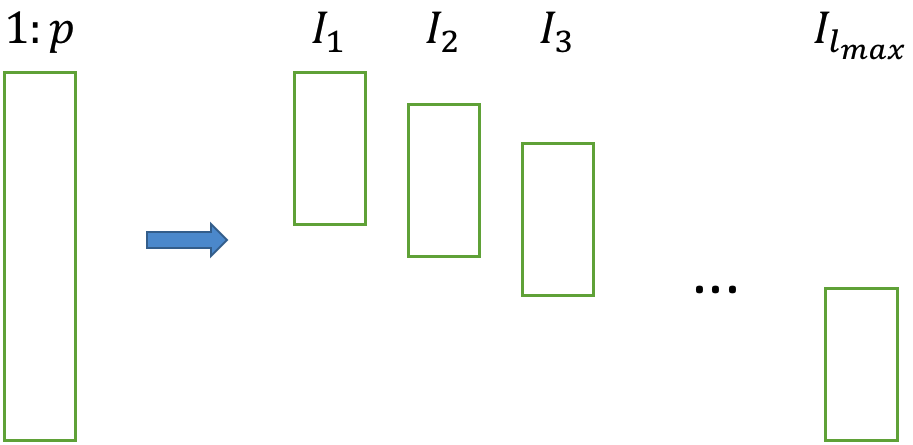
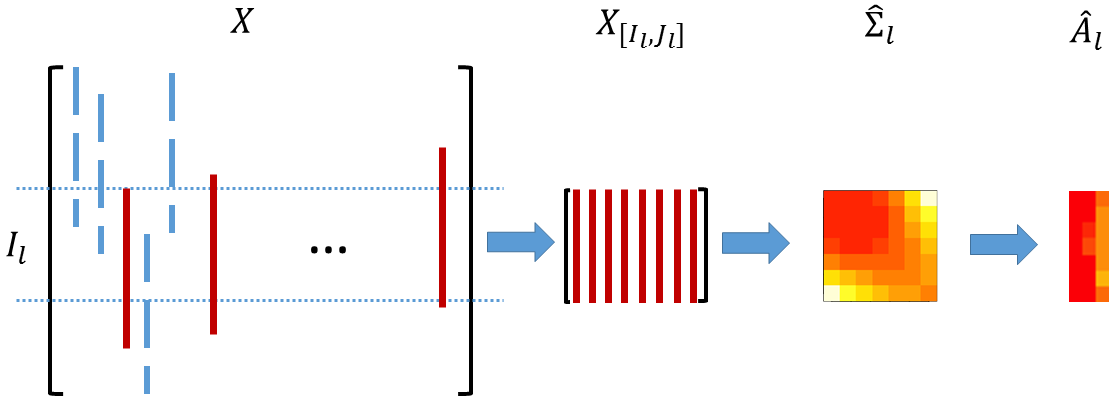
- Propose a sequential-aggregation scheme that pools pairwise observations across subjects to estimate the covariance function $ G(s,t) $ over the full time domain $ \mathcal{T}^2 $, even when individual trajectories are partial.
- Use a noniterative algorithm based on singular value decomposition (SVD) of a pooled matrix of pairwise observations, ensuring computational efficiency and closed-form solutions at each step.
- Apply a projection-based estimation strategy that respects the structure of partially observed functional data, minimizing bias from missing data patterns.
- Incorporate measurement error modeling by assuming i.i.d. zero-mean errors with constant variance $ \sigma^2 $, and estimate the underlying process covariance $ G(s,t) $ nonparametrically.
- Establish theoretical consistency of the estimator through rigorous proofs involving Ky Fan norms and singular value decomposition inequalities.
- Leverage Abel’s summation formula and matrix norm inequalities to bound estimation error and prove convergence under mild regularity conditions on the true covariance function.
Experimental results
Research questions
- RQ1How can we consistently estimate the covariance function of a functional process when data are collected in a mixed longitudinal design with partial, noisy trajectories?
- RQ2What is a computationally efficient, noniterative method for covariance estimation that avoids iterative optimization and relies only on basic matrix operations?
- RQ3Can the proposed method recover complex, nonlinear aging patterns in cognitive function, such as an initial improvement followed by decline in working memory?
- RQ4How does the estimator perform in finite samples, particularly when the number of time points per subject is small and the observation window is limited?
- RQ5To what extent does the method outperform traditional parametric or semiparametric approaches in capturing the true underlying covariance structure in real-world mixed longitudinal data?
Key findings
- The proposed nonparametric covariance estimator achieves consistency under mild regularity conditions, even when individual trajectories are short and irregular.
- The algorithm is noniterative and relies solely on matrix operations and SVD, enabling fast and stable computation without convergence issues.
- Numerical experiments confirm the method's robustness and accuracy in estimating covariance functions under various sampling schemes and noise levels.
- Application to SWAN data reveals a complex, non-monotonic pattern in working memory decline among midlife women, with individual trajectories showing early improvement followed by decline.
- The method successfully recovers the full covariance structure over a 15-year age span (48–62) despite only 5-year-long partial trajectories per subject.
- Theoretical proofs establish that the estimator's error converges to zero as sample size increases, with convergence rates dependent on smoothness of the true covariance function.
Read this paper
Open the full text in the Nubint reader and ask about any passage as you read.
Read this paper on NubintThis review was generated by AI from the original paper. Please check the paper before citing it.