
[Paper Review] OccuQuest: Mitigating Occupational Bias for Inclusive Large Language Models
This paper introduces OccuQuest, a large-scale instruction-tuning dataset with 148,772 prompt-completion pairs and 31,811 dialogues across 1,013 occupations in 26 categories, designed to mitigate occupational bias in LLMs. By leveraging GPT-3.5-turbo to generate occupation-specific queries and responses in a hierarchical structure (Occupation → Responsibility → Topic → Question), the authors fine-tune LLaMA into OccuLLaMA, which achieves a 86.4% win rate over WizardLM on real-world occupational queries and improves performance by over 4 points on GSM8K compared to other 7B variants.
The emergence of large language models (LLMs) has revolutionized natural language processing tasks. However, existing instruction-tuning datasets suffer from occupational bias: the majority of data relates to only a few occupations, which hampers the instruction-tuned LLMs to generate helpful responses to professional queries from practitioners in specific fields. To mitigate this issue and promote occupation-inclusive LLMs, we create an instruction-tuning dataset named \emph{OccuQuest}, which contains 110,000+ prompt-completion pairs and 30,000+ dialogues covering over 1,000 occupations in 26 occupational categories. We systematically request ChatGPT, organizing queries hierarchically based on Occupation, Responsibility, Topic, and Question, to ensure a comprehensive coverage of occupational specialty inquiries. By comparing with three commonly used datasets (Dolly, ShareGPT, and WizardLM), we observe that OccuQuest exhibits a more balanced distribution across occupations. Furthermore, we assemble three test sets for comprehensive evaluation, an occu-test set covering 25 occupational categories, an estate set focusing on real estate, and an occu-quora set containing real-world questions from Quora. We then fine-tune LLaMA on OccuQuest to obtain OccuLLaMA, which significantly outperforms state-of-the-art LLaMA variants (Vicuna, Tulu, and WizardLM) on professional questions in GPT-4 and human evaluations. Notably, on the occu-quora set, OccuLLaMA reaches a high win rate of 86.4\% against WizardLM.
Motivation & Objective
- To address occupational bias in instruction-tuning datasets, which predominantly favor AI/tech professions and underrepresent practitioners in non-technical fields.
- To create a comprehensive, occupation-inclusive instruction-tuning dataset covering over 1,000 occupations across 26 categories.
- To develop and evaluate a fine-tuned LLaMA model (OccuLLaMA) that performs significantly better on professional, occupation-specific queries than existing SOTA models.
- To demonstrate the effectiveness of combining OccuQuest with other datasets to further improve LLM performance across general and professional benchmarks.
Proposed method
- The authors collect 1,013 job titles and responsibilities across 26 occupational categories from Workable’s job description resources.
- They use GPT-3.5-turbo to generate occupation-specific queries and responses through a hierarchical prompting strategy: Occupation → Responsibility → Topic → Question.
- The dataset is constructed with 114,090 prompt-completion pairs and 31,682 multi-turn dialogues, totaling 145,772 instances.
- Three evaluation test sets are created: occu-test (25 categories), estate (real estate), and occu-quora (real-world Quora questions).
- LLaMA is fine-tuned on OccuQuest to create OccuLLaMA, and a mixture of OccuQuest and Tulu is used to train ProLLaMA.
- Performance is evaluated via GPT-4 preference scoring and human evaluation on professional question-answering tasks.
Experimental results
Research questions
- RQ1Can a large-scale, occupation-inclusive instruction-tuning dataset reduce occupational bias in LLMs compared to existing datasets?
- RQ2How does fine-tuning on OccuQuest improve LLM performance on professional, occupation-specific queries compared to SOTA instruction-tuned models?
- RQ3To what extent can combining OccuQuest with other instruction-tuning datasets enhance overall LLM performance across general and specialized benchmarks?
Key findings
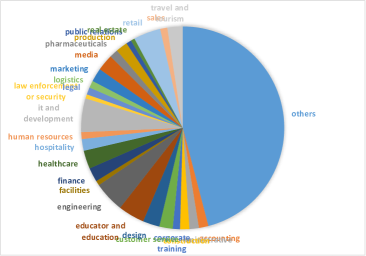
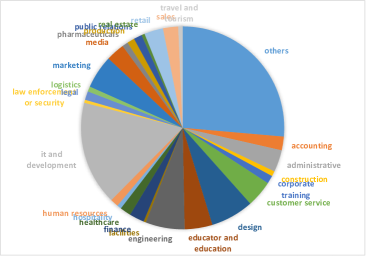
- OccuQuest exhibits a significantly more balanced distribution across occupational categories than Dolly, ShareGPT, and WizardLM, with 2–6% of data per category compared to over 15% in 'IT and Development' for the latter.
- OccuLLaMA achieves a 86.4% win rate over WizardLM on the occu-quora test set, demonstrating superior performance on real-world professional queries.
- The 7B and 13B ProLLaMA models achieve the highest performance on MMLU and GSM8K, with the 7B ProLLaMA model improving by over 4 points on GSM8K compared to other 7B variants.
- Fine-tuning on OccuQuest alone improves performance on professional queries, while combining it with Tulu further enhances performance on general benchmarks like MMLU, GSM8K, BBH, and HumanEval.
- The average response length in OccuQuest is 351.0 tokens, with dialogues averaging 6.4 turns, indicating rich, multi-turn professional interactions.
- The dataset is released publicly at Hugging Face, including OccuQuest, OccuLLaMA-7B, and ProLLaMA-7B, enabling broader research and model development.
Read this paper
Open the full text in the Nubint reader and ask about any passage as you read.
Read this paper on NubintThis review was generated by AI from the original paper. Please check the paper before citing it.