
[Paper Review] OCRBench: On the Hidden Mystery of OCR in Large Multimodal Models
The paper evaluates how large multimodal models perform on OCR-related tasks and introduces OCRBench, a 1000-item benchmark across five text-centric tasks to study OCR capabilities of LMMs including handwritten and multilingual text.
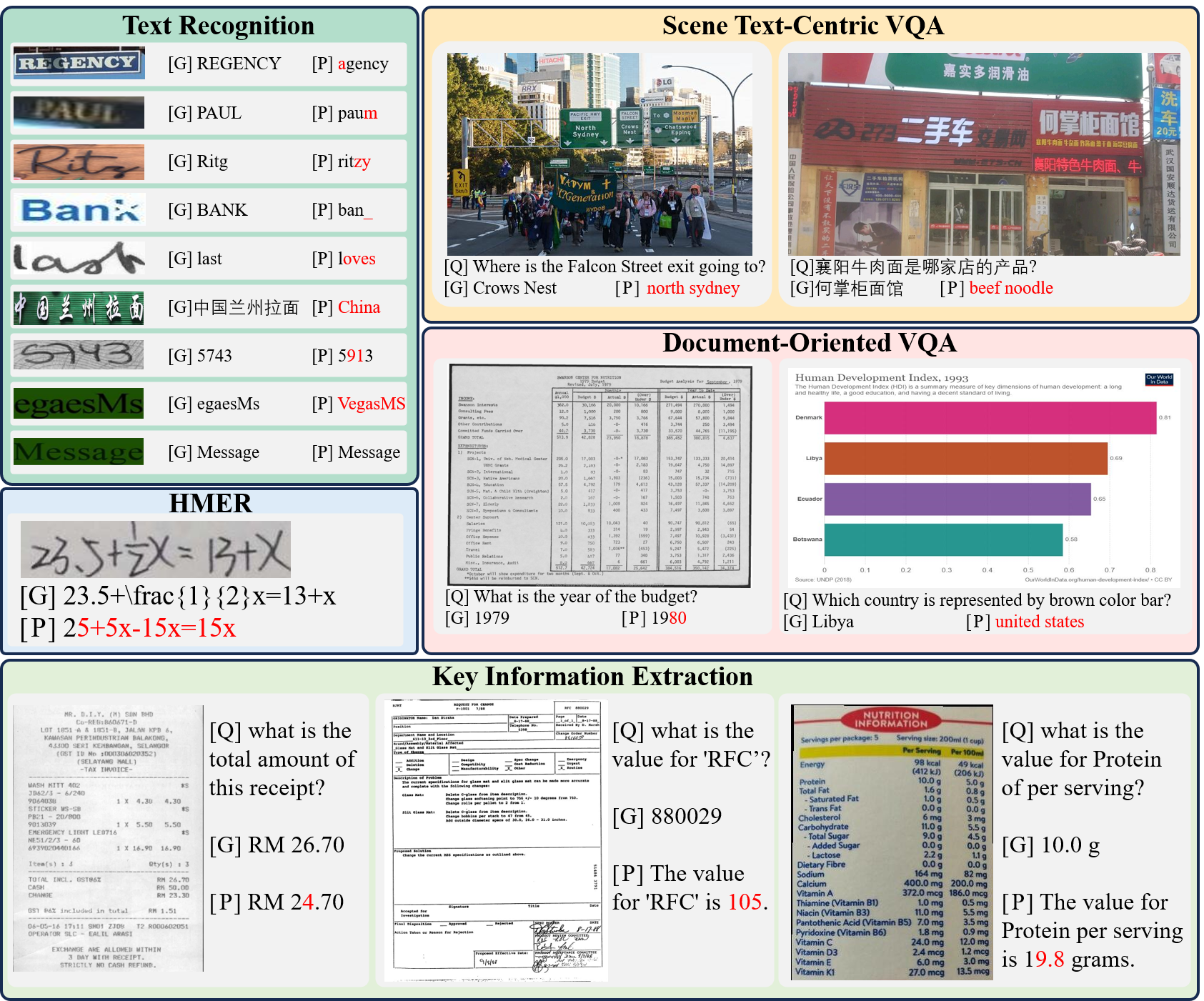
Large models have recently played a dominant role in natural language processing and multimodal vision-language learning. However, their effectiveness in text-related visual tasks remains relatively unexplored. In this paper, we conducted a comprehensive evaluation of Large Multimodal Models, such as GPT4V and Gemini, in various text-related visual tasks including Text Recognition, Scene Text-Centric Visual Question Answering (VQA), Document-Oriented VQA, Key Information Extraction (KIE), and Handwritten Mathematical Expression Recognition (HMER). To facilitate the assessment of Optical Character Recognition (OCR) capabilities in Large Multimodal Models, we propose OCRBench, a comprehensive evaluation benchmark. OCRBench contains 29 datasets, making it the most comprehensive OCR evaluation benchmark available. Furthermore, our study reveals both the strengths and weaknesses of these models, particularly in handling multilingual text, handwritten text, non-semantic text, and mathematical expression recognition. Most importantly, the baseline results presented in this study could provide a foundational framework for the conception and assessment of innovative strategies targeted at enhancing zero-shot multimodal techniques. The evaluation pipeline and benchmark are available at https://github.com/Yuliang-Liu/MultimodalOCR.
Motivation & Objective
- Assess OCR capabilities of large multimodal models (LMMs) across diverse text-related visual tasks.
- Build and release OCRBench to provide a standardized, manually verified evaluation suite for zero-shot OCR performance in LMMs.
- Identify strengths, limitations, and directions for improving text-related multimodal understanding (handwritten, multilingual, HMER).
- Compare a range of LMMs (e.g., GPT4V, Gemini, Monkey, BLIP-based models) on a comprehensive set of OCR tasks and datasets.
Proposed method
- Evaluate 14 LMMs on five text-related tasks: text recognition, Scene Text-Centric VQA, Document-Oriented VQA, Key Information Extraction (KIE), and Handwritten Mathematical Expression Recognition (HMER).
- Use a unified evaluation criterion: whether ground-truth answers appear in the model outputs, filtering out very short answers (< 4 symbols).
- Assemble OCRBench with 1000 manually filtered/corrected QA pairs across tasks and provide alternative correct answers for robustness.
- Analyze performance across 29 OCR datasets, including Regular/Irregular/Occluded/Artistic text, handwritten text, Chinese text, and semantic vs non-semantic text.
- Present detailed per-model, per-task results to identify where LMMs excel or struggle (e.g., HMER, handwritten/Chinese text).
- Discuss potential mechanisms for OCR ability in LMMs and propose directions for future improvement (fine-grained visual features, multilingual data, and domain-adapted training).
Experimental results
Research questions
- RQ1How well do current large multimodal models perform on OCR-related tasks across diverse datasets?
- RQ2What are the primary strengths and weaknesses of LMMs in OCR, including handwritten, multilingual, non-semantic, and mathematical expression recognition?
- RQ3Does higher input resolution or model design correlate with improved performance on fine-grained text understanding tasks?
- RQ4Can OCRBench provide a stable baseline to guide future improvements in zero-shot OCR for multimodal models?
Key findings
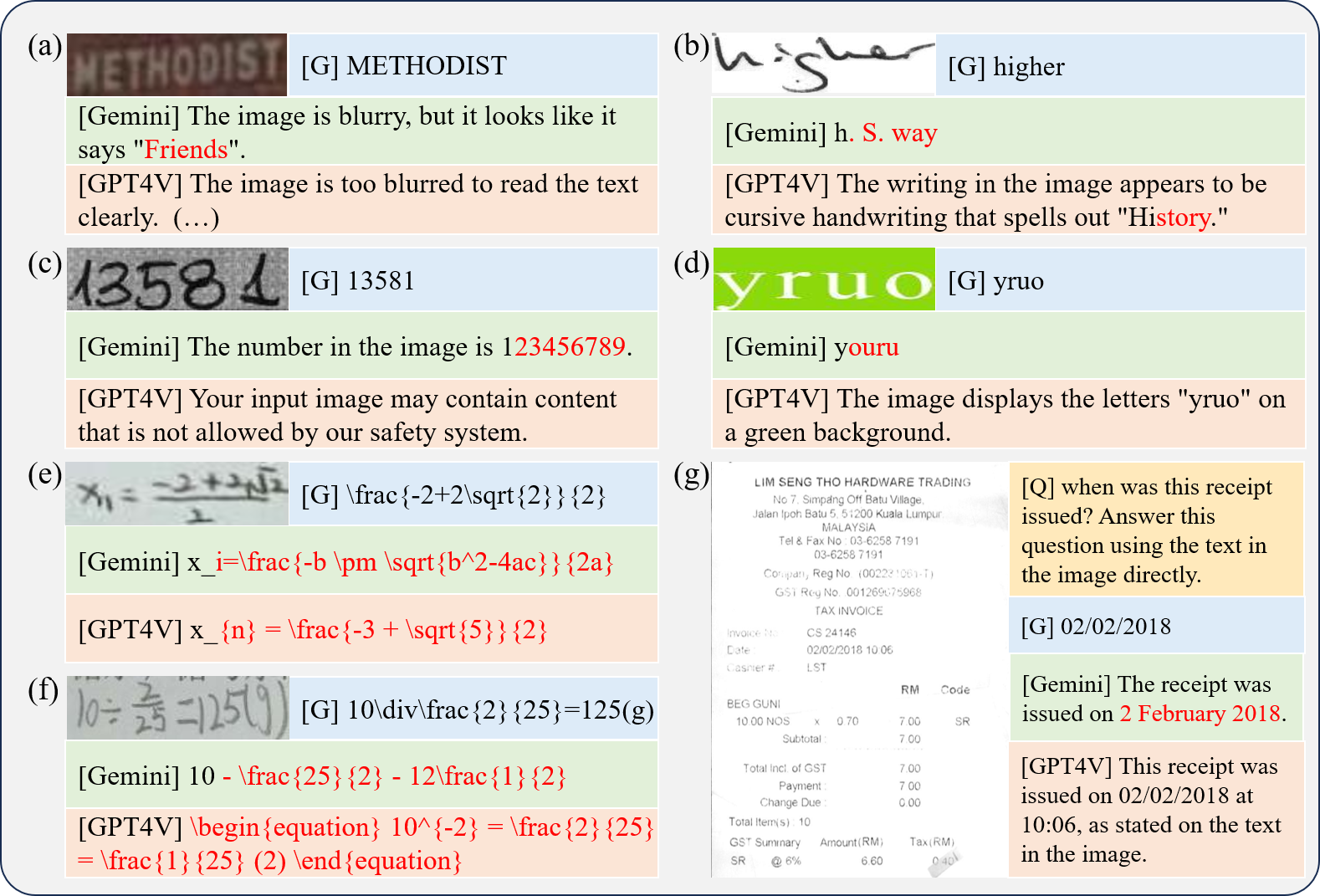
- LMMs show competitive performance with supervised models on regular/irregular/occluded/ artistic text in text recognition, but struggle notably with handwritten text, Chinese text, handwritten strings, and non-semantic text.
- Smaller input resolutions generally yield poorer results for Scene Text-Centric VQA, Document-Oriented VQA, and KIE, while higher-resolution models (e.g., Monkey) can improve performance on these tasks.
- Significant gaps remain in Handwritten Mathematical Expression Recognition (HMER) for LMMs, indicating domain-specific challenges beyond standard OCR.
- OCRBench results place Gemini first and GPT4V second overall, with Monkey close behind, while several baselines lag on HMER and non-semantic/handwritten cases.
- LMMs tend to rely on semantic cues to recognize words, showing weaker performance when character order is shuffled or semantics are absent (NST vs ST).
- The study highlights opportunities to improve fine-grained visual feature extraction, multilingual training, and domain-specific OCR adaptation for LMMs.
Read this paper
Open the full text in the Nubint reader and ask about any passage as you read.
Read this paper on NubintThis review was generated by AI from the original paper. Please check the paper before citing it.