
[Paper Review] Old Data, New Forensics: The First Second of SN 1987A Neutrino Emission
This study performs the first comprehensive comparison of modern 1-, 2-, and 3D core-collapse supernova models to the SN 1987A neutrino data, focusing on the first second post-bounce. Despite consistent modeling approaches, most models disagree with the observed low neutrino counts, and neither neutrino oscillations nor progenitor mass variations resolve the tension, highlighting urgent needs for improved simulations and data analysis to prepare for the next Milky Way supernova event.
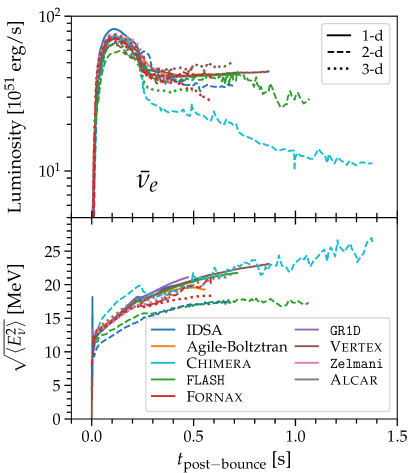
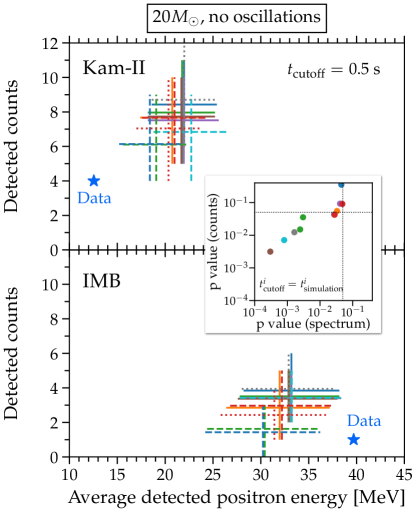
The next Milky Way supernova will be an epochal event in multi-messenger astronomy, critical to tests of supernovae, neutrinos, and new physics. Realizing this potential depends on having realistic simulations of core collapse. We investigate the neutrino predictions of nearly all modern models (1-, 2-, and 3-d) over the first $\simeq$1 s, making the first detailed comparisons of these models to each other and to the SN 1987A neutrino data. Even with different methods and inputs, the models generally agree with each other. However, even considering the low neutrino counts, the models generally disagree with data. What can cause this? We show that neither neutrino oscillations nor different progenitor masses appear to be a sufficient solution. We outline urgently needed work.
Motivation & Objective
- To assess modeling uncertainties by comparing modern 1-, 2-, and 3D core-collapse supernova simulations to each other.
- To evaluate physical uncertainties by testing how well these models match the actual SN 1987A neutrino data.
- To identify whether neutrino oscillations or progenitor mass variations can resolve the observed tension between models and data.
- To stimulate new work in supernova modeling and neutrino data analysis ahead of the next Milky Way core-collapse supernova.
Proposed method
- The authors compile and compare neutrino flux predictions from multiple state-of-the-art 1-, 2-, and 3D supernova simulations with varying dimensionality, progenitor masses, and neutrino oscillation scenarios.
- They use the KamLAND-II (Kam-II) data from SN 1987A as a benchmark, focusing on the first ~1 second after core bounce.
- For model-data comparison, they compute p-values based on both total event counts and energy spectra, using a test statistic derived from Monte Carlo simulations.
- They analyze the impact of different neutrino oscillation scenarios—normal hierarchy (NH), inverted hierarchy (IH), and flavor equilibration—on predicted event rates and spectra.
- The comparison includes simulations with cutoff times of 0.5 s and 1.3 s to assess sensitivity to time range selection.
- They use a standard oscillation formula to compute the oscillated electron antineutrino flux: $\tilde{f}_{\bar{\nu}_e} = f_{\bar{\nu}_e} P(\bar{\nu}_e \to \bar{\nu}_e) + f_{\bar{\nu}_x} [1 - P(\bar{\nu}_e \to \bar{\nu}_e)]$, with $P(\bar{\nu}_e \to \bar{\nu}_e) \approx 0.7$ (NH), 0 (IH), and 1/3 (equilibration).
Experimental results
Research questions
- RQ1Do modern 1-, 2-, and 3D supernova simulations produce consistent neutrino predictions in the first second after core bounce?
- RQ2To what extent do these models agree with the actual SN 1987A neutrino data, given the low number of observed events?
- RQ3Can neutrino oscillations—under different hierarchy scenarios—resolve the discrepancy between model predictions and SN 1987A data?
- RQ4Does varying the progenitor mass (e.g., 10–20 M⊙) significantly alter the model-data agreement for the first-second neutrino emission?
- RQ5What are the dominant sources of uncertainty in current supernova simulations when compared to real neutrino burst data?
Key findings
- Despite differences in dimensionality and input physics, modern 1-, 2-, and 3D supernova simulations show general agreement among themselves in their predicted neutrino fluxes during the first ~1 s after core bounce.
- The models generally disagree with the SN 1987A data, as indicated by p-values below the 0.05 threshold for most models when using a cutoff time of 1.3 s.
- The choice of cutoff time significantly affects the p-value: using 0.5 s reduces statistical tension, but the 1.3 s cutoff reveals persistent model-data disagreement.
- Neutrino oscillations do not resolve the tension; in some cases, they worsen the fit to the energy spectrum despite improving the count p-value, due to complex interplay in the test statistics.
- The inclusion of oscillations shifts the predicted $¯{\nu}_e$ spectrum to higher energy and lower flux, but the net effect on p-values is dominated by count misfit, leading to ambiguous overall improvement.
- The study identifies a critical need for longer-duration simulations and more comprehensive model comparisons to resolve the persistent discrepancy with SN 1987A data.
Read this paper
Open the full text in the Nubint reader and ask about any passage as you read.
Read this paper on NubintThis review was generated by AI from the original paper. Please check the paper before citing it.