
[論文レビュー] On Controllability and Persistency of Excitation in Data-Driven Control: Extensions of Willems' Fundamental Lemma
本稿は、WillemsのFundamental Lemmaを、完全な可制御性および高次持続的励起性の古典的仮定を緩和することで拡張する。初期状態が可制御部分空間、非可観測部分空間、およびデータに依存する部分空間の和に含まれる場合、測定されたデータから軌道をパラメータ化できることを示し、必要な持続的励起性の次数を $n+L$ から $\delta_{\text{min}}+L$ に低減する。ここで $\delta_{\text{min}}$ はシステム行列 $A$ の最小多項式の次数である。これにより、非可制御系に対してもデータ駆動型予測制御が可能となり、特に大規模またはマルチエージェント系においてデータ要件が著しく削減される。
Willems' fundamental lemma asserts that all trajectories of a linear time-invariant system can be obtained from a finite number of measured ones, assuming that controllability and a persistency of excitation condition hold. We show that these two conditions can be relaxed. First, we prove that the controllability condition can be replaced by a condition on the controllable subspace, unobservable subspace, and a certain subspace associated with the measured trajectories. Second, we prove that the persistency of excitation requirement can be relaxed if the degree of a certain minimal polynomial is tightly bounded. Our results show that data-driven predictive control using online data is equivalent to model predictive control, even for uncontrollable systems. Moreover, our results significantly reduce the amount of data needed in identifying homogeneous multi-agent systems.
研究の動機と目的
- WillemsのFundamental Lemmaにおける可制御性および高次持続的励起性の古典的仮定が、データ駆動型軌道パラメータ化に必要かどうかを調査すること。
- すべての対応する軌道が測定された入出力軌道の線形結合として表現可能な初期状態の最小部分空間を特定すること。
- 特に大規模またはマルチエージェント系において、データ駆動型制御における必要な持続的励起性の次数を低減すること。
- 非可制御系に対しても、データ駆動型予測制御とモデル予測制御の等価性を確立すること。
提案手法
- 一般化された部分空間条件を導入:初期状態が可制御部分空間 $\mathcal{R}$、非可観測部分空間 $\mathcal{O}$、およびデータに依存する部分空間 $\mathcal{K}[x_0^1, \dots, x_0^\tau]$ の和に含まれる軌道は、測定データからパラメータ化可能である。
- Cayley-Hamilton定理を用いて、観測性行列 $O_L$ が非可観測部分空間を消滅させることを示し、初期状態を可制御および非可観測成分に分解可能であることを可能にする。
- 測定データのハンケル行列を用いて、入出力軌道の線形パラメータ化を導出する。構造は $\begin{bmatrix} H_L(u) \\ H_L(y) \end{bmatrix} = \begin{bmatrix} 0 & I \\ O_L & T_L \end{bmatrix} \begin{bmatrix} x_0^a + x_0^b \\ u \end{bmatrix}$ である。
- 必要な持続的励起性の次数を $n+L$ から $\delta_{\text{min}} + L$ に低減する。ここで $\delta_{\text{min}}$ は $A$ の最小多項式の次数であり、システムのダイナミクスがこの多項式に従うことに基づく。
- 同様の結果を用いて、均一なマルチエージェント系において、入出力データのハンケル行列を用いた構造的線形システムを解くことで、マーカフパラメータを計算する。
![Figure 1: Output trajectory for Online DeePC. The blue and red curves denote $y_{[0,T-1]}$ and $y_{[T,K-1]}$ , respectively. The dashed lines denote the output reference values.](https://ar5iv.labs.arxiv.org/html/2102.02953/assets/application/online.png)
実験結果
リサーチクエスチョン
- RQ1データ駆動型軌道パラメータ化は、可制御系を超えて拡張可能か?
- RQ2すべての対応する軌道が測定軌道の線形結合として表現可能な初期状態の正確な部分空間は何か?
- RQ3必要な持続的励起性の次数を $n+L$ 未満に低減可能か?
- RQ4非可制御系に対しても、データ駆動型予測制御はモデル予測制御と等価か?
主な発見
- 初期状態が $\mathcal{R} + \mathcal{O} + \mathcal{K}[x_0^1, \dots, x_0^\tau]$ に含まれる軌道は、システムが可制御でなくても測定データからパラメータ化可能である。
- 持続的励起性要件は $n+L$ から $\delta_{\text{min}} + L$ に低減され、$\delta_{\text{min}}$ は $A$ の最小多項式の次数である。これは、データ要件を著しく削減する。
- データ駆動型予測制御は、可制御および非可制御の両方のシステムにおいて、モデル予測制御と等価である。これは、先行研究を拡張する。
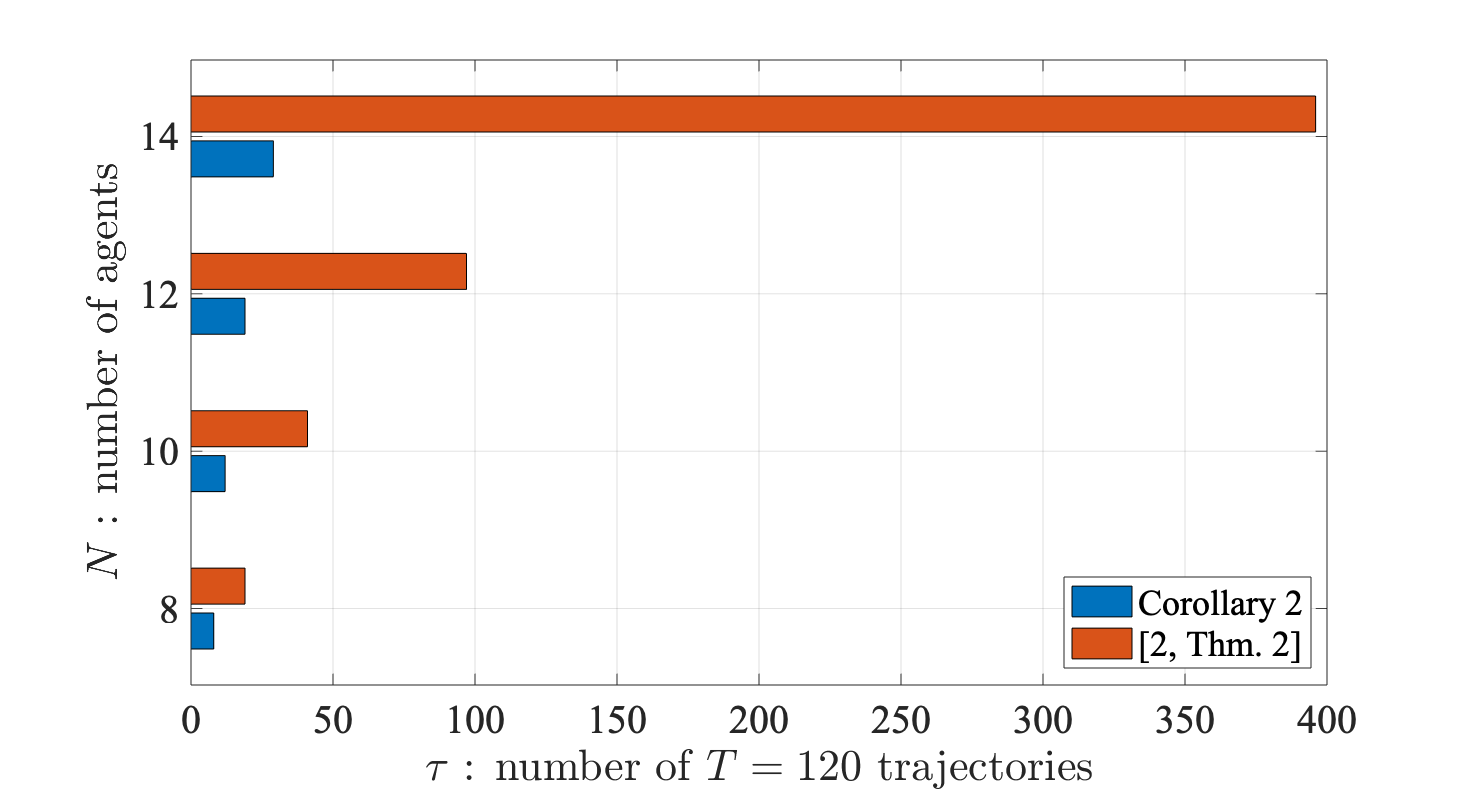
- 均一なマルチエージェント系では、$n+L$ の持続的励起性に依存する従来の手法と比較して、データ要件が1桁低減される。
- 全システムが可制御でない場合でも、集団的持続的励起性の次数 $(N+1)\widebar{n}+1$ で収集された入出力データから、システムのマーカフパラメータを一意に計算可能である。
より良い研究を、今すぐ始めましょう
論文の読解から最終レビューまで、研究時間を劇的に削減しましょう。
クレジットカード登録不要
このレビューはAIが作成し、人間の編集者が確認しました。