
[Paper Review] On the effect of the luni-solar gravitational attraction on trees
This study demonstrates that luni-solar gravitational tides drive sap flow in trees, as evidenced by electrical signals in poplar, oak, and hornbeam trees that decompose into seven precise tidal periods (e.g., P1, K1, S1, Mf, K2) with <0.01% deviation from theoretical values. The electrokinetic coefficient in trees (10 V/Pa) is tenfold higher than in rocks, suggesting trees are highly sensitive to tidal forces, with physiological differences affecting amplitude modulation but not period, confirming tidal forcing as a key driver of sap flow.
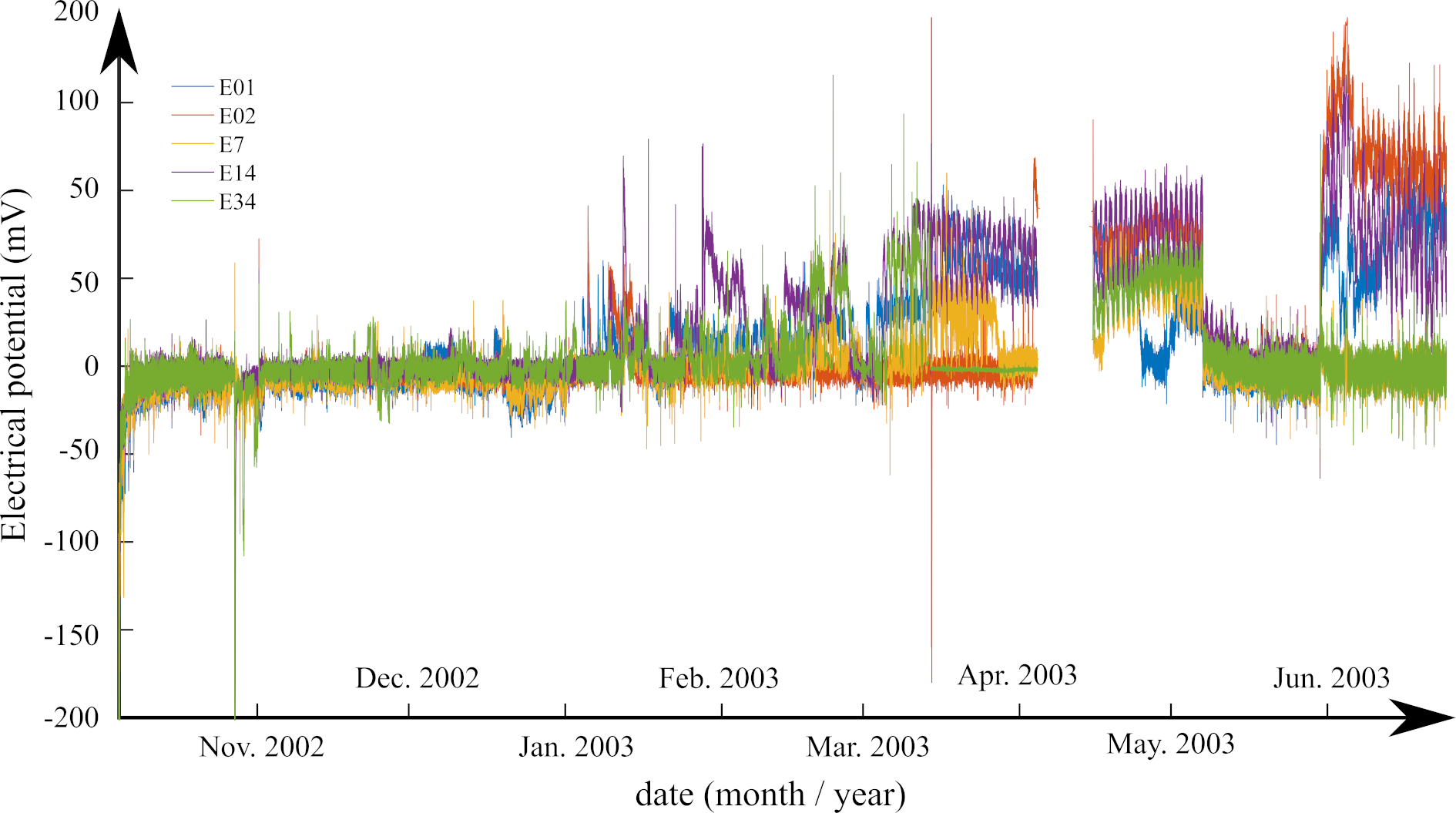
In this paper, we revisit old electrical measurements conducted on a poplar tree in 2003 (Gibert et al. 2006), which showed the presence of a diurnal electrical signal, attributed to an electrokinetic phenomenon correlated with sap flow, even in winter. We reanalyze these data using the singular spectrum analysis method and demonstrate that the electrical signal measured at various locations (roots, trunk, and branches) on the poplar tree can be decomposed to over 80\% into a sum of 7 pseudo-periods, all linked to luni-solar tides. The precision of the extracted periods exceeds that of models. To validate these old measurements, we have reproduced the 2003 protocol since 2018 at the Jardin des Plantes in Paris, on 3 oak trees and 3 hornbeams. The electrical signals today exhibit the same characteristics as those of 2003. Tidal forces could be a driving force of sap flow in trees.
Motivation & Objective
- To investigate whether luni-solar gravitational tides influence sap flow in trees by reanalyzing historical electrical measurements.
- To validate the 2003 poplar tree experiment using modern data and methods.
- To determine if tidal components in electrical signals are consistent across multiple tree species and individuals.
- To assess whether physiological differences in trees affect tidal signal modulation without altering tidal periods.
- To establish a causal link between tidal forces and sap movement via electrokinetic phenomena in xylem.
Proposed method
- Reanalyzed 2003 electrical measurements from a poplar tree using Singular Spectrum Analysis (SSA) to extract periodic components.
- Applied SSA to decompose non-stationary, discontinuous electrical signals into pseudo-periodic components, avoiding Fourier transform limitations.
- Compared extracted periods with theoretical luni-solar tidal periods (P1, K1, S1, Mf, K2) to assess precision and match.
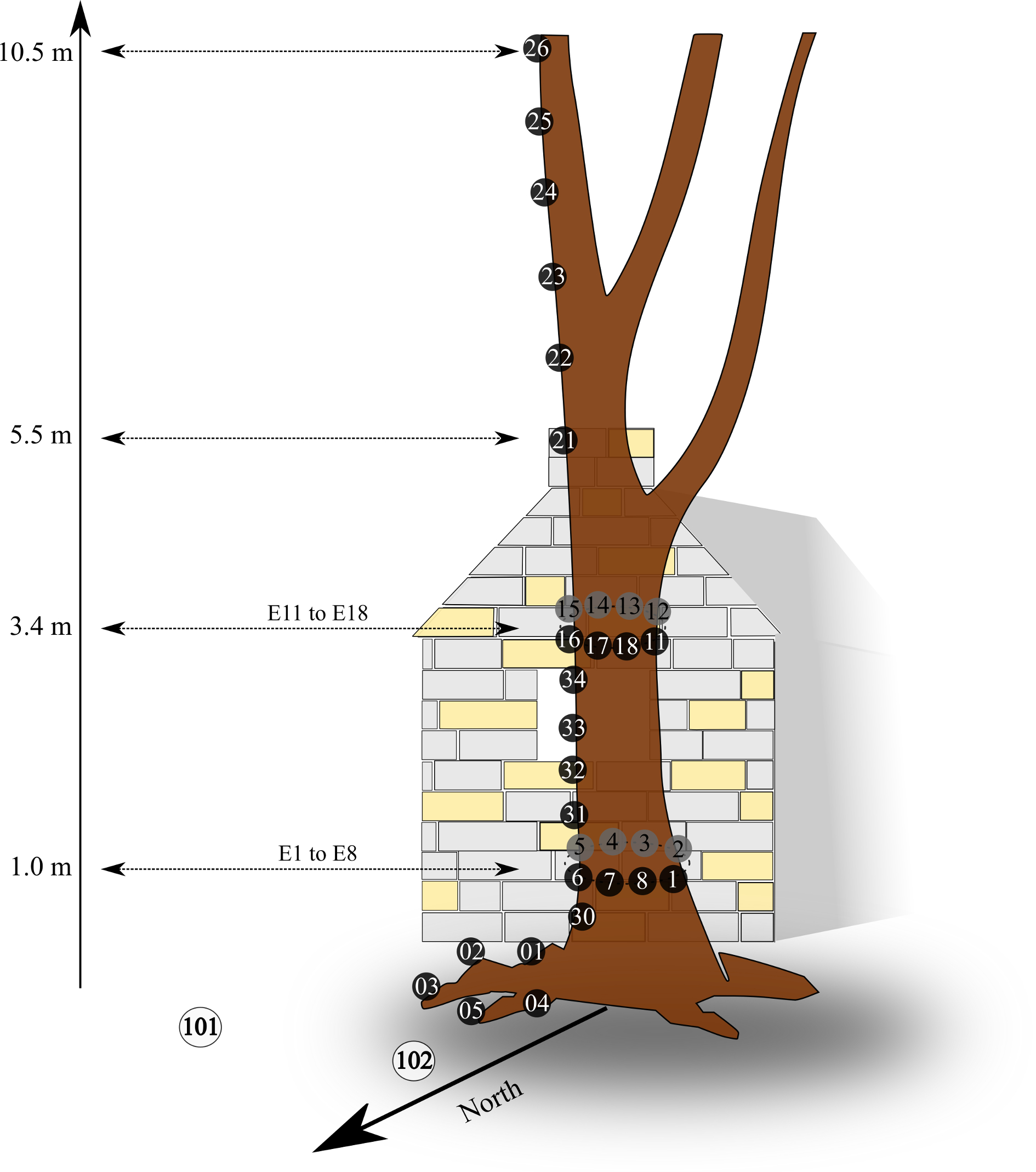
- Reproduced the 2003 protocol at the MNHN Observatory in Paris since 2018, measuring electrical potential on 3 oaks, 3 hornbeams, and other species.
- Used non-polarizable electrodes in soil and stainless steel electrodes in roots, trunk, and branches to record signals.
- Calculated the electrokinetic coefficient in trees using a geophysical model adapted to xylem structure, comparing it to values in rocks.
Experimental results
Research questions
- RQ1Do electrical signals in trees contain periodic components that match luni-solar tidal periods with high precision?
- RQ2Is the tidal influence on sap flow consistent across different tree species and individuals?
- RQ3How do physiological differences in trees affect the amplitude and phase of tidal components in electrical signals?
- RQ4Can the electrokinetic coefficient in trees be quantified and how does it compare to that in rocks?
- RQ5Is the observed tidal signal in trees a proxy for sap flow, and does it persist in winter when transpiration is low?
Key findings
- The electrical signals from the Remungol poplar tree were decomposed into seven pseudo-periodic components, all matching luni-solar tidal periods with a precision of 0.01%.
- The sum of the extracted tidal components accounts for over 80% of the total variance in the electrical signals.
- The electrokinetic coefficient in the poplar tree was estimated at 10 V/Pa, ten times higher than typical values in rocks, due to the lack of tortuosity in xylem structure.
- Replicated measurements on three oak and three hornbeam trees at the MNHN Observatory since 2018 show identical signal characteristics, confirming reproducibility.
- Diurnal tidal components (e.g., K1, S1) are perfectly in phase across different species and individuals, indicating a common external forcing mechanism.
- Amplitude modulations of tidal components vary significantly between tree parts and individuals, indicating physiological modulation, but tidal periods remain unchanged.
Read this paper
Open the full text in the Nubint reader and ask about any passage as you read.
Read this paper on NubintThis review was generated by AI from the original paper. Please check the paper before citing it.