
[Paper Review] On The Planning Abilities of OpenAI's o1 Models: Feasibility, Optimality, and Generalizability
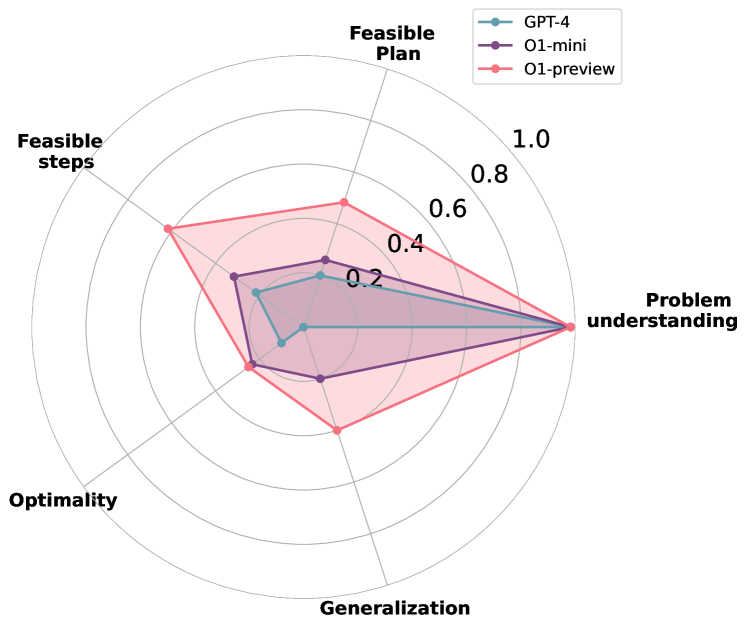
The paper empirically evaluates OpenAI’s o1 models on planning tasks, analyzing feasibility, optimality, and generalizability across multiple benchmarks, and compares them to GPT-4.
Recent advancements in Large Language Models (LLMs) have showcased their ability to perform complex reasoning tasks, but their effectiveness in planning remains underexplored. In this study, we evaluate the planning capabilities of OpenAI's o1 models across a variety of benchmark tasks, focusing on three key aspects: feasibility, optimality, and generalizability. Through empirical evaluations on constraint-heavy tasks (e.g., $ extit{Barman}$, $ extit{Tyreworld}$) and spatially complex environments (e.g., $ extit{Termes}$, $ extit{Floortile}$), we highlight o1-preview's strengths in self-evaluation and constraint-following, while also identifying bottlenecks in decision-making and memory management, particularly in tasks requiring robust spatial reasoning. Our results reveal that o1-preview outperforms GPT-4 in adhering to task constraints and managing state transitions in structured environments. However, the model often generates suboptimal solutions with redundant actions and struggles to generalize effectively in spatially complex tasks. This pilot study provides foundational insights into the planning limitations of LLMs, offering key directions for future research on improving memory management, decision-making, and generalization in LLM-based planning. Code available at https://github.com/VITA-Group/o1-planning.
Motivation & Objective
- Assess how well o1 models generate feasible plans under domain constraints.
- Evaluate the optimality of plans produced by o1 models, focusing on action efficiency and redundancy.
- Examine generalizability of o1 models to unseen or symbolically represented tasks.
- Identify common planning errors and bottlenecks in memory/decision-making.
- Provide directions for improving LLM-based planning through self-evaluation and memory techniques.
Proposed method
- Benchmark a set of planning tasks (Barman, Blocksworld, Floortile, Grippers, Tyreworld, Termes) with GPT-4, o1-mini, and o1-preview.
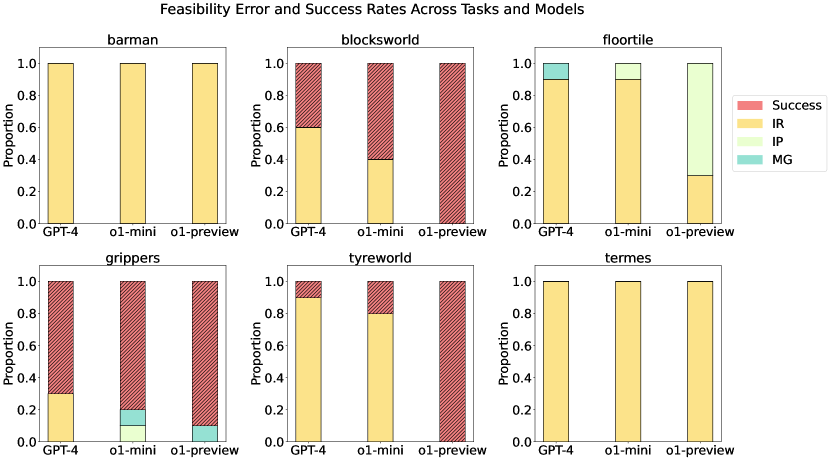
- Categorize errors into feasibility (IR, IP, MG), and optimality (LO); measure success/feasibility, and optimality rates.
- Analyze performance across spatial and action complexity to identify bottlenecks.
- Utilize self-evaluation mechanisms in o1-preview to assess and correct actions during planning.
- Compare generalization by testing with abstract/symbolic task representations (randomized Tyreworld).
- Highlight limitations and propose future directions for memory management, constraint adherence, and generalization.
Experimental results
Research questions
- RQ1How feasible are the plans produced by o1 models across diverse planning domains?
- RQ2Do o1 models produce more optimal (efficient) plans than GPT-4, and where do they still fall short?
- RQ3Can o1 models generalize planning strategies to abstract or symbolically represented tasks?
- RQ4What are the main types of planning errors (IR, IP, MG, LO) observed in o1 models, and how do they vary by domain?
- RQ5What are the key bottlenecks in memory, state management, and spatial reasoning affecting planning performance?
Key findings
- o1-preview generally achieves higher success rates than GPT-4 and o1-mini across several domains, with perfect success in Blocksworld and Tyreworld test sets in some cases.
- o1-preview improves constraint adherence and self-evaluation, yet still exhibits non-optimal plans (LO) and misinterpretations (MG) in complex spaces like Termes.
- GPT-4 often underperforms in constraint following and planning efficiency, especially in more spatially complex tasks.
- Floortile shows widespread failures across all models, with IR errors dominating GPT-4 and o1-mini, while o1-preview reduces IR occurrences but faces other errors.
- Grippers task shows o1-preview achieving up to 90% success and 70% optimality, outperforming GPT-4 and o1-mini in many instances.
- Generalization tests reveal that o1-preview can handle structured generalization (Grippers) better than GPT-4, but performance degrades with abstract symbolic representations (randomized Tyreworld).
Read this paper
Open the full text in the Nubint reader and ask about any passage as you read.
Read this paper on NubintThis review was generated by AI from the original paper. Please check the paper before citing it.