
[Paper Review] On the Robustness of the Backdoor-based Watermarking in Deep Neural Networks
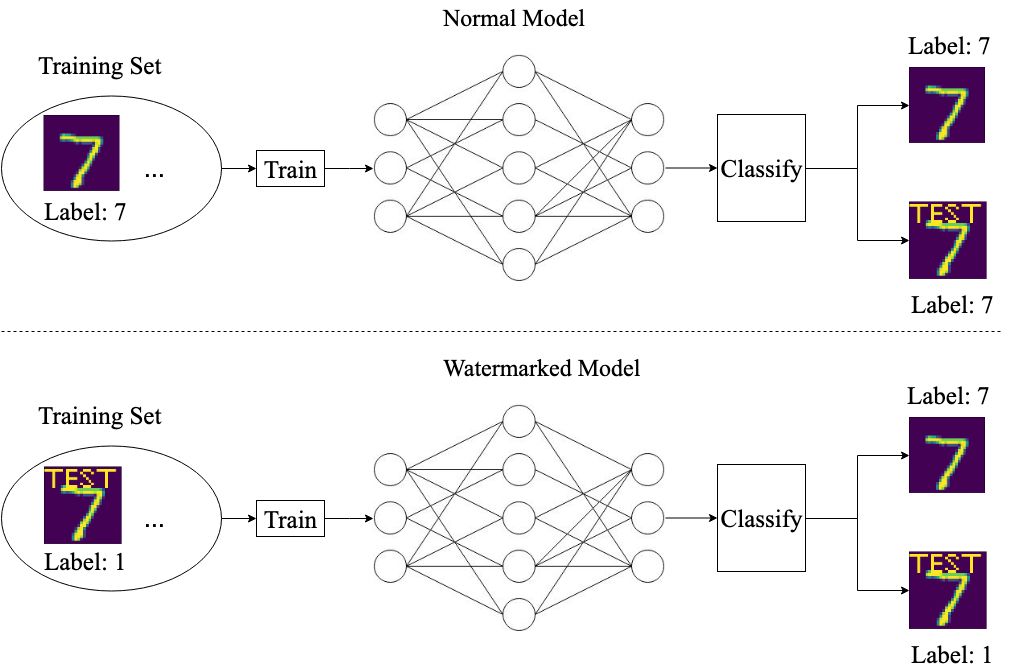
This paper demonstrates that backdoor-based watermarking in deep neural networks is insecure by proposing two effective attacks: a black-box attack using only public unlabeled data and model labels, and a white-box attack using model parameters. Both attacks successfully remove watermarks with minimal accuracy loss, proving that watermarking schemes are vulnerable to removal without access to training data or triggers.
Obtaining the state of the art performance of deep learning models imposes a high cost to model generators, due to the tedious data preparation and the substantial processing requirements. To protect the model from unauthorized re-distribution, watermarking approaches have been introduced in the past couple of years. We investigate the robustness and reliability of state-of-the-art deep neural network watermarking schemes. We focus on backdoor-based watermarking and propose two -- a black-box and a white-box -- attacks that remove the watermark. Our black-box attack steals the model and removes the watermark with minimum requirements; it just relies on public unlabeled data and a black-box access to the classification label. It does not need classification confidences or access to the model's sensitive information such as the training data set, the trigger set or the model parameters. The white-box attack, proposes an efficient watermark removal when the parameters of the marked model are available; our white-box attack does not require access to the labeled data or the trigger set and improves the runtime of the black-box attack up to seventeen times. We as well prove the security inadequacy of the backdoor-based watermarking in keeping the watermark undetectable by proposing an attack that detects whether a model contains a watermark. Our attacks show that a recipient of a marked model can remove a backdoor-based watermark with significantly less effort than training a new model and some other techniques are needed to protect against re-distribution by a motivated attacker.
Motivation & Objective
- To evaluate the robustness and reliability of backdoor-based watermarking schemes in deep neural networks.
- To develop a black-box attack that removes watermarks using only public unlabeled data and model classification labels, without requiring model parameters or labeled data.
- To design a white-box attack that efficiently removes watermarks when model parameters are available, improving runtime over the black-box approach.
- To demonstrate that watermark detection is feasible, exposing the insecurity of backdoor-based watermarking in maintaining undetectability.
- To show that existing backdoor removal techniques are ineffective for watermark removal, necessitating new defenses against motivated attackers.
Proposed method
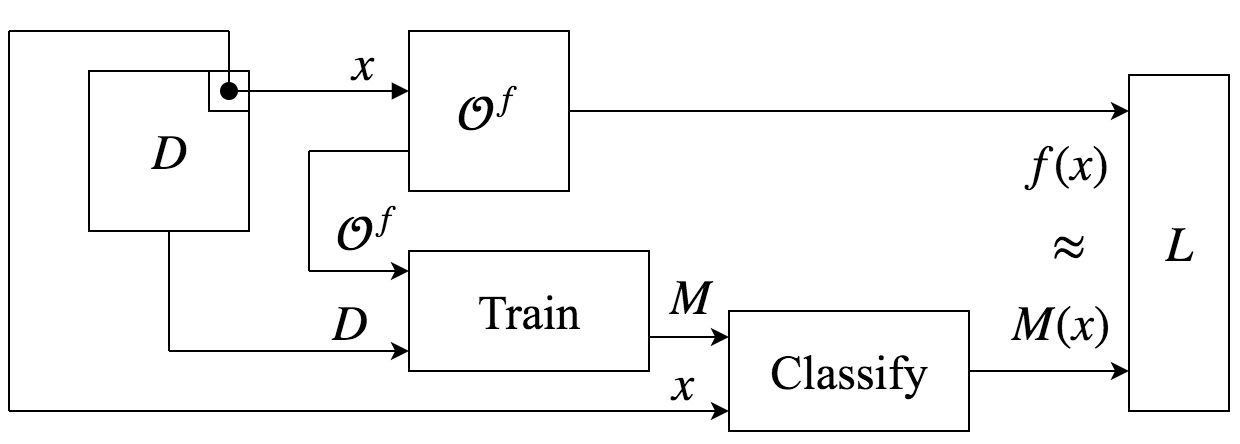
- The black-box attack queries the target model with 20,000–50,000 publicly available, unlabeled inputs from the model’s input distribution and collects only final classification labels.
- The attack uses active learning on the label responses to reconstruct a surrogate model that mimics the original marked model’s behavior.
- The white-box attack leverages access to the model’s parameters to optimize a watermark removal process, significantly reducing runtime compared to the black-box method.
- The attacks do not require access to the original training data, trigger set, or labeled examples, relying solely on inference-time queries or parameter access.
- A property inference attack is introduced to detect whether a model contains a watermark, enabling pre-verification before applying removal techniques.
- The attacks are validated on models with various watermark types: embedded logos, noise patterns, and abstract trigger images, showing generalizability across watermark forms.
Experimental results
Research questions
- RQ1Can a watermark be removed from a deep neural network without access to the original training data or trigger set?
- RQ2How effective is a black-box attack that only uses classification labels and unlabeled data in removing backdoor-based watermarks?
- RQ3Can a white-box attack achieve faster and more accurate watermark removal than black-box methods when model parameters are available?
- RQ4Is it possible to detect the presence of a watermark in a model without prior knowledge of the trigger or training data?
- RQ5Do existing backdoor removal techniques such as Neural-Cleanse or Fine-Pruning apply to watermark removal, and if not, why?
Key findings
- The black-box attack successfully removes watermarks using only 20,000–50,000 unlabeled inputs and classification labels, with negligible accuracy drop.
- The white-box attack reduces runtime by up to 17 times compared to the black-box approach, demonstrating significant efficiency gains with parameter access.
- The property inference attack can reliably distinguish watermarked models from unmarked ones, enabling automated detection of watermark presence.
- Watermark removal is possible without access to the trigger set or labeled data, undermining the security assumptions of backdoor-based watermarking.
- Existing backdoor removal methods like Neural-Cleanse and Fine-Pruning are ineffective for watermark removal due to their reliance on specific trigger patterns or labeled data.
- The results show that watermarking schemes are not robust against motivated attackers, and alternative protection mechanisms are needed to prevent unauthorized redistribution.
Read this paper
Open the full text in the Nubint reader and ask about any passage as you read.
Read this paper on NubintThis review was generated by AI from the original paper. Please check the paper before citing it.