
[Paper Review] On the Variance of Neural Network Training with respect to Test Sets and Distributions
The paper argues that test-set variance across independent training runs is largely due to finite-sample noise and initial-condition sensitivity, while distribution-wise variance is small when trained to convergence; ensemble calibration implies inevitable, but bounded, test-set variance.
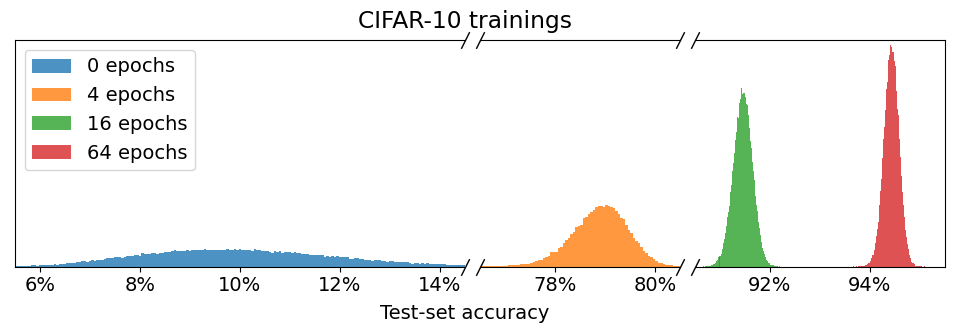
Typical neural network trainings have substantial variance in test-set performance between repeated runs, impeding hyperparameter comparison and training reproducibility. In this work we present the following results towards understanding this variation. (1) Despite having significant variance on their test-sets, we demonstrate that standard CIFAR-10 and ImageNet trainings have little variance in performance on the underlying test-distributions from which their test-sets are sampled. (2) We show that these trainings make approximately independent errors on their test-sets. That is, the event that a trained network makes an error on one particular example does not affect its chances of making errors on other examples, relative to their average rates over repeated runs of training with the same hyperparameters. (3) We prove that the variance of neural network trainings on their test-sets is a downstream consequence of the class-calibration property discovered by Jiang et al. (2021). Our analysis yields a simple formula which accurately predicts variance for the binary classification case. (4) We conduct preliminary studies of data augmentation, learning rate, finetuning instability and distribution-shift through the lens of variance between runs.
Motivation & Objective
- Investigate what causes variance in test-set accuracy between independent training runs.
- Determine whether best-performing runs generalize above average on the test-distribution.
- Identify which hyperparameters or training aspects affect variance.
- Develop a statistical framework linking test-set variance to distribution-wise variance and ensemble calibration.
Proposed method
- Empirically train ~350,000 networks on CIFAR-10 and ImageNet to characterize variance.
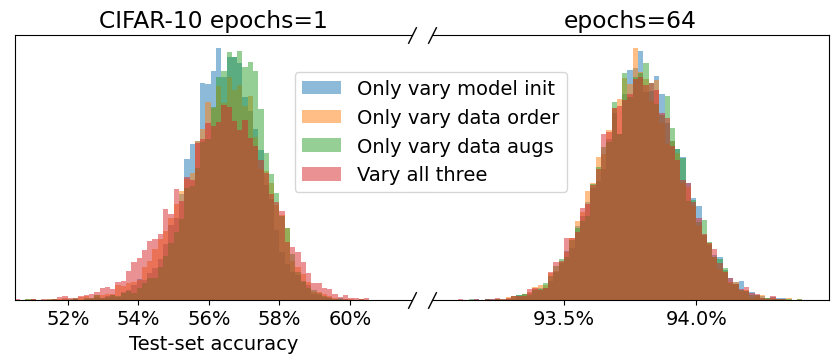
- Control sources of randomness (model init, data order, augmentations) to isolate their effects.
- Propose Hypothesis 1 (example-wise independence) to model test accuracy distribution.
- Derive an unbiased estimator (Equation 2) for distribution-wise variance.
- Theoretically relate test-set variance to ensemble-calibration through Theorems 3–5.
Experimental results
Research questions
- RQ1What causes variance between independent training runs and which randomness source is most responsible?
- RQ2Does selecting the best run on the test-set imply above-average generalization to the test distribution?
- RQ3Which hyperparameters affect test-set variance and distribution-wise variance?
- RQ4Can we estimate distribution-wise variance from finite test samples and relate it to ensemble calibration?
- RQ5How does variance behave under distribution shift, data augmentation, and learning rate changes?
Key findings
- Variance between runs is largely due to extreme sensitivity to initial conditions, not any single randomness source.
- Disjoint test splits decorrelate as training converges, indicating limited genuine variance in distribution-wise accuracy.
- An unbiased estimator shows distribution-wise variance can be as low as ~0.033% for CIFAR-10 and 0.034% for ImageNet after convergence.
- Ensemble calibration implies positive test-set variance between runs for classification tasks.
- BERT-Large finetuning exhibits much higher distribution-wise variance than BERT-Base, indicating model size affects instability.
- Distribution-shifted test-sets show more variance between runs than in-domain sets, and data augmentation reduces variance.
Read this paper
Open the full text in the Nubint reader and ask about any passage as you read.
Read this paper on NubintThis review was generated by AI from the original paper. Please check the paper before citing it.