
[Paper Review] One Law, Many Languages: Benchmarking Multilingual Legal Reasoning for Judicial Support
This paper introduces a multilingual, multi-task legal NLP benchmark—SCALE—featuring Swiss legal documents across five languages, testing long-context understanding, domain-specific knowledge, and multilingual reasoning. Despite extensive in-domain pretraining, even large models achieve only a 48.4% Macro F1 score, highlighting significant challenges in legal reasoning and underscoring the benchmark’s value for advancing LLM capabilities in real-world judicial applications.
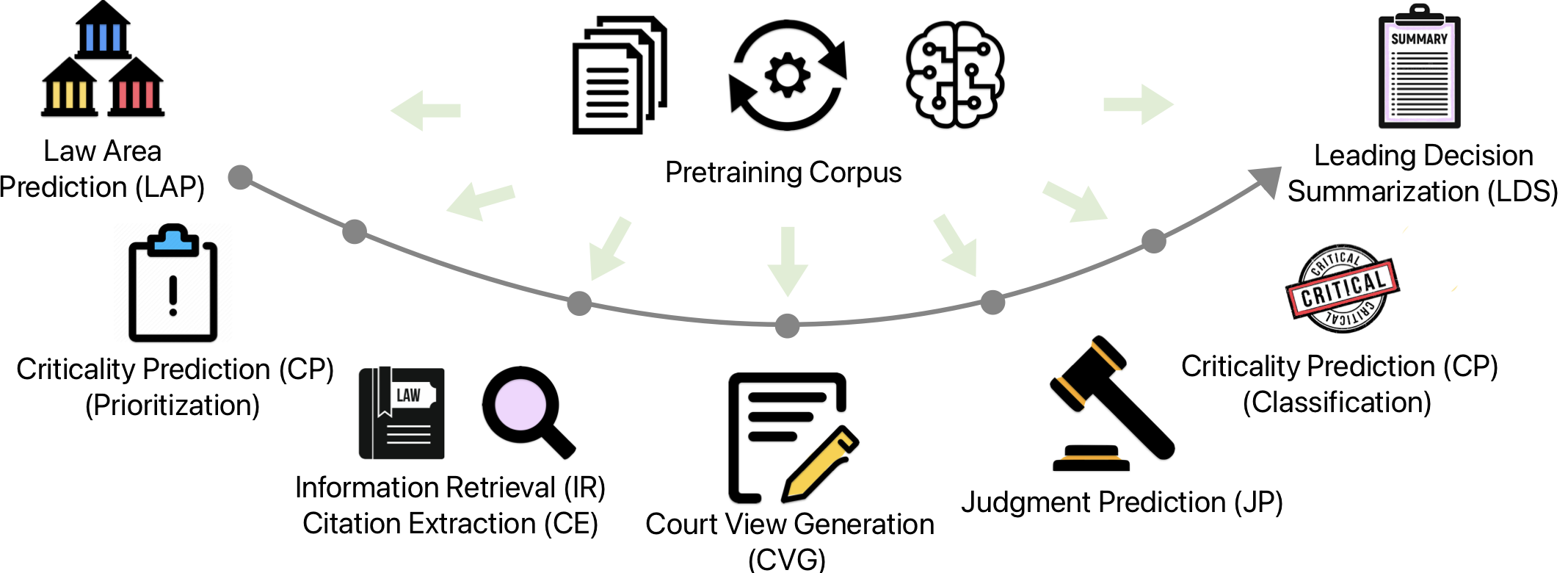
Recent strides in Large Language Models (LLMs) have saturated many Natural Language Processing (NLP) benchmarks, emphasizing the need for more challenging ones to properly assess LLM capabilities. However, domain-specific and multilingual benchmarks are rare because they require in-depth expertise to develop. Still, most public models are trained predominantly on English corpora, while other languages remain understudied, particularly for practical domain-specific NLP tasks. In this work, we introduce a novel NLP benchmark for the legal domain that challenges LLMs in five key dimensions: processing \emph{long documents} (up to 50K tokens), using \emph{domain-specific knowledge} (embodied in legal texts), \emph{multilingual} understanding (covering five languages), \emph{multitasking} (comprising legal document-to-document Information Retrieval, Court View Generation, Leading Decision Summarization, Citation Extraction, and eight challenging Text Classification tasks) and \emph{reasoning} (comprising especially Court View Generation, but also the Text Classification tasks). Our benchmark contains diverse datasets from the Swiss legal system, allowing for a comprehensive study of the underlying non-English, inherently multilingual legal system. Despite the large size of our datasets (some with hundreds of thousands of examples), existing publicly available multilingual models struggle with most tasks, even after extensive in-domain pre-training and fine-tuning. We publish all resources (benchmark suite, pre-trained models, code) under permissive open CC BY-SA licenses.
Motivation & Objective
- To address the lack of comprehensive, multilingual, and domain-specific benchmarks in legal NLP, especially for non-English, high-complexity legal reasoning tasks.
- To evaluate the performance of current LLMs on long-form legal documents (up to 50K tokens) requiring deep legal domain understanding.
- To create a benchmark that spans five languages within a single jurisdiction (Switzerland), enabling rigorous testing of cross-lingual transfer and multilingual generalization.
- To establish strong baselines for future research by evaluating multiple pre-trained multilingual models and training custom Swiss legal models.
- To publish all data, models, and code under a permissive CC BY-SA license to foster open research and reproducibility in legal NLP.
Proposed method
- The benchmark, SCALE, comprises seven diverse legal NLP datasets derived from 26 Swiss cantons and the Swiss Federal Supreme Court (FSCS), covering five official languages.
- Tasks include text classification (Criticality Prediction, Judgment Prediction, Law Area Prediction), information retrieval, and two generative tasks: Court View Generation and Leading Decision Summarization.
- The authors fine-tune and evaluate a range of multilingual pre-trained models, including mBERT, mT5, and their own Legal Swiss RoBERTa and Legal Swiss Longformer models.
- Evaluation uses standard metrics such as Macro F1, BLEU, METEOR, ROUGE, and NDCG, with a focus on long-context processing (up to 50K tokens).
- The study includes in-domain pretraining on Swiss legal corpora to assess the impact of domain-specific fine-tuning on model performance.
- All resources are released under a CC BY-SA license on Hugging Face, ensuring full reproducibility and open access.
Experimental results
Research questions
- RQ1To what extent can current multilingual LLMs generalize across five languages in a complex, multi-jurisdictional legal context like Switzerland?
- RQ2How well do LLMs perform on long-form legal documents (up to 50K tokens) requiring deep reasoning and contextual understanding?
- RQ3Can in-domain pretraining on Swiss legal corpora significantly improve performance on legal text classification and generation tasks?
- RQ4Why do even large, fine-tuned models underperform on critical legal tasks such as Criticality Prediction and Citation Extraction?
- RQ5How do generative models like mT5 and BERT perform on summarization and court view generation when grounded in complex legal reasoning?
Key findings
- The best-performing model achieved only a 48.4% Macro F1 score across all classification tasks, indicating significant room for improvement in legal reasoning.
- ChatGPT performed poorly on text classification tasks, significantly underperforming compared to fine-tuned models, suggesting limitations in zero-shot legal reasoning.
- Results for Criticality Prediction, Information Retrieval, and Court View Generation were particularly weak, appearing arbitrary and inconsistent.
- Even after extensive in-domain pretraining, publicly available multilingual models struggled with most tasks, highlighting the benchmark’s difficulty.
- Generative tasks like Leading Decision Summarization showed mixed results: while some outputs were coherent (e.g., BERT score of 88.03), others were factually inaccurate or off-topic.
- The benchmark revealed that current LLMs lack robustness in handling complex legal reasoning, domain-specific terminology, and cross-lingual generalization in professional legal settings.
Read this paper
Open the full text in the Nubint reader and ask about any passage as you read.
Read this paper on NubintThis review was generated by AI from the original paper. Please check the paper before citing it.