
[Paper Review] OnePose++: Keypoint-Free One-Shot Object Pose Estimation without CAD Models
A keypoint-free SfM and sparse-to-dense 2D-3D matching pipeline that reconstructs semi-dense object point clouds from reference images and estimates pose of query images without CAD models, achieving strong one-shot results on textured and low-textured objects.
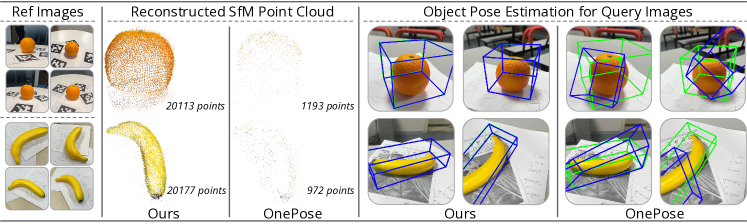
We propose a new method for object pose estimation without CAD models. The previous feature-matching-based method OnePose has shown promising results under a one-shot setting which eliminates the need for CAD models or object-specific training. However, OnePose relies on detecting repeatable image keypoints and is thus prone to failure on low-textured objects. We propose a keypoint-free pose estimation pipeline to remove the need for repeatable keypoint detection. Built upon the detector-free feature matching method LoFTR, we devise a new keypoint-free SfM method to reconstruct a semi-dense point-cloud model for the object. Given a query image for object pose estimation, a 2D-3D matching network directly establishes 2D-3D correspondences between the query image and the reconstructed point-cloud model without first detecting keypoints in the image. Experiments show that the proposed pipeline outperforms existing one-shot CAD-model-free methods by a large margin and is comparable to CAD-model-based methods on LINEMOD even for low-textured objects. We also collect a new dataset composed of 80 sequences of 40 low-textured objects to facilitate future research on one-shot object pose estimation. The supplementary material, code and dataset are available on the project page: https://zju3dv.github.io/onepose_plus_plus/.
Motivation & Objective
- Eliminate dependence on repeatable image keypoints for one-shot object pose estimation.
- Develop a keypoint-free SfM pipeline to reconstruct accurate semi-dense object point clouds from reference views.
- Design a sparse-to-dense 2D-3D matching network for efficient and accurate pose estimation on test images.
- Demonstrate improved performance over CAD-model-free baselines and competitive results with CAD-model-based methods on standard datasets.
- Provide a challenging low-textured object dataset to spur future research in one-shot pose estimation.
Proposed method
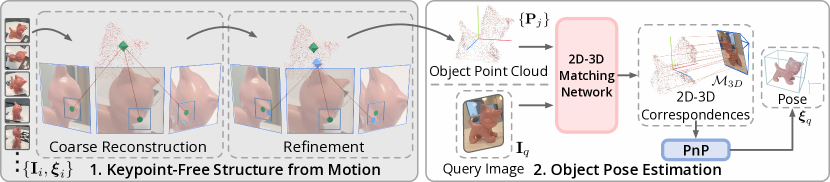
- Adapt LoFTR-style keypoint-free matching into a two-stage SfM framework: coarse reconstruction with repeatable coarse matches to form a complete semi-dense point cloud, followed by refinement of feature tracks and 3D points to sub-pixel accuracy.
- Refine coarse tracks by fixing a reference node per track and performing local sub-pixel refinement, then optimize the 3D point cloud via reprojection errors.
- At test time, perform coarse 2D-3D matching between the query image and the reconstructed point cloud using a Transformer-based cross-attention network, followed by fine 2D-3D matching within local windows to obtain precise correspondences for PnP.
- Use self- and cross-attention with linear attention to model long-range dependencies in 2D-3D matching, and apply a dual-softmax in the coarse stage to obtain robust correspondences.
- Train with a joint loss combining coarse matching focal loss and fine 2D coordinate regression loss, using ground-truth visible 2D-3D correspondences projected from SfM.
Experimental results
Research questions
- RQ1Can a keypoint-free SfM pipeline reconstruct accurate and complete semi-dense 3D object models from a limited set of pose-annotated reference images for one-shot pose estimation?
- RQ2Does a sparse-to-dense 2D-3D matching network, built atop a keypoint-free reconstruction, achieve competitive or superior pose estimation accuracy compared to CAD-model-free baselines and close to CAD-model-based methods on standard datasets?
- RQ3Is the proposed method robust to low-textured objects where keypoint-based methods fail, and can it generalize to unseen objects without per-object training?
- RQ4How does the proposed coarse-to-fine strategy impact completeness of reconstruction and accuracy of pose estimation in real-world AR-like scenarios?
Key findings
- Outperforms existing one-shot CAD-model-free methods by a large margin on OnePose and OnePose-LowTexture datasets.
- Achieves comparable results to CAD-model-based methods on LINEMOD, and substantially better performance on low-textured objects where keypoint-based methods struggle.
- The proposed pipeline runs significantly faster than some baselines (e.g., ~88 ms for a 512x512 query on V100) and provides more accurate semi-dense reconstructions through coarse-to-fine refinement.
- On OnePose-LowTexture, the method shows substantial gains over OnePose and HLoc, highlighting robustness to low-textured regions.
- On LINEMOD, the method outperforms other one-shot baselines and approaches the accuracy of instance-level methods without CAD models or per-object training.
Read this paper
Open the full text in the Nubint reader and ask about any passage as you read.
Read this paper on NubintThis review was generated by AI from the original paper. Please check the paper before citing it.