
[Paper Review] OpenChemIE: An Information Extraction Toolkit For Chemistry Literature
OpenChemIE is an open-source, multimodal information extraction toolkit that stitches together text, tables, and figures to extract detailed chemical reactions from literature, achieving strong module-level performance and 69.5% F1 on a curated substrate-scope dataset and 64.3% accuracy against Reaxys.
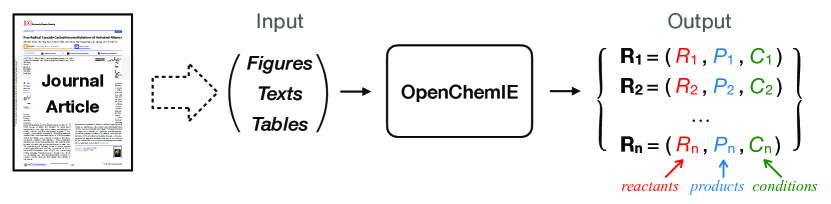
Information extraction from chemistry literature is vital for constructing up-to-date reaction databases for data-driven chemistry. Complete extraction requires combining information across text, tables, and figures, whereas prior work has mainly investigated extracting reactions from single modalities. In this paper, we present OpenChemIE to address this complex challenge and enable the extraction of reaction data at the document level. OpenChemIE approaches the problem in two steps: extracting relevant information from individual modalities and then integrating the results to obtain a final list of reactions. For the first step, we employ specialized neural models that each address a specific task for chemistry information extraction, such as parsing molecules or reactions from text or figures. We then integrate the information from these modules using chemistry-informed algorithms, allowing for the extraction of fine-grained reaction data from reaction condition and substrate scope investigations. Our machine learning models attain state-of-the-art performance when evaluated individually, and we meticulously annotate a challenging dataset of reaction schemes with R-groups to evaluate our pipeline as a whole, achieving an F1 score of 69.5%. Additionally, the reaction extraction results of \ours attain an accuracy score of 64.3% when directly compared against the Reaxys chemical database. We provide OpenChemIE freely to the public as an open-source package, as well as through a web interface.
Motivation & Objective
- Motivate up-to-date reaction data curation for data-driven chemistry and reduce reliance on manual extraction.
- Develop a document-level extraction system that combines multimodal information to recover complete reactions.
- Build chemistry-aware modules for figure, text, and table parsing and integrate them through coreference, alignment, and R-group resolution.
- Provide an open-source toolkit and public web interface to facilitate broader adoption and evaluation.
Proposed method
- Decompose extraction into modality-specific components: figure analysis (molecule detection, coreference, diagram parsing, molecule recognition), text analysis (named entity recognition, reaction extraction), and multimodal integration (R-group resolution, reaction condition alignment).
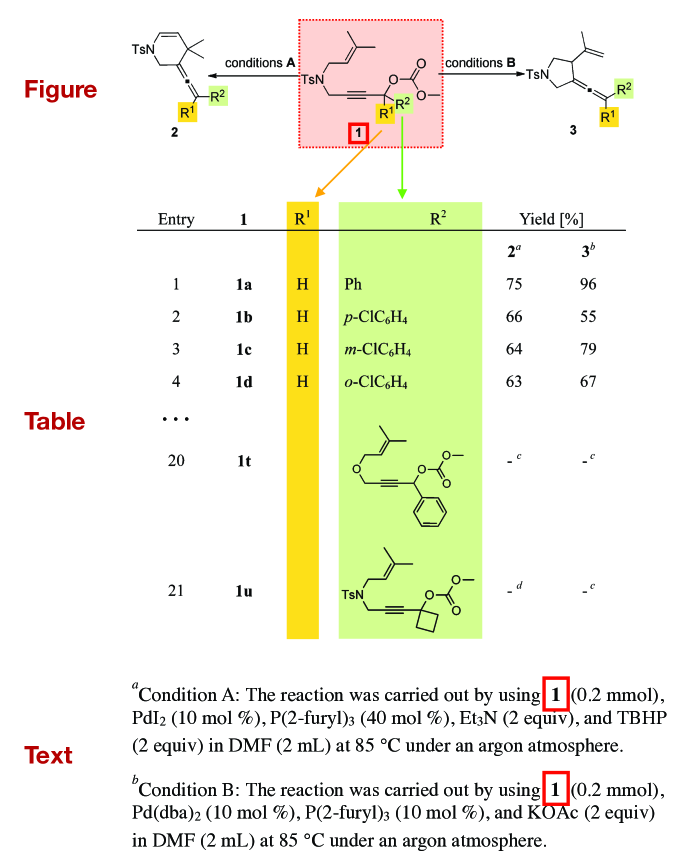
- Represent outputs in a unified pipeline to obtain a final list of reactions with reactants, products, and conditions; align conditions from tables with figures and substitute R-groups using substrate scope information.
- Use MolDetect, MolCoref, RxnScribe, MolScribe, ChemNER, and ChemRxnExtractor as specialized neural modules; fuse outputs via chemistry-informed algorithms for condition alignment and R-group resolution.
- Annotate a dataset of 1007 reactions from 78 substrate scope figures across five journals to evaluate the end-to-end pipeline; compare against Reaxys for external validation.
Experimental results
Research questions
- RQ1Can multimodal integration across figures, tables, and text yield more complete reaction data than per-modality extraction alone?
- RQ2How effective are chemistry-informed alignment and R-group resolution techniques in recovering full reaction structures from substrate scope diagrams?
- RQ3What is the end-to-end performance of OpenChemIE on a manually annotated dataset and on external databases (e.g., Reaxys)?
Key findings
- OpenChemIE achieves an end-to-end F1 score of 69.5% on the annotated substrate scope dataset.
- OpenChemIE attains 64.3% accuracy when comparing extracted reactions against Reaxys.
- The annotated dataset comprises 1007 reactions from 78 substrate scope figures across five journals, illustrating the pipeline’s coverage.
- Individual modules show strong benchmarks: MolCoref F1 around 90.1%, RxnScribe F1 around 91.0%, MolDetect AP 86.0, MolScribe accuracy 71.9%, ChemNER F1 around 87.6–88.1%, ChemRxnExtractor F1 around 78.7%.
- End-to-end errors largely stem from molecule recognition and OCR; R-group resolution contributes modestly to errors.
Read this paper
Open the full text in the Nubint reader and ask about any passage as you read.
Read this paper on NubintThis review was generated by AI from the original paper. Please check the paper before citing it.