
[Paper Review] Optimization or Architecture: How to Hack Kalman Filtering
This paper introduces the Optimized Kalman Filter (OKF), which improves standard Kalman filtering by directly optimizing process and measurement noise parameters via supervised learning instead of relying on traditional noise estimation. OKF achieves superior performance over both standard KF and neural network-based Kalman filters in multiple benchmarks, demonstrating that the perceived advantage of non-linear models often stems from flawed experimental baselines where KF is not optimized fairly.
In non-linear filtering, it is traditional to compare non-linear architectures such as neural networks to the standard linear Kalman Filter (KF). We observe that this mixes the evaluation of two separate components: the non-linear architecture, and the parameters optimization method. In particular, the non-linear model is often optimized, whereas the reference KF model is not. We argue that both should be optimized similarly, and to that end present the Optimized KF (OKF). We demonstrate that the KF may become competitive to neural models - if optimized using OKF. This implies that experimental conclusions of certain previous studies were derived from a flawed process. The advantage of OKF over the standard KF is further studied theoretically and empirically, in a variety of problems. Conveniently, OKF can replace the KF in real-world systems by merely updating the parameters.
Motivation & Objective
- To address the flawed comparison between non-linear models (e.g., neural networks) and the standard Kalman Filter (KF), where the KF is typically not optimized while non-linear models are.
- To demonstrate that the standard KF's performance is suboptimal when assumptions like i.i.d. Gaussian noise are violated, rendering noise estimation ineffective as a proxy for MSE optimization.
- To propose a fairer benchmarking methodology by optimizing the KF using the same supervised learning process as non-linear models.
- To show that the KF, when properly optimized, can outperform neural network-based Kalman filters in real-world filtering tasks, challenging the perceived necessity of non-linear architectures.
Proposed method
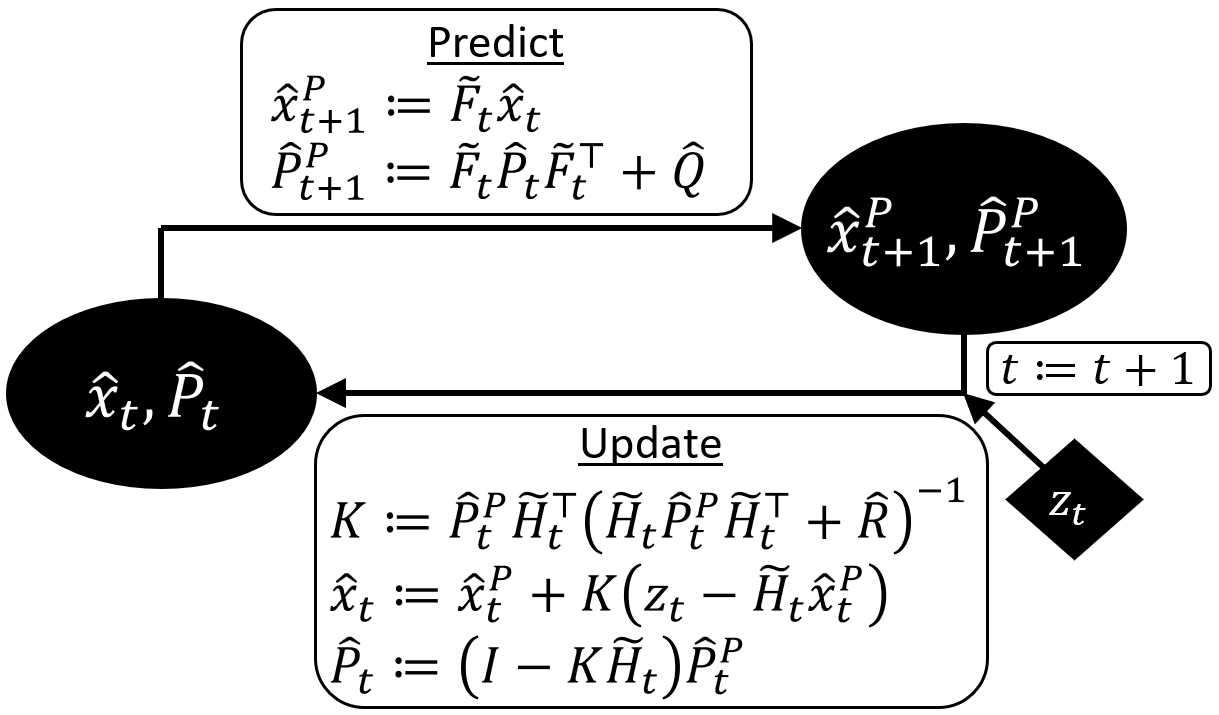
- Propose the Optimized Kalman Filter (OKF), which retains the linear KF architecture but replaces traditional noise estimation with end-to-end supervised optimization of process (Q) and measurement (R) noise parameters.
- Train OKF using mean squared error (MSE) loss between predicted and true states, using labeled training data that includes both observations and ground-truth states.
- Apply the same optimization procedure used for neural network-based Kalman filters (e.g., NKF) to the standard KF, ensuring a fair comparison between linear and non-linear models.
- Implement OKF as a plug-in replacement for standard KF by updating only the noise parameters, enabling drop-in integration into real-world systems.
- Use both synthetic and real-world datasets, including Doppler radar and motion tracking tasks, to evaluate performance under distributional shifts and varying data sizes.
- Compare OKF against standard KF, neural KF (NKF), and variants like aKF and NKFH, using metrics including MSE and Negative Log-Likelihood (NLL).

Experimental results
Research questions
- RQ1Does the standard Kalman Filter’s performance degrade when its noise parameters are estimated via traditional methods under violated modeling assumptions?
- RQ2Can a linear Kalman Filter outperform non-linear neural network-based Kalman filters if both are trained using the same supervised optimization objective?
- RQ3To what extent does noise estimation serve as a valid proxy for MSE optimization in non-linear filtering scenarios?
- RQ4How does the performance of the KF change when optimized via supervised learning versus traditional estimation, especially under distributional shifts?
- RQ5What are the implications of using non-optimized KF baselines in prior studies claiming superiority of non-linear models in filtering tasks?
Key findings
- OKF outperforms the standard KF in all evaluated benchmarks, including free-motion and constant-acceleration scenarios, demonstrating that standard KF tuning is suboptimal.
- In the free-motion benchmark, OKF achieves the lowest MSE and NLL, outperforming even the more complex NKF and NKFH models, which suffer from high NLL and instability.
- In the Const_a benchmark, OKF is outperformed only by NKFH in MSE, but NKFH exhibits extremely high NLL, indicating poor probabilistic calibration.
- The standard KF’s performance degrades with more data when noise estimation is used, contradicting the assumption that more data always improves estimation.
- Even under oracle noise estimation, MSE optimization cannot be reliably achieved, highlighting the fundamental mismatch between noise estimation and MSE minimization.
- The study reveals that prior conclusions favoring non-linear models in filtering tasks are often invalid due to unfair comparisons where the KF was not optimized.
Read this paper
Open the full text in the Nubint reader and ask about any passage as you read.
Read this paper on NubintThis review was generated by AI from the original paper. Please check the paper before citing it.