
[Paper Review] Orbit: A Unified Simulation Framework for Interactive Robot Learning Environments
Orbit is an open-source, GPU-accelerated simulation framework built on NVIDIA Isaac Sim that unifies high-fidelity physics, photorealistic rendering, and modular robot-environment interaction for scalable robot learning. It enables fast training of reinforcement learning policies and efficient collection of demonstration data across 16 robotic platforms, 10 motion generators, and 20+ benchmark tasks with support for diverse sensors and sim-to-real deployment.
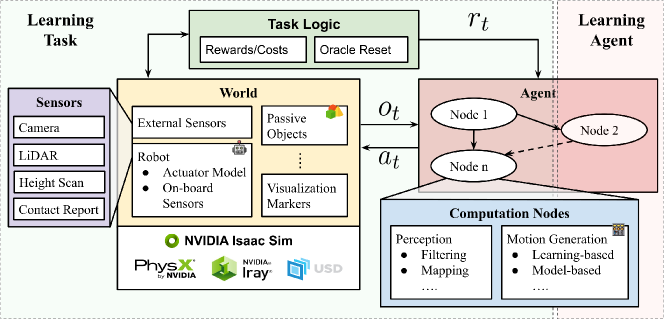
We present Orbit, a unified and modular framework for robot learning powered by NVIDIA Isaac Sim. It offers a modular design to easily and efficiently create robotic environments with photo-realistic scenes and high-fidelity rigid and deformable body simulation. With Orbit, we provide a suite of benchmark tasks of varying difficulty -- from single-stage cabinet opening and cloth folding to multi-stage tasks such as room reorganization. To support working with diverse observations and action spaces, we include fixed-arm and mobile manipulators with different physically-based sensors and motion generators. Orbit allows training reinforcement learning policies and collecting large demonstration datasets from hand-crafted or expert solutions in a matter of minutes by leveraging GPU-based parallelization. In summary, we offer an open-sourced framework that readily comes with 16 robotic platforms, 4 sensor modalities, 10 motion generators, more than 20 benchmark tasks, and wrappers to 4 learning libraries. With this framework, we aim to support various research areas, including representation learning, reinforcement learning, imitation learning, and task and motion planning. We hope it helps establish interdisciplinary collaborations in these communities, and its modularity makes it easily extensible for more tasks and applications in the future.
Motivation & Objective
- To address the lack of a unified, modular, and high-fidelity simulation framework that supports diverse robotic platforms, sensor modalities, and learning paradigms in robot learning research.
- To reduce the barrier to entry for researchers by providing a standardized, extensible platform that integrates realistic physics, rendering, and sensor simulation.
- To enable efficient training and data collection for reinforcement learning and imitation learning through GPU-based parallelization and real-time simulation.
- To support sim-to-real transfer by ensuring accurate contact dynamics and compatibility with real-world robot stacks like ROS and ZMQ-based control pipelines.
- To establish a common foundation for interdisciplinary collaboration in representation learning, task and motion planning, and robot learning by open-sourcing a comprehensive framework.
Proposed method
- Leverages NVIDIA Isaac Sim’s PhysX 5 and Omniverse RTX rendering engines to enable high-fidelity, real-time simulation of rigid and deformable bodies with photo-realistic visuals.
- Employs a modular architecture with reusable components for robotic platforms, sensors, motion generators, and environment assets, enabling rapid task and environment composition.
- Uses GPU-accelerated physics and sensor simulation to achieve high throughput—up to 125,000 simulation steps per second—enabling fast policy training and data collection.
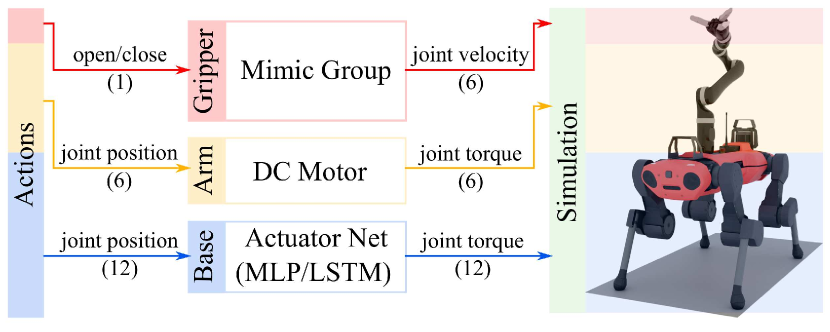
- Integrates CPU and GPU-based motion generators (e.g., inverse kinematics, MPC, pre-trained locomotion policies) to support diverse action spaces and control strategies.
- Supports sim-to-real deployment via ZMQ-based communication and 1000 Hz command upsampling for real-time control, validated on Franka Emika and ANYmal-D robots.
- Provides standardized benchmark tasks across rigid and deformable manipulation (e.g., cabinet opening, cloth folding, room reorganization), with support for multiple sensor modalities and observation spaces.
Experimental results
Research questions
- RQ1Can a unified simulation framework efficiently support diverse robotic platforms, sensor modalities, and learning paradigms such as reinforcement learning and imitation learning?
- RQ2To what extent does high-fidelity physics and rendering in simulation enable successful sim-to-real transfer for contact-rich manipulation and locomotion tasks?
- RQ3How effectively can GPU-accelerated simulation enable scalable data collection and policy training for complex robotic tasks?
- RQ4Can a modular, extensible framework reduce development overhead and accelerate research in robot learning across different application domains?
- RQ5How does the integration of physically based sensors and noise models improve the realism and generalization of learned policies?
Key findings
- Orbit enables training and evaluation of complete robotic systems at scale, with simulation throughput reaching up to 125,000 steps per second on a single GPU.
- The framework supports 16 robotic platforms, including fixed-arm, mobile manipulators, and quadrupeds, with 10 GPU and CPU-based motion generators for diverse control strategies.
- Sim-to-real deployment was successfully demonstrated on a Franka Emika robot using ZMQ and 1000 Hz command upsampling, achieving stable real-time control.
- An RL policy for ANYmal-D locomotion was trained in simulation and deployed on the real robot using the ANYmal ROS stack, confirming the fidelity of contact dynamics in Orbit.
- Camera rendering is currently limited to ~270 FPS for ten 640×480 RGB cameras on an RTX 3090, though ongoing GPU acceleration efforts aim to improve this bottleneck.
- The framework includes more than 20 benchmark tasks—11 in rigid object manipulation and 13 in deformable object manipulation—providing a standardized testbed for evaluating robot learning algorithms.
Read this paper
Open the full text in the Nubint reader and ask about any passage as you read.
Read this paper on NubintThis review was generated by AI from the original paper. Please check the paper before citing it.