
[Paper Review] Origin and magnitude of 'designer' spin-orbit interaction in graphene on semiconducting transition metal dichalcogenides
This paper demonstrates that graphene on semiconducting transition metal dichalcogenides (TMDs) exhibits an ultra-strong, robust, and interface-induced spin-orbit interaction (SOI), with spin relaxation times as short as ~0.2 ps. The SOI arises from band structure modifications rather than disorder, confirmed by gate-tunable Shubnikov-de Haas oscillations showing a ~10 meV splitting, making graphene-on-TMD a promising platform for spin- and valley-Hall effects.
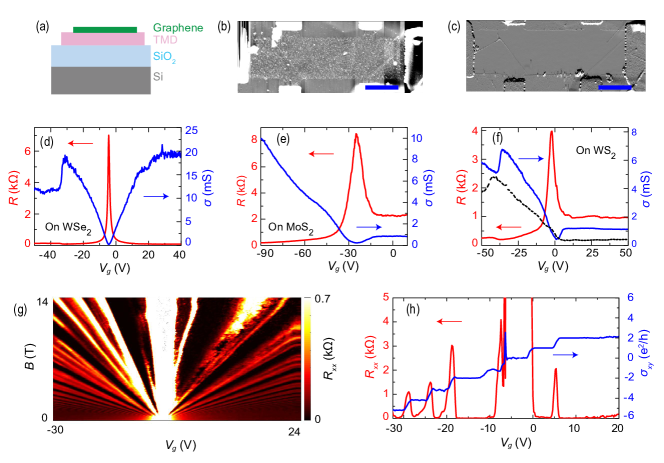
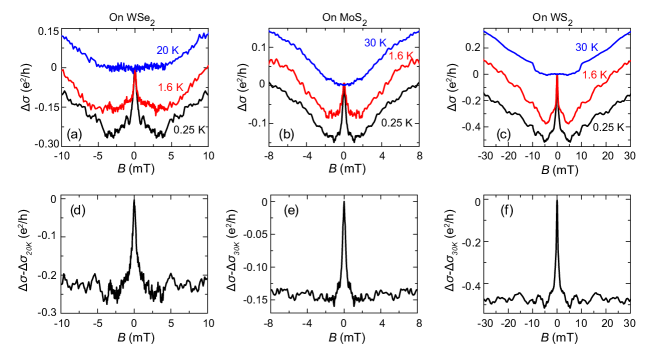
We use a combination of experimental techniques to demonstrate a general occurrence of spin-orbit interaction (SOI) in graphene on transition metal dichalcogenide (TMD) substrates. Our measurements indicate that SOI is ultra-strong and extremely robust, despite it being merely interfacially-induced, with neither graphene nor the TMD substrates changing their structure. This is found to be the case irrespective of the TMD material used, of the transport regime, of the carrier type in the graphene band, and of the thickness of the graphene multilayer. Specifically, we perform weak antilocalization measurements as the simplest and most general diagnostic of SOI, and show that the spin relaxation time is very short in all cases regardless of the elastic scattering time. Such a short spin-relaxation time strongly suggests that the SOI originates from a modification of graphene band structure. We confirmed this expectation by measuring a gate-dependent beating, and a corresponding frequency splitting, in the low-field Shubnikov-de Haas magneto-resistance oscillations in high quality bilayer graphene on WSe$_2$. These measurements provide an unambiguous diagnostic of a SOI-induced splitting in the electronic band structure, and their analysis allows us to determine the SOI coupling constants for the Rashba term and the so-called spin-valley coupling term, i.e., the terms that were recently predicted theoretically for interface-induced SOI in graphene. The magnitude of the SOI splitting is found to be on the order of 10 meV, more than 100 times greater than the SOI intrinsic to graphene. Both the band character of the interfacially induced SOI, as well as its robustness and large magnitude make graphene-on-TMD a promising system to realize and explore a variety of spin-dependent transport phenomena, such as, in particular, spin-Hall and valley-Hall topological insulating states.
Motivation & Objective
- To determine the origin and magnitude of the 'designer' spin-orbit interaction (SOI) in graphene on semiconducting transition metal dichalcogenides (TMDs).
- To establish whether the observed SOI is a generic, robust phenomenon across different TMD materials and graphene configurations.
- To distinguish between disorder-driven and band-structure-driven SOI mechanisms in these heterostructures.
- To quantify the strength of the Rashba and spin-valley coupling terms in the induced SOI using transport measurements.
- To explore the potential of graphene-on-TMD as a platform for realizing spin-Hall and valley-Hall topological states.
Proposed method
- Conducting weak antilocalization (WAL) measurements to probe spin-orbit coupling strength via spin relaxation time extraction.
- Measuring gate-dependent Shubnikov-de Haas (SdH) magneto-resistance oscillations in high-quality bilayer graphene on WSe₂ to detect band structure splitting.
- Analyzing the frequency splitting in SdH oscillations to extract the Rashba and spin-valley coupling constants.
- Using a theoretical model based on the Dirac Hamiltonian with spin-orbit terms to interpret experimental data.
- Comparing spin relaxation times across devices with varying elastic scattering times to isolate intrinsic SOI effects.
- Applying the Hikami-Larkin-Nagaoka (HLN) formula to fit WAL data and extract spin relaxation time τ_so.
Experimental results
Research questions
- RQ1What is the microscopic origin of the ultra-strong spin-orbit interaction in graphene on TMD substrates?
- RQ2Is the observed spin-orbit coupling a generic feature of graphene-on-TMD heterostructures, independent of TMD material, carrier type, or graphene thickness?
- RQ3Does the spin-orbit interaction arise from band structure modification or from disorder scattering?
- RQ4What are the quantitative values of the Rashba and spin-valley coupling terms induced at the graphene-TMD interface?
- RQ5Can the strength of the induced SOI be tuned via electrostatic gating, and what does this imply for topological spintronic applications?
Key findings
- The spin relaxation time τ_so is consistently ≤ 0.2 ps across all devices, regardless of elastic scattering time, indicating a robust, intrinsic SOI mechanism.
- The observed SOI is not disorder-driven, as τ_so remains short even when elastic scattering time varies by nearly two orders of magnitude.
- Gate-dependent SdH oscillations in bilayer graphene on WSe₂ reveal a frequency splitting of ~10 meV, directly evidencing a band structure modification due to SOI.
- The Rashba and spin-valley coupling terms are quantitatively extracted, confirming their role in the interface-induced SOI.
- The magnitude of the SOI splitting is ~10 meV, exceeding the intrinsic SOI in graphene by over 100 times.
- The SOI is universal across different TMD materials, carrier types, and graphene multilayer thicknesses, indicating a robust, interface-specific effect.
Read this paper
Open the full text in the Nubint reader and ask about any passage as you read.
Read this paper on NubintThis review was generated by AI from the original paper. Please check the paper before citing it.