
[Paper Review] Overview and Comparison of Gate Level Quantum Software Platforms
This paper provides a comprehensive, comparative analysis of four leading gate-level quantum software platforms—Forest (pyQuil), Qiskit, ProjectQ, and the Quantum Developer Kit (Q#)—evaluating their installation, syntax, library support, simulators, and hardware integration. It offers researchers a practical, up-to-date guide to selecting the most suitable platform based on performance, ecosystem, and target hardware capabilities.
Quantum computers are available to use over the cloud, but the recent explosion of quantum software platforms can be overwhelming for those deciding on which to use. In this paper, we provide a current picture of the rapidly evolving quantum computing landscape by comparing four software platforms---Forest (pyQuil), Qiskit, ProjectQ, and the Quantum Developer Kit (Q\#)---that enable researchers to use real and simulated quantum devices. Our analysis covers requirements and installation, language syntax through example programs, library support, and quantum simulator capabilities for each platform. For platforms that have quantum computer support, we compare hardware, quantum assembly languages, and quantum compilers. We conclude by covering features of each and briefly mentioning other quantum computing software packages.
Motivation & Objective
- Address the growing complexity and fragmentation in quantum software platforms, which hinders researchers and students in selecting appropriate tools.
- Provide a practical, up-to-date comparison of the most prominent gate-level quantum software platforms to guide tool selection.
- Evaluate key criteria including installation, syntax, library support, simulator performance, and real quantum hardware access.
- Highlight differences in quantum compilers, assembly languages, and support for real devices across platforms.
- Offer a decision framework for researchers to choose the most suitable platform based on their computational needs and target hardware.
Proposed method
- Select four major gate-level quantum software platforms with real hardware access: Forest (pyQuil), Qiskit, ProjectQ, and Microsoft's Quantum Developer Kit (Q#).
- Evaluate each platform across multiple dimensions: installation requirements, syntax through example programs (e.g., quantum teleportation), and library support.
- Benchmark and compare quantum simulators using standardized quantum circuits, including performance metrics and resource usage.
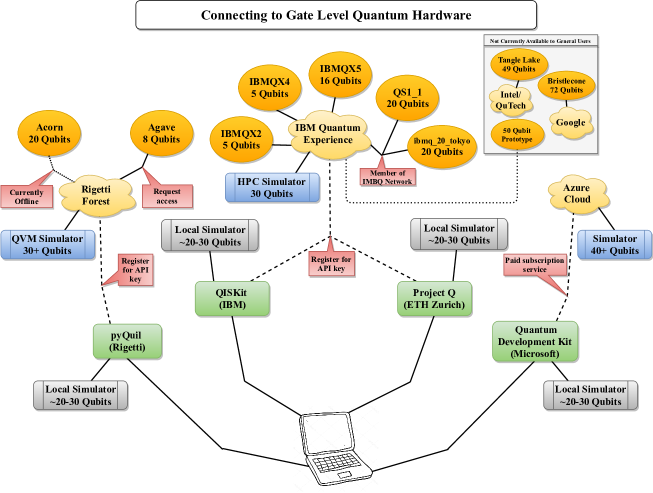
- Analyze hardware support, including available quantum processors (e.g., 8-qubit Rigetti, 16-qubit IBM), access policies, and quantum assembly languages.
- Examine quantum compilers and optimization capabilities, including circuit transpilation and native gate mapping.
- Include side-by-side code examples (e.g., quantum teleportation) in all four platforms to illustrate syntax and abstraction differences.
Experimental results
Research questions
- RQ1Which quantum software platform offers the most intuitive and readable syntax for implementing standard quantum algorithms?
- RQ2How do the performance characteristics of local and cloud-based quantum simulators compare across the four platforms?
- RQ3What is the extent and maturity of quantum algorithm library support in each platform?
- RQ4How do the quantum compilers and hardware mapping capabilities differ in terms of circuit optimization and gate fidelity?
- RQ5What are the practical barriers to accessing real quantum hardware, and how do the platforms differ in access requirements and device availability?
Key findings
- Qiskit offers the most comprehensive documentation and tutorials, making it the most accessible for beginners and researchers new to quantum computing.
- Forest (pyQuil) provides strong integration with Rigetti’s 8-qubit quantum processor and supports custom gate definitions, though access is limited to approved users.
- ProjectQ features a highly expressive, gate-level syntax using Python operators and supports advanced circuit optimization through its compiler stack.
- The Quantum Developer Kit (Q#) stands out for its integration with Visual Studio and strong classical-quantum hybrid programming support, though it currently lacks access to real quantum hardware.
- Simulator performance varies significantly: Qiskit’s local QASM simulator is fast for small circuits, while ProjectQ’s simulator supports high-qubit counts with efficient state-vector simulation.
- All platforms support the quantum teleportation circuit, but Q# and ProjectQ provide clearer classical control flow for conditional operations, while Qiskit and pyQuil require more verbose syntax for measurement-based feedback.
Read this paper
Open the full text in the Nubint reader and ask about any passage as you read.
Read this paper on NubintThis review was generated by AI from the original paper. Please check the paper before citing it.