
[Paper Review] $PC^2$: Projection-Conditioned Point Cloud Diffusion for Single-Image 3D Reconstruction
This paper proposes $\mathbf{PC}^2$, a diffusion-based method for single-image 3D reconstruction that generates high-resolution sparse point clouds by iteratively denoising random 3D points conditioned on image features projected from the input view. The key innovation—projection conditioning—ensures geometric consistency with the input image, enabling high-fidelity, diverse, and color-accurate reconstructions on both synthetic and real-world data.
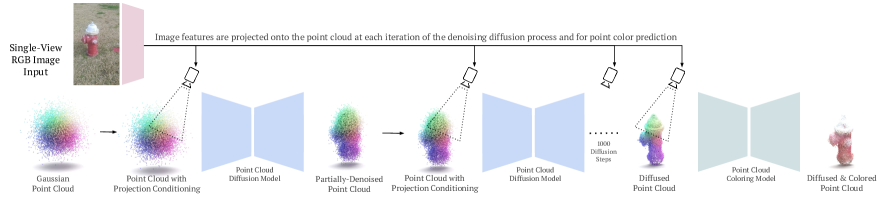
Reconstructing the 3D shape of an object from a single RGB image is a long-standing and highly challenging problem in computer vision. In this paper, we propose a novel method for single-image 3D reconstruction which generates a sparse point cloud via a conditional denoising diffusion process. Our method takes as input a single RGB image along with its camera pose and gradually denoises a set of 3D points, whose positions are initially sampled randomly from a three-dimensional Gaussian distribution, into the shape of an object. The key to our method is a geometrically-consistent conditioning process which we call projection conditioning: at each step in the diffusion process, we project local image features onto the partially-denoised point cloud from the given camera pose. This projection conditioning process enables us to generate high-resolution sparse geometries that are well-aligned with the input image, and can additionally be used to predict point colors after shape reconstruction. Moreover, due to the probabilistic nature of the diffusion process, our method is naturally capable of generating multiple different shapes consistent with a single input image. In contrast to prior work, our approach not only performs well on synthetic benchmarks, but also gives large qualitative improvements on complex real-world data.
Motivation & Objective
- Address the long-standing challenge of single-image 3D reconstruction, which is ill-posed due to limited 2D input and the need for plausible 3D shape priors.
- Overcome limitations of prior methods that produce low-resolution geometries, struggle with fine details, or lack diversity in reconstructions.
- Leverage the probabilistic nature of diffusion models to generate multiple plausible 3D shapes from a single input image, enabling uncertainty-aware reconstruction.
- Develop a conditioning mechanism that ensures geometric consistency between the reconstructed 3D shape and the input image across all diffusion steps.
- Extend the method to predict point colors after shape reconstruction using the same projection conditioning mechanism.
Proposed method
- Represent 3D shapes as unstructured sparse point clouds, initialized with random 3D points sampled from a 3D Gaussian distribution.
- Apply a conditional denoising diffusion process that gradually refines the point cloud toward a shape consistent with the input RGB image and camera pose.
- Introduce projection conditioning: at each denoising step, project image features (from a CNN backbone) onto the current partially-denoised point cloud using the known camera pose.
- Use the projected features to guide the denoising network in refining point positions, ensuring geometric alignment with the input image.
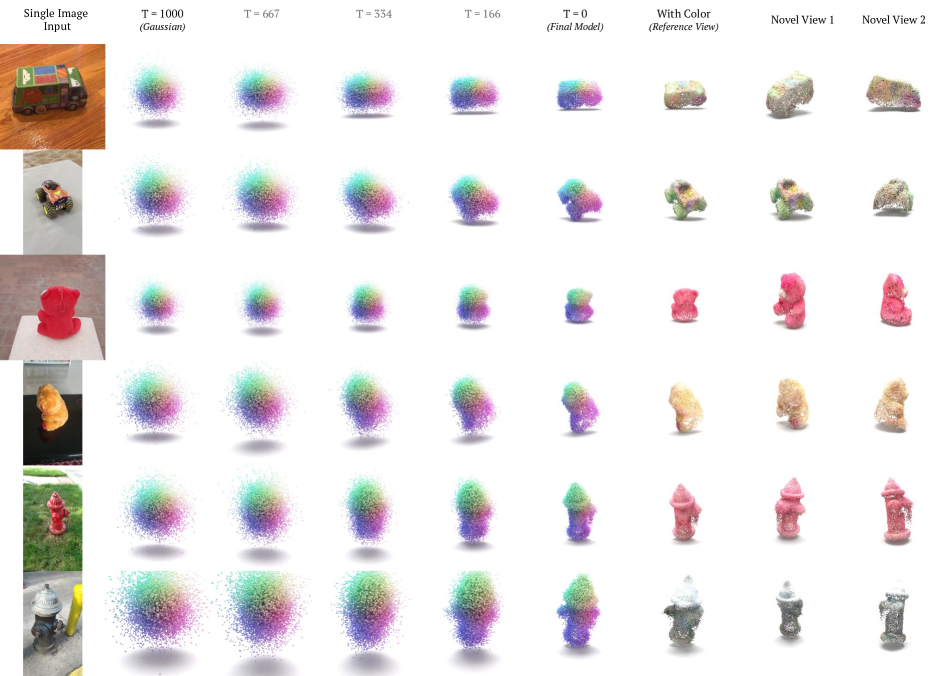
- After shape reconstruction, reuse the same projection mechanism to predict colors for each point using image features projected onto the final 3D point cloud.
- Enable diverse generation by sampling multiple times from the diffusion model and apply a filtering step based on mask IoU to select the best reconstruction.
Experimental results
Research questions
- RQ1Can a diffusion model conditioned on image features projected onto a 3D point cloud produce high-fidelity, geometrically consistent 3D reconstructions from a single RGB image?
- RQ2How does projection conditioning improve geometric alignment and reconstruction quality compared to alternative conditioning mechanisms in 3D diffusion models?
- RQ3Can the probabilistic nature of diffusion models be leveraged to generate diverse, plausible 3D shapes from a single input image, and how can this diversity be effectively filtered to improve performance?
- RQ4To what extent can the same projection conditioning mechanism be used to predict accurate point colors after shape reconstruction?
- RQ5How does the method generalize to complex, real-world images beyond synthetic benchmarks like ShapeNet?
Key findings
- With filtering, $\mathbf{PC}^2$-FM achieves state-of-the-art performance on the ShapeNet-R2N2 benchmark, outperforming prior methods on average and across most categories, especially for fine-grained objects like rifles and airplanes.
- The method produces qualitatively superior results on the real-world Co3D dataset, generating detailed, view-consistent 3D shapes that are not blurry or ambiguous in novel views.
- Filtering based on mask IoU significantly improves performance: $\mathbf{PC}^2$-FM with 10 samples achieves a mean F-score of 0.786 on ShapeNet, outperforming the oracle in some categories.
- Using just two images in the filtering process yields substantial performance gains, with diminishing returns as more samples are added.
- The model generates diverse, plausible 3D shapes for ambiguous inputs (e.g., chairs with missing backrests), demonstrating its ability to capture uncertainty in reconstruction.
- The method is robust to noisy ground-truth point clouds, such as those with holes from incomplete multi-view reconstruction, indicating practical viability on real-world data.
Read this paper
Open the full text in the Nubint reader and ask about any passage as you read.
Read this paper on NubintThis review was generated by AI from the original paper. Please check the paper before citing it.