
[Paper Review] Performance of Double-Stacked Intelligent Metasurface-Assisted Multiuser Massive MIMO Communications in the Wave Domain
Proposes a two-stack intelligent metasurface (SIM) architecture for uplink multiuser mMIMO, derives closed-form uplink SE under imperfect CSI, and optimizes BS-side and intermediate-space SIM phase shifts with PGAM.
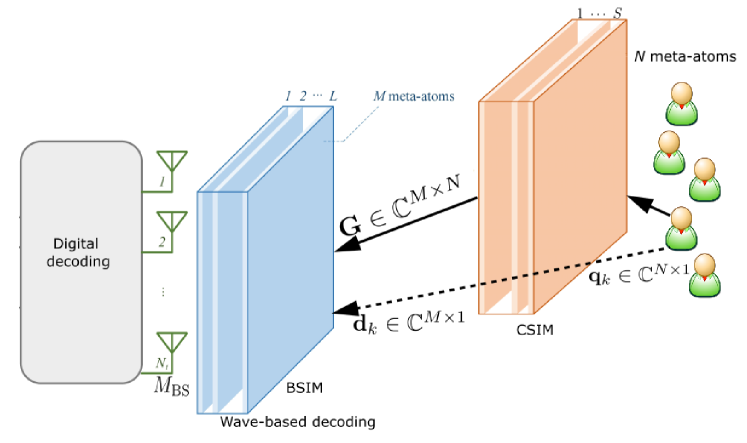
Although reconfigurable intelligent surface (RIS) is a promising technology for shaping the propagation environment, it consists of a single-layer structure within inherent limitations regarding the number of beam steering patterns. Based on the recently revolutionary technology, denoted as stacked intelligent metasurface (SIM), we propose its implementation not only on the base station (BS) side in a massive multiple-input multiple-output (mMIMO) setup but also in the intermediate space between the base station and the users to adjust the environment further as needed. For the sake of convenience, we call the former BS SIM (BSIM), and the latter channel SIM (CSIM). Hence, we achieve wave-based combining at the BS and wave-based configuration at the intermediate space. Specifically, we propose a channel estimation method with reduced overhead, being crucial for SIMassisted communications. Next, we derive the uplink sum spectral efficiency (SE) in closed form in terms of statistical channel state information (CSI). Notably, we optimize the phase shifts of both BSIM and CSIM simultaneously by using the projected gradient ascent method (PGAM). Compared to previous works on SIMs, we study the uplink transmission, a mMIMO setup, channel estimation in a single phase, a second SIM at the intermediate space, and simultaneous optimization of the two SIMs. Simulation results show the impact of various parameters on the sum SE, and demonstrate the superiority of our optimization approach compared to the alternating optimization (AO) method.
Motivation & Objective
- Motivate programmable wireless environments with stacked intelligent metasurfaces (SIM) to enhance energy efficiency and connectivity in mMIMO systems.
- Introduce a BS-integrated SIM (BSIM) and an intermediate-space SIM (CSIM) to enable wave-based decoding and environment shaping.
- Develop a low-overhead channel estimation method for SIM-assisted systems and derive uplink sum spectral efficiency under statistical CSI.
- Formulate and solve a simultaneous phase-shift optimization problem for both SIMs using projected gradient ascent.
- Provide numerical insights on parameter impacts and compare PGAM with alternating optimization (AO).
Proposed method
- Model a BS with a large antenna array assisted by BSIM and a CSIM in the intermediate space.
- Describe the wave-domain channel through cascaded SIMs using phase-diagonal matrices and inter-layer transmission matrices.
- Derive a closed-form uplink SE expression based on channel covariance and statistical CSI with MRC decoding (Theorem 1).
- Propose a reduced-overhead LMMSE channel estimation method that estimates the aggregated BSIM-CSIM channel in one phase (not individual links).
- Formulate a non-convex optimization of BSIM and CSIM phase shifts to maximize sum SE and apply a simultaneous projected gradient ascent method (PGAM).
- Provide gradients in closed form (Proposition 1) and employ Armijo backtracking for step-size selection (Algorithm 1).
Experimental results
Research questions
- RQ1How does a double-SIM architecture (BSIM and CSIM) affect uplink SE in a multiuser mMIMO system?
- RQ2Can channel estimation be performed with reduced overhead by estimating aggregated channels instead of individual links?
- RQ3What is the performance gain of simultaneous BSIM-CSIM phase optimization via PGAM compared to AO?
- RQ4How do system parameters (numbers of meta-atoms, layers, users) influence sum SE in the proposed architecture?
- RQ5What is the impact of imperfect CSI on uplink SE with wave-domain combining and SIMs?
Key findings
- Uplink SE is derived in closed form using statistical CSI with maximum-ratio combining (Theorem 1).
- A reduced-overhead LMMSE channel estimator for aggregated BSIM-CSIM channels is proposed and analyzed.
- Simultaneous optimization of BSIM and CSIM phase shifts via PGAM outperforms alternating optimization in simulations.
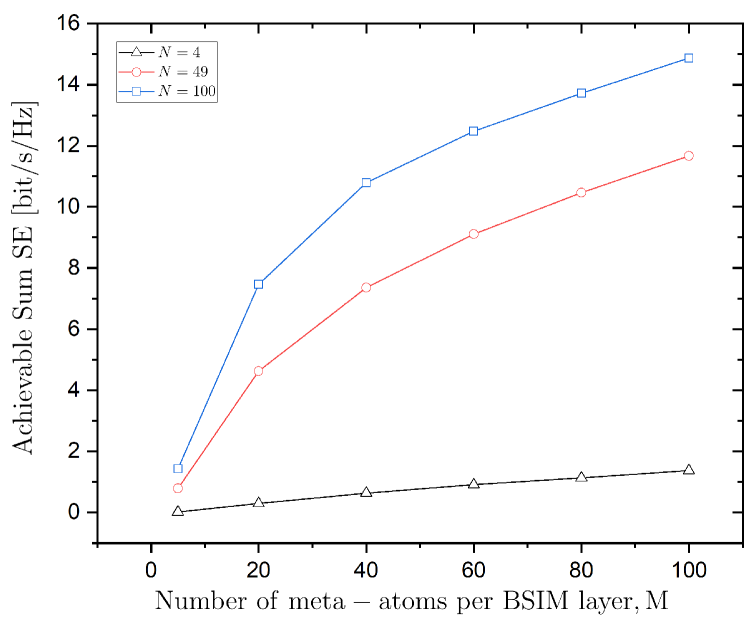
- Increasing CSIM meta-atoms (N) yields larger SE gains than equivalent increases in BSIM meta-atoms (M) in reported results (CSIM has greater impact).
- More metasurfaces (layers L, S) and larger arrays improve SE, with CSIM showing substantial improvements (up to 170% gain when doubling N versus 200% when doubling M in certain setups).
- The dual-SIM architecture significantly outperforms single-layer BSIM or CSIM configurations in the presented scenarios.
Read this paper
Open the full text in the Nubint reader and ask about any passage as you read.
Read this paper on NubintThis review was generated by AI from the original paper. Please check the paper before citing it.