
[Paper Review] Performance of the low-latency GstLAL inspiral search towards LIGO, Virgo, and KAGRA's fourth observing run
This paper evaluates the performance of the low-latency GstLAL pipeline in detecting gravitational wave signals during LIGO, Virgo, and KAGRA's fourth observing run. It demonstrates high accuracy in estimating chirp mass, especially for binary neutron stars and neutron star-black hole systems, with mean errors below 10^{-3}, while end-time recovery achieves sub-millisecond precision across detectors, enabling rapid follow-up observations.
GstLAL is a stream-based matched-filtering search pipeline aiming at the prompt discovery of gravitational waves from compact binary coalescences such as the mergers of black holes and neutron stars. Over the past three observation runs by the LIGO, Virgo, and KAGRA (LVK) collaboration, the GstLAL search pipeline has participated in several tens of gravitational wave discoveries. The fourth observing run (O4) is set to begin in May 2023 and is expected to see the discovery of many new and interesting gravitational wave signals which will inform our understanding of astrophysics and cosmology. We describe the current configuration of the GstLAL low-latency search and show its readiness for the upcoming observation run by presenting its performance on a mock data challenge. The mock data challenge includes 40 days of LIGO Hanford, LIGO Livingston, and Virgo strain data along with an injection campaign in order to fully characterize the performance of the search. We find an improved performance in terms of detection rate and significance estimation as compared to that observed in the O3 online analysis. The improvements are attributed to several incremental advances in the likelihood ratio ranking statistic computation and the method of background estimation.
Motivation & Objective
- To assess the low-latency detection performance of the GstLAL pipeline during the fourth observing run of LIGO, Virgo, and KAGRA.
- To quantify parameter estimation accuracy for key gravitational wave parameters including chirp mass, effective inspiral spin, mass ratio, and coalescence end time.
- To support rapid follow-up by providing accurate initial parameter estimates for transient gravitational wave events.
- To inform Bayesian parameter estimation pipelines like Bilby by characterizing the prior quality derived from search results.
Proposed method
- The study uses a large set of simulated gravitational wave injections across binary neutron star (BNS), neutron star-black hole (NSBH), and binary black hole (BBH) parameter spaces.
- It evaluates detection performance using the false alarm rate (FAR) threshold of 2.31 × 10^{-5} Hz to select significant triggers.
- Parameter estimation accuracy is quantified by comparing injected values to recovered values from the GstLAL pipeline using error metrics defined as (recovered - injected)/injected for parameters, and absolute difference for end time.
- The analysis includes scatter plots of injected vs. recovered parameters and histograms of estimation errors to visualize biases and uncertainties.
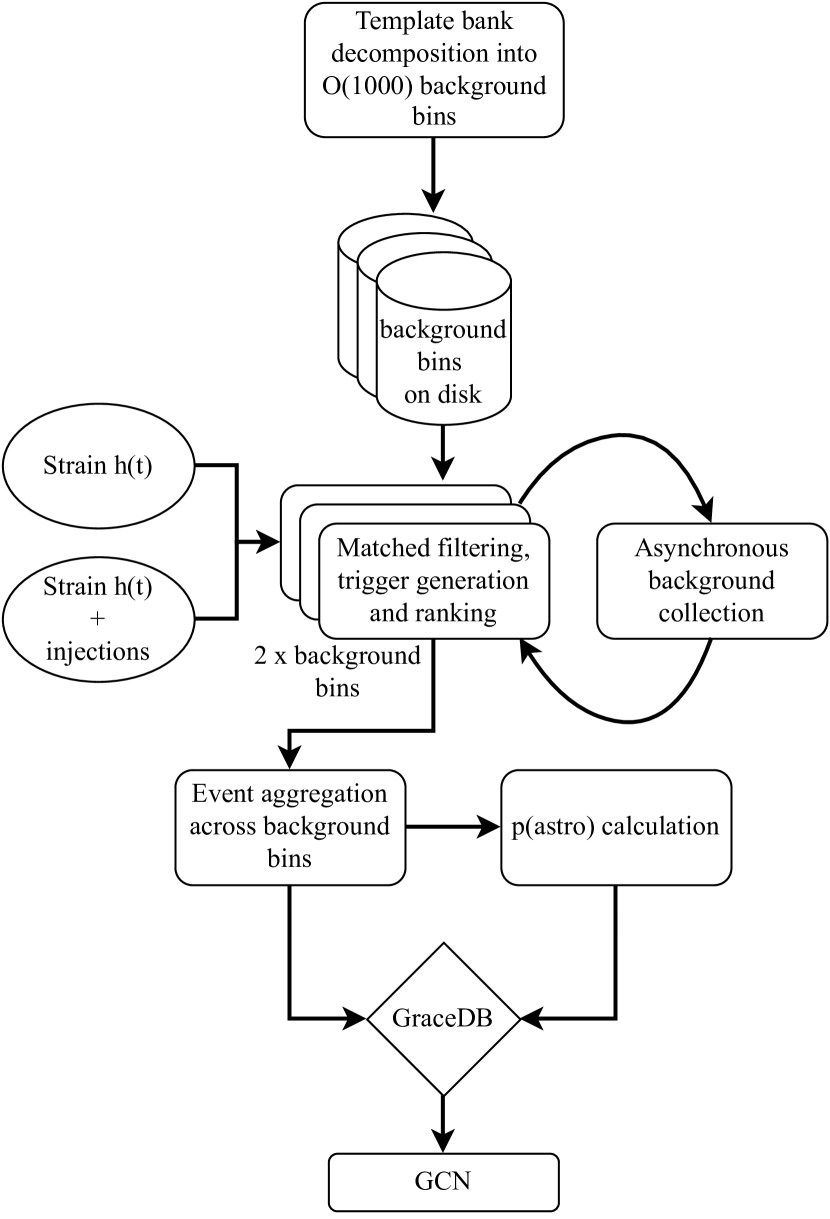
- The pipeline uses matched filtering with a bank of template waveforms to identify triggers in real-time data streams from LIGO, Virgo, and KAGRA.
- Statistical summaries such as mean and standard deviation of errors are computed across injection classes and detectors to assess consistency and reliability.
Experimental results
Research questions
- RQ1How accurately does the GstLAL pipeline recover the chirp mass for different binary systems during O4?
- RQ2What is the performance of the pipeline in estimating the effective inspiral spin and mass ratio for BNS, NSBH, and BBH injections?
- RQ3How precisely is the coalescence end time estimated across LIGO Hanford, LIGO Livingston, and Virgo detectors?
- RQ4To what extent do parameter estimation errors vary with signal-to-noise ratio and source class?
- RQ5How do the recovered parameter distributions inform the choice of priors in downstream Bayesian inference pipelines like Bilby?
Key findings
- The mean error in chirp mass recovery is 2.06 × 10^{-4} for BNS systems, with a standard deviation of 8.33 × 10^{-4}, indicating high accuracy.
- For NSBH systems, the mean chirp mass error is -2.14 × 10^{-4}, with a standard deviation of 6.26 × 10^{-3}, showing moderate but acceptable accuracy.
- BBH systems exhibit the largest chirp mass errors, with a mean of 1.54 × 10^{-1} and standard deviation of 4.53 × 10^{-1}, reflecting greater uncertainty due to higher masses.
- The recovered end time is estimated with a mean difference of 6.23 milliseconds across all source classes and detectors, with sub-millisecond precision observed in individual detector histograms.
- There is minimal correlation between injected and recovered effective spin (χ_eff) and mass ratio (q), indicating limited bias but moderate scatter in these parameters.
- The parameter estimation accuracy supports the use of narrow priors in Bilby for BNS and NSBH systems, while broader priors are needed for BBH systems due to larger uncertainties.
Read this paper
Open the full text in the Nubint reader and ask about any passage as you read.
Read this paper on NubintThis review was generated by AI from the original paper. Please check the paper before citing it.