
[Paper Review] Personal VAD: Speaker-Conditioned Voice Activity Detection
This paper proposes Personal VAD, a lightweight, speaker-conditioned voice activity detection system that classifies audio frames into non-speech, target speaker speech, or non-target speaker speech using a 130K-parameter neural network conditioned on speaker embeddings. It outperforms standard VAD + speaker verification baselines while enabling on-device, low-latency, low-power speech recognition triggered only by the target user.
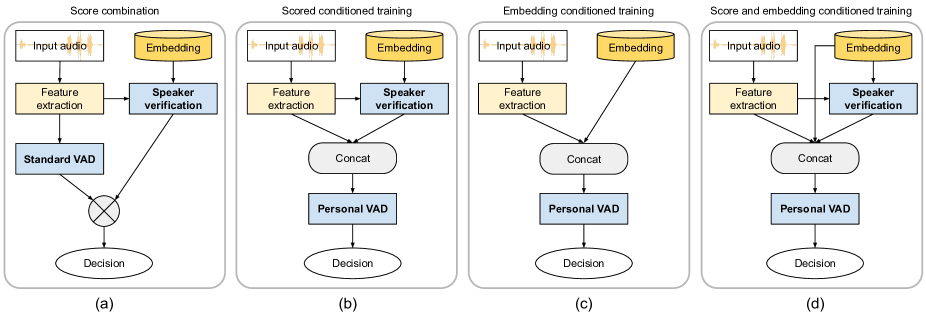
In this paper, we propose "personal VAD", a system to detect the voice activity of a target speaker at the frame level. This system is useful for gating the inputs to a streaming on-device speech recognition system, such that it only triggers for the target user, which helps reduce the computational cost and battery consumption, especially in scenarios where a keyword detector is unpreferable. We achieve this by training a VAD-alike neural network that is conditioned on the target speaker embedding or the speaker verification score. For each frame, personal VAD outputs the probabilities for three classes: non-speech, target speaker speech, and non-target speaker speech. Under our optimal setup, we are able to train a model with only 130K parameters that outperforms a baseline system where individually trained standard VAD and speaker recognition networks are combined to perform the same task.
Motivation & Objective
- To develop a real-time, on-device voice activity detection system that triggers speech recognition only when the target speaker is speaking, reducing battery and computational costs.
- To address the limitations of combining separate VAD and speaker verification models, which suffer from high latency and computational overhead.
- To design a lightweight, frame-level inference model that distinguishes between non-speech, target speaker speech, and non-target speaker speech.
- To improve robustness in noisy and multi-speaker environments by learning speaker-specific speech activity with minimal model size.
- To enable seamless, keyword-free voice assistant interaction by eliminating the need for wake-word detection.
Proposed method
- Proposes a three-class frame-level classification model that takes acoustic features and a target speaker embedding as input to predict: non-speech, target speaker speech, or non-target speaker speech.
- Uses a 2-layer LSTM network with 64 units and a final fully connected layer, trained with cross-entropy loss for initial three-class learning.
- Introduces a weighted pairwise loss function that assigns higher importance to distinguishing target speaker speech from non-speech and non-target speech, while reducing emphasis on differentiating non-speech from non-target speech.
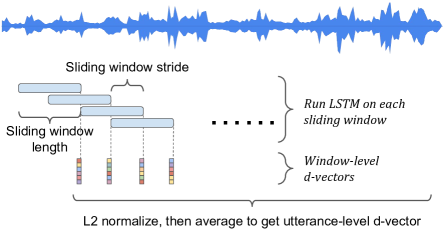
- Employs a d-vector speaker embedding model (retrained on 8 languages) to encode speaker identity, which is used as a conditioning input during inference.
- Optimizes for low inference cost by minimizing model size (0.13M parameters) and enabling real-time, frame-by-frame processing.
- Evaluates performance using Average Precision (AP) on an augmented LibriSpeech dataset with and without multi-turn recognition (MTR).
Experimental results
Research questions
- RQ1Can a single, lightweight neural network outperform the cascade of standard VAD and speaker verification models in detecting target speaker voice activity?
- RQ2How does the choice of loss function—specifically, a weighted pairwise loss—affect the model's ability to distinguish target speaker speech from non-speech and non-target speech?
- RQ3To what extent can a personal VAD model maintain performance on standard VAD tasks (speech/non-speech detection) while being optimized for target speaker detection?
- RQ4What is the optimal trade-off between model size, inference speed, and accuracy in on-device, real-time speaker-conditioned VAD?
- RQ5Does conditioning the VAD on speaker embeddings significantly improve false alarm and miss detection rates in noisy, multi-speaker environments?
Key findings
- The ET architecture (embedding-conditional transformer) achieved 0.932 mAP for target speaker speech (tss) without MTR and 0.878 with MTR, using only 0.13 million parameters—40 times smaller than the baseline speaker verification model.
- The weighted pairwise loss outperformed standard cross-entropy loss, with optimal performance at w<ns,ntss> = 0.1, reducing confusion between non-speech and non-target speech without degrading overall accuracy.
- Personal VAD models achieved AP scores of 0.991 (CE loss) and 0.991 (weighted pairwise loss) for speech detection, comparable to a standard VAD model (0.992), proving minimal performance degradation on standard VAD tasks.
- The ET model achieved 0.893 mAP for non-speech (ns) and 0.901 for non-target speaker speech (ntss) with MTR, demonstrating strong generalization across all three classes.
- The proposed personal VAD system outperforms the baseline cascade of standard VAD and speaker verification models in both accuracy and efficiency, especially in low-resource on-device settings.
- The results confirm that personal VAD can replace standard VAD in downstream ASR systems without increasing model size or computational cost, while enabling target-speaker-only activation.
Read this paper
Open the full text in the Nubint reader and ask about any passage as you read.
Read this paper on NubintThis review was generated by AI from the original paper. Please check the paper before citing it.