
[Paper Review] Perspectives and Prospects on Transformer Architecture for Cross-Modal Tasks with Language and Vision
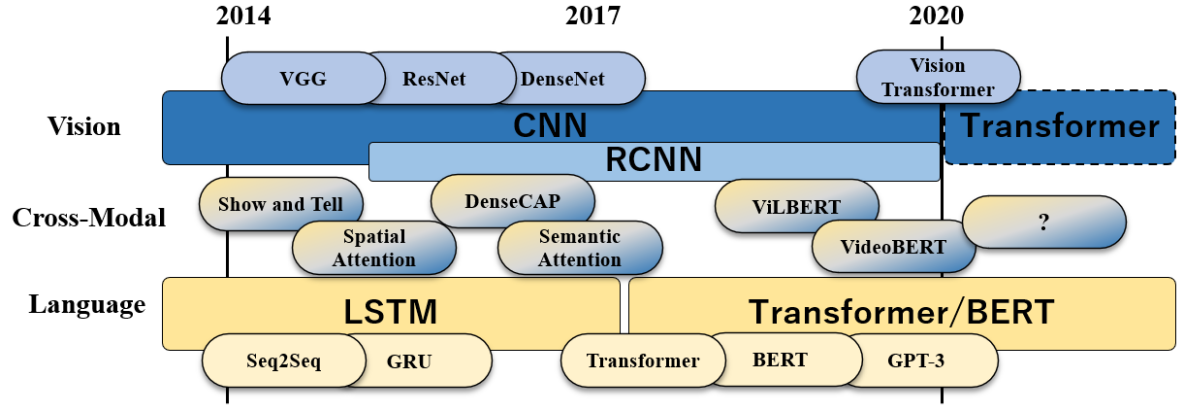
This paper reviews the evolution and impact of transformer architectures in cross-modal tasks combining language and vision, emphasizing pre-training schemes and architectural innovations. It highlights the shift from CNN-RNN pipelines to end-to-end transformers, demonstrates the feasibility of CNN-free vision representation via models like ViT and ViLT, and explores prospects in generative modeling, such as text-to-image synthesis, with key advances in efficiency and performance.
Transformer architectures have brought about fundamental changes to computational linguistic field, which had been dominated by recurrent neural networks for many years. Its success also implies drastic changes in cross-modal tasks with language and vision, and many researchers have already tackled the issue. In this paper, we review some of the most critical milestones in the field, as well as overall trends on how transformer architecture has been incorporated into visuolinguistic cross-modal tasks. Furthermore, we discuss its current limitations and speculate upon some of the prospects that we find imminent.
Motivation & Objective
- To analyze the transformative role of transformer architectures in cross-modal learning between language and vision.
- To examine how pre-training schemes and architectural modifications have improved performance in visuolinguistic tasks.
- To investigate the potential of replacing convolutional neural networks with pure transformer-based vision encoders.
- To explore emerging prospects in generative cross-modal modeling, such as text-to-image synthesis.
- To assess computational efficiency and scalability of transformer-only models compared to hybrid CNN-RNN or CNN-transformer approaches.
Proposed method
- Surveying key milestones in vision and language domains, including BERT, GPT, ViT, and ViLBERT, to trace the evolution of cross-modal modeling.
- Analyzing architectural adaptations of transformers for joint language-vision representation, including cross-attention mechanisms and modality-specific tokenization.
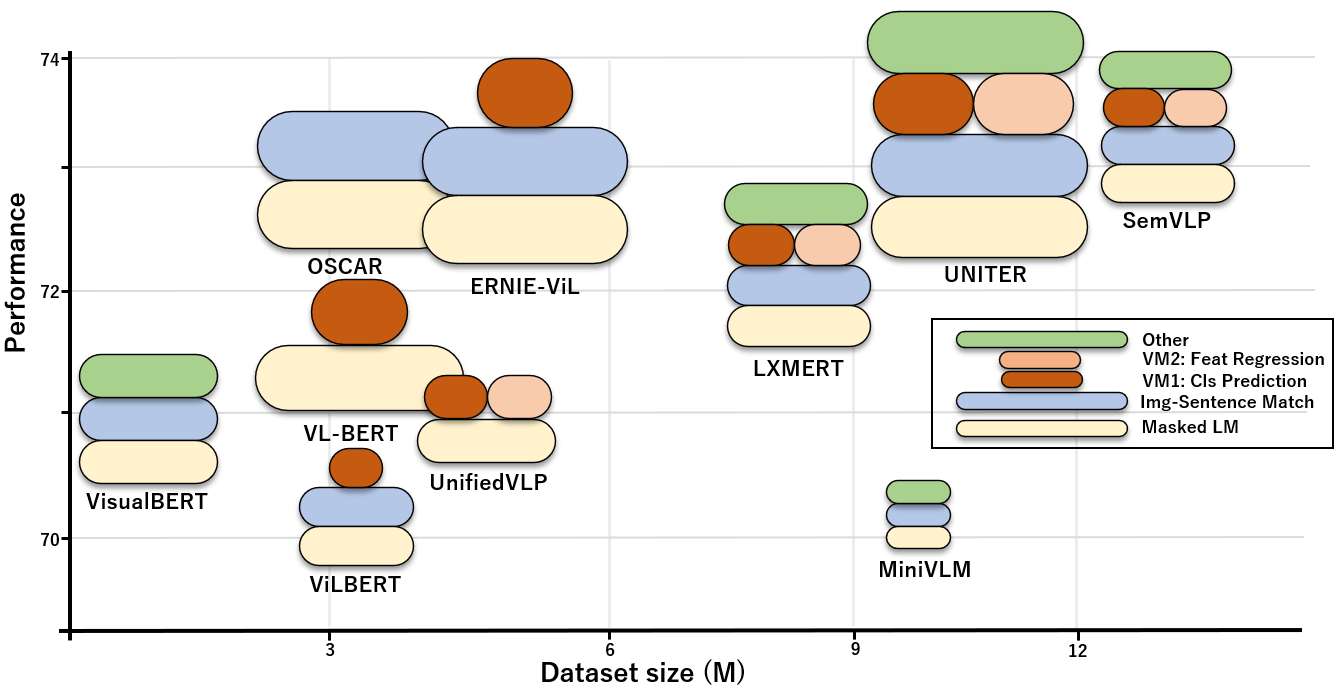
- Evaluating pre-training objectives such as masked language modeling and contrastive learning in multi-modal settings.
- Reviewing CNN-free vision models like Vision Transformer (ViT) and ViLT, which use patch embeddings and self-attention to replace convolutional feature extraction.
- Examining generative applications such as DALL·E and StyleCLIP, which combine transformer-based language models with diffusion or GAN-based image generation.
- Assessing computational efficiency and memory usage through benchmarks comparing ViT to ResNets, including distillation techniques to improve performance-cost trade-offs.
Experimental results
Research questions
- RQ1How have transformer architectures transformed the design of cross-modal models in vision and language tasks?
- RQ2To what extent can pure transformer-based vision encoders replace convolutional neural networks in multi-modal learning?
- RQ3What are the key differences and advantages of pre-training schemes—especially masked language modeling and contrastive learning—in multi-modal settings?
- RQ4Can end-to-end transformer-only models achieve state-of-the-art performance while improving computational efficiency?
- RQ5What are the prospects for generative cross-modal tasks, such as text-to-image synthesis, using transformer-based architectures?
Key findings
- Vision Transformers (ViT) achieve performance comparable to ResNets while being up to 4 times more memory-efficient, indicating strong potential for replacing CNNs in vision representation.
- Models like ViLT and UniT demonstrate that end-to-end transformer-only architectures can match or exceed CNN-RNN baselines, with up to 60x inference speedup.
- Pre-training on manually annotated datasets is more data-efficient than weakly supervised pre-training, though large-scale weak supervision can compensate with sufficient data volume.
- Fine-tuning on target task-specific datasets leads to better performance than generic pre-training, highlighting the importance of task-specific adaptation.
- Generative models such as DALL·E and StyleCLIP show that GPT-3-based language models can generate diverse, high-quality images from text prompts using discrete VAE tokenization.
- The emergence of CNN-free, transformer-exclusive models suggests a paradigm shift toward unified, hardware-optimized architectures for multi-modal learning.
Read this paper
Open the full text in the Nubint reader and ask about any passage as you read.
Read this paper on NubintThis review was generated by AI from the original paper. Please check the paper before citing it.