
[Paper Review] Phase-space analysis of a novel cosmological model in $f(Q)$ theory
This paper proposes a novel $f(Q)$ gravity model using non-vanishing affine connections in spatially flat FLRW spacetime, breaking the degeneracy with $f(T)$ theory. Through phase-space analysis of dynamical systems, it identifies stable de Sitter attractors for late-time acceleration and unstable fixed points for matter/radiation eras, demonstrating a complete cosmic evolution sequence without scalar fields.
The vanishing affine connections have been used solely while adopting the modified $f(Q)$ gravity theory to the cosmology. Consequently, researchers could not get beyond what is already known in $f(T)$ theory earlier. To alleviate this problem, in the present manuscript we investigate a recently proposed construction of $f(Q)$ theory using non-vanishing affine connection in the spatially flat FLRW spacetime. We then investigate the cosmological solutions of $f(Q)$ theory for a perfect fluid through the phase space analysis. We introduce few variables and dimensionless parameters to construct the corresponding equations suitable for the dynamical system approach. The conservation of the energy-momentum tensor leads to a constraint equation that relates the dynamical variables. Briefly, both unstable and stable de Sitter solutions appear which correspond to early and late times accelerated expansions. Also, unstable points corresponding to the matter dominated and radiation dominated eras have been found which do exist for every $f(Q)$ function. As a result, the present discussion shows that $f(Q)$ gravity endowed by non-vanishing affine connections is capable of explaining a true sequence of cosmic eras.
Motivation & Objective
- To overcome the limitation in existing $f(Q)$ cosmology studies that rely solely on vanishing affine connections, which reproduce $f(T)$ results.
- To develop a new formulation of $f(Q)$ gravity using a non-vanishing, torsion-free affine connection parameterized by $\gamma(t)$, ensuring distinct dynamics from $f(T)$ theory.
- To analyze cosmological solutions of the new $f(Q)$ model using dynamical systems theory, focusing on fixed points and stability.
- To demonstrate that the model can describe a full sequence of cosmic epochs: early de Sitter (inflation), matter-dominated, and late-time de Sitter (dark energy) phases.
- To show that the model achieves this without introducing an auxiliary scalar field, relying only on geometric modifications of gravity.
Proposed method
- Formulate $f(Q)$ gravity using a non-vanishing affine connection $\Gamma^\lambda_{\mu\nu}$ with vanishing curvature and torsion, introducing a time-dependent parameter $\gamma(t)$ in the spatially flat FLRW metric.
- Derive the field equations, energy density, and pressure from the action $\mathcal{L} = \sqrt{-g} f(Q)$, with $Q$ the non-metricity scalar.
- Enforce energy-momentum tensor conservation to derive a constraint equation linking dynamical variables, enabling closure of the dynamical system.
- Introduce dimensionless variables $x_1, x_2, x_3$ to transform the system into autonomous form suitable for phase-space analysis.
- Analyze the resulting dynamical system by identifying critical points and evaluating their stability via linearization and eigenvalue analysis.
- Investigate specific models: $f(Q) = \alpha Q^\beta$, $f(Q) = \eta Q + \zeta Q^\sigma$, and $f(Q) = \xi e^{\chi Q}$, under both time-varying and constant $\gamma(t)$.
Experimental results
Research questions
- RQ1Can a non-vanishing affine connection in $f(Q)$ gravity produce cosmological dynamics distinct from $f(T)$ theory?
- RQ2Does the proposed $f(Q)$ model with $\gamma(t)$-dependent connection support stable de Sitter solutions at both early and late times?
- RQ3Can the model naturally describe a sequence of cosmic epochs—radiation, matter domination, and late-time acceleration—without external scalar fields?
- RQ4What is the role of the parameter $\gamma(t)$ in shaping the phase-space structure and stability of fixed points?
- RQ5How do different functional forms of $f(Q)$ affect the existence and nature of fixed points, particularly those corresponding to accelerated expansion?
Key findings
- The model with non-vanishing affine connection produces Friedmann-type equations distinct from $f(T)$ theory, breaking the prior degeneracy.
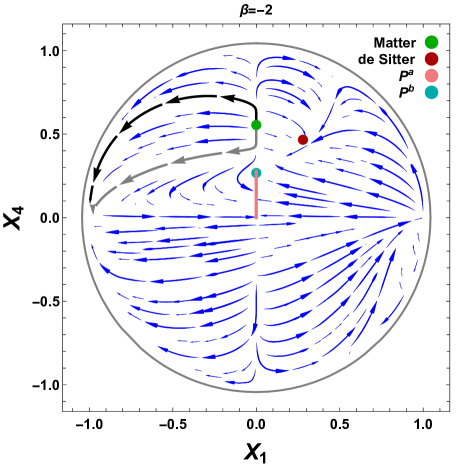
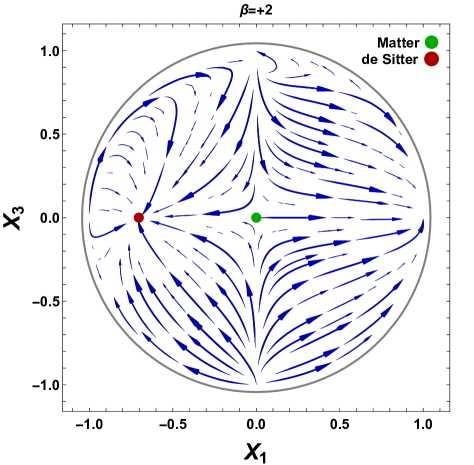
- For $f(Q) = \alpha Q^\beta$, a stable de Sitter fixed point exists at late times and an unstable matter-dominated fixed point at early times, with trajectories evolving from the latter to the former.
- The model with $f(Q) = \xi e^{\chi Q}$ exhibits two de Sitter fixed points: one unstable (early-time inflation) and one stable (late-time acceleration), enabling a transition from early to late de Sitter phases.
- Phase-space trajectories in the $f(Q) = \xi e^{\chi Q}$ model show evolution from $R^{ds}_e$ (early de Sitter) to $R^{ds}_l$ (late de Sitter), with minimal deviation from zero $x_1$ in late times for small initial values.
- The model with $f(Q) = \eta Q + \zeta Q^\sigma$ fails to support a matter-dominated fixed point, indicating incompatibility with standard cosmic evolution.
- Isolated stable fixed points with $w^{\text{eff}} < -1/3$ exist in some models, indicating accelerated expansion not connected to the matter-dominated point, suggesting alternative late-time dynamics.
Read this paper
Open the full text in the Nubint reader and ask about any passage as you read.
Read this paper on NubintThis review was generated by AI from the original paper. Please check the paper before citing it.