
[論文レビュー] Physics-Constrained Hardware-Efficient Ansatz on Quantum Computers that is Universal, Systematically Improvable, and Size-consistent
本稿は、汎用性、体系的な改善可能性、サイズ整合性を備えた物理的制約付きのハードウェア効率的アーキテクチャ(XYZ2F)を導入し、変分量子アルゴリズムの優れたスケーラビリティと精度を保証する。基本的な物理的制約を課し、線形近接量子ビットアーキテクチャを採用することで、ヒューリスティックなアーキテクチャに比べて層数を減らして化学的精度に到達でき、特にヘイゼンベルク模型やH₂O、N₂のような分子における強い電子相関系で優れた性能を示す。
Variational wavefunction ansätze are at the heart of solving quantum many-body problems in physics and chemistry. Previous designs of hardware-efficient ansatz (HEA) on quantum computers are largely based on heuristics and lack rigorous theoretical foundations. In this work, we introduce a physics-constrained approach for designing HEA with rigorous theoretical guarantees by imposing a few fundamental constraints. Specifically, we require that the target HEA to be universal, systematically improvable, and size-consistent, which is an important concept in quantum many-body theories for scalability, but has been overlooked in previous designs of HEA. We extend the notion of size-consistency to HEA, and present a concrete realization of HEA that satisfies all these fundamental constraints while only requiring linear qubit connectivity. The developed physics-constrained HEA is superior to other heuristically designed HEA in terms of both accuracy and scalability, as demonstrated numerically for the Heisenberg model and some typical molecules. In particular, we find that restoring size-consistency can significantly reduce the number of layers needed to reach certain accuracy. In contrast, the failure of other HEA to satisfy these constraints severely limits their scalability to larger systems with more than ten qubits. Our work highlights the importance of incorporating physical constraints into the design of HEA for efficiently solving many-body problems on quantum computers.
研究の動機と目的
- 既存のハードウェア効率的アーキテクチャ(HEA)設計に理論的基盤が欠如しており、主にヒューリスティック的でスケーラビリティと精度に関する保証がないことに対処する。
- 密度汎関数理論における成功事例にインspiredして、汎用性、体系的な改善可能性、サイズ整合性という厳密な物理的制約を、HEAの設計原則として確立する。
- すべての3つの制約を満たす具体的なHEA実装(XYZ2F)を開発するが、線形量子ビット接続とネイティブゲートのみを要する。
- これらの制約を満たすことで、化学的精度に到達するための収束速度と回路深さが顕著に向上することを示す。
- 近位量子ハードウェア上で、強い電子相関を持つ系(分子やスピン模型を含む)のスケーラブルかつ高精度な変分量子シミュレーションを可能にする。
提案手法
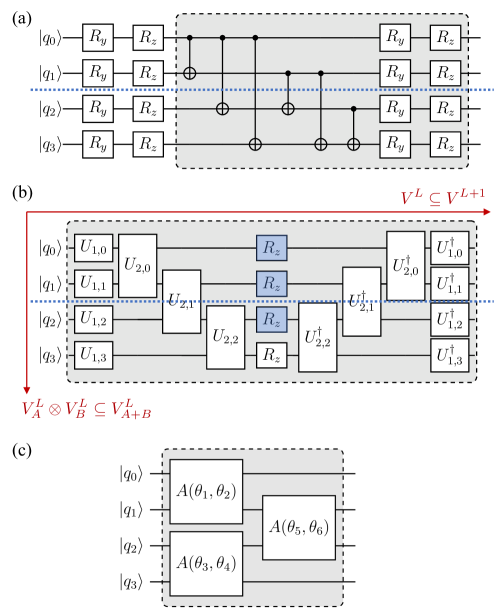
- アーキテクチャは、層を追加することで体系的に改善可能な固定された繰り返し構造を持つパラメータ化量子回路(PQC)の積として構築される。
- 回路アーキテクチャは、サブシステムに乗法的分離可能であることを保証することでサイズ整合性を実現し、大規模系における正しいスケーリングを維持する。
- 各回路ブロックが任意のパウリ演算子の指数関数を表現可能であるようにすることで、汎用性を達成し、任意の量子状態を近似可能とする。
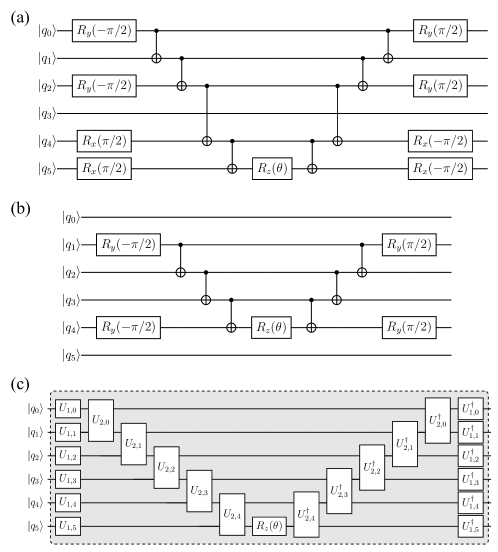
- アーキテクチャは単一量子ビット回転と近接量子ビット間の2量子ビットエンタングルゲートのみを用いるため、線形接続量子ハードウェアで実装可能である。
- バーレンプレート問題を緩和し、学習可能性を向上させるために、段階的最適化戦略が採用される。
- アーキテクチャはヘイゼンベルク模型およびH₄、H₆、H₈、LiH、H₂O、N₂などのさまざまな分子に対して数値的にテストされ、正確な対角化とUCCSDがベンチマークとして用いられる。
実験結果
リサーチクエスチョン
- RQ1汎用性、体系的な改善可能性、サイズ整合性といった厳密な理論的保証を持つハードウェア効率的アーキテクチャを設計可能か?
- RQ2サイズ整合性を強制することで、量子化学シミュレーションにおける化学的精度に到達するための収束速度と回路深さにどのような影響を与えるか?
- RQ3物理的制約付きアーキテクチャは、強い電子相関系において、ヒューリスティックに設計されたHEAに比べて精度とスケーラビリティで優位に立てるか?
- RQ4段階的最適化戦略は、大規模な変分量子アルゴリズムにおけるバーレンプレート問題を効果的に緩和できるか?
- RQ5提案されたアーキテクチャは2次元系へ拡張可能であり、理論的および実用的利点を維持できるか?
主な発見
- 物理的制約付きアーキテクチャXYZ2Fは、H₄、H₆、H₈、LiH、H₂O、N₂において、他のHEAに比べてはるかに少ない層数で化学的精度(1 mH)に到達し、優れた収束性能を示した。
- 1.5 Åのモノマー間隔をもつH₃–H₃ラダー系では、XYZ2Fは約37層で化学的精度に到達したが、XYZ1F や ASWAP といった他のHEAははるかに遅く収束した。
- 他のHEAは解離領域(3.0 Å)および中間距離で完全に失敗し、サイズ整合性の重要性が顕著に示された。
- サイズ整合性を満たさないHEAが10量子ビットを超えてスケーリングできないことは、大規模系シミュレーションにおいてこの制約を強制する必要性を強く示唆している。
- 段階的最適化戦略はバーレンプレート問題を効果的に緩和し、安定した学習と層数増加に伴う体系的改善を可能にした。
- UCCSDの性能が低下するような困難な強い電子相関領域(近接解離限界付近)でも、アーキテクチャは高い精度を維持した。
より良い研究を、今すぐ始めましょう
論文の読解から最終レビューまで、研究時間を劇的に削減しましょう。
クレジットカード登録不要
このレビューはAIが作成し、人間の編集者が確認しました。