
[Paper Review] PiSLTRc: Position-informed Sign Language Transformer with Content-aware Convolution
This paper proposes PiSLTRc, a sign language Transformer model that enhances sign representation through content-aware and position-informed convolution, and injects relative position encoding into self-attention mechanisms. By dynamically selecting semantically similar neighboring frames and aggregating them with position-aware convolutions, and by using disentangled relative position encoding, PiSLTRc achieves state-of-the-art performance with +1.6 BLEU improvements on sign language translation benchmarks.
Since the superiority of Transformer in learning long-term dependency, the sign language Transformer model achieves remarkable progress in Sign Language Recognition (SLR) and Translation (SLT). However, there are several issues with the Transformer that prevent it from better sign language understanding. The first issue is that the self-attention mechanism learns sign video representation in a frame-wise manner, neglecting the temporal semantic structure of sign gestures. Secondly, the attention mechanism with absolute position encoding is direction and distance unaware, thus limiting its ability. To address these issues, we propose a new model architecture, namely PiSLTRc, with two distinctive characteristics: (i) content-aware and position-aware convolution layers. Specifically, we explicitly select relevant features using a novel content-aware neighborhood gathering method. Then we aggregate these features with position-informed temporal convolution layers, thus generating robust neighborhood-enhanced sign representation. (ii) injecting the relative position information to the attention mechanism in the encoder, decoder, and even encoder-decoder cross attention. Compared with the vanilla Transformer model, our model performs consistently better on three large-scale sign language benchmarks: PHOENIX-2014, PHOENIX-2014-T and CSL. Furthermore, extensive experiments demonstrate that the proposed method achieves state-of-the-art performance on translation quality with $+1.6$ BLEU improvements.
Motivation & Objective
- To address the limitation of vanilla Transformers in capturing temporal semantic structure of sign gestures due to frame-wise attention.
- To overcome the direction- and distance-agnostic nature of absolute position encoding in sign language modeling.
- To improve sign language recognition and translation by integrating content-aware neighborhood gathering and position-informed convolution.
- To inject relative position information into both encoder, decoder, and cross-attention mechanisms for better sequence modeling.
- To achieve state-of-the-art performance in sign language translation while maintaining strong recognition quality.
Proposed method
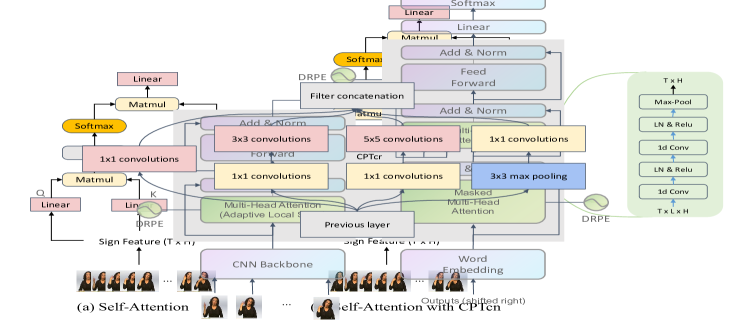
- Proposes a content-aware neighborhood gathering method that dynamically selects neighboring frames based on semantic similarity to enhance local gesture representation.
- Introduces position-informed temporal convolution layers that aggregate selected features while preserving positional context using relative position encoding.
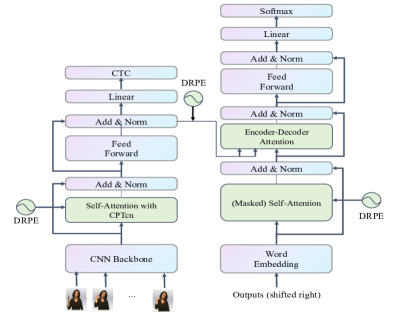
- Employs disentangled relative position encoding (DRPE) to inject direction and distance awareness into self-attention mechanisms in the encoder, decoder, and cross-attention.
- Designs a unified framework, PiSLTRc, that jointly performs sign language recognition and translation with shared feature learning.
- Utilizes a CNN-LSTM-HMM backbone for feature extraction, followed by the proposed CPTcn module and DRPE-enhanced Transformer blocks.
- Trains the model end-to-end with a multi-task loss combining recognition (gloss) and translation (text) objectives.
Experimental results
Research questions
- RQ1Can content-aware neighborhood gathering improve sign representation by leveraging temporal semantic consistency?
- RQ2Does incorporating position-informed convolution enhance the robustness of sign gesture representation?
- RQ3Can relative position encoding in self-attention improve sign language modeling beyond absolute position encoding?
- RQ4Does joint learning of sign language recognition and translation lead to better performance than isolated training?
- RQ5Can the proposed method achieve state-of-the-art results on large-scale sign language benchmarks?
Key findings
- PiSLTRc achieves a +1.6 BLEU improvement over the vanilla SLTR model on the PHOENIX-2014-T dataset, demonstrating superior translation quality.
- On the PHOENIX-2014 sign2gloss task, PiSLTRc-R outperforms vanilla SLTR-R by 12% on the development set and 7% on the test set.
- On the CSL dataset, PiSLTRc-R achieves a 24% improvement over SLTR-R on the test set, indicating strong generalization to diverse sign languages.
- In the sign2text task, PiSLTRc-T surpasses the vanilla SLTR-T model by 3.8% and 5.6% in BLEU-4 scores, confirming the effectiveness of the proposed components.
- The ablation study confirms that both content-aware neighborhood gathering and relative position encoding contribute significantly to performance gains.
- The model achieves state-of-the-art results on all three evaluated benchmarks: PHOENIX-2014, PHOENIX-2014-T, and CSL, across both recognition and translation tasks.
Read this paper
Open the full text in the Nubint reader and ask about any passage as you read.
Read this paper on NubintThis review was generated by AI from the original paper. Please check the paper before citing it.