
[Paper Review] Pragmatic Instruction Following and Goal Assistance via Cooperative Language-Guided Inverse Planning
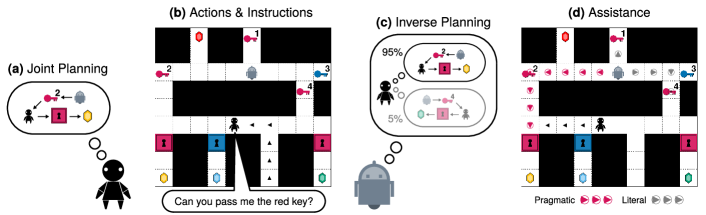
This paper proposes Cooperative Language-Guided Inverse Plan Search (CLIPS), a Bayesian agent architecture that enables pragmatic instruction following and goal assistance by modeling humans as cooperative planners who communicate joint plans via language. CLIPS performs multimodal Bayesian inference over human goals using LLMs to score instruction likelihood and inverse planning, then acts to minimize expected goal achievement cost, significantly outperforming GPT-4V, literal instruction following, and unimodal inverse planning in accuracy and helpfulness across two domains.
People often give instructions whose meaning is ambiguous without further context, expecting that their actions or goals will disambiguate their intentions. How can we build assistive agents that follow such instructions in a flexible, context-sensitive manner? This paper introduces cooperative language-guided inverse plan search (CLIPS), a Bayesian agent architecture for pragmatic instruction following and goal assistance. Our agent assists a human by modeling them as a cooperative planner who communicates joint plans to the assistant, then performs multimodal Bayesian inference over the human's goal from actions and language, using large language models (LLMs) to evaluate the likelihood of an instruction given a hypothesized plan. Given this posterior, our assistant acts to minimize expected goal achievement cost, enabling it to pragmatically follow ambiguous instructions and provide effective assistance even when uncertain about the goal. We evaluate these capabilities in two cooperative planning domains (Doors, Keys & Gems and VirtualHome), finding that CLIPS significantly outperforms GPT-4V, LLM-based literal instruction following and unimodal inverse planning in both accuracy and helpfulness, while closely matching the inferences and assistive judgments provided by human raters.
Motivation & Objective
- To address the challenge of ambiguous human instructions that rely on contextual cues for disambiguation.
- To develop an assistive agent that integrates linguistic and behavioral cues for robust goal inference in cooperative settings.
- To enable goal assistance under uncertainty by minimizing expected cost of goal achievement.
- To align assistant behavior with human intentions through a theory-of-mind framework grounded in rational speech act and inverse planning theory.
Proposed method
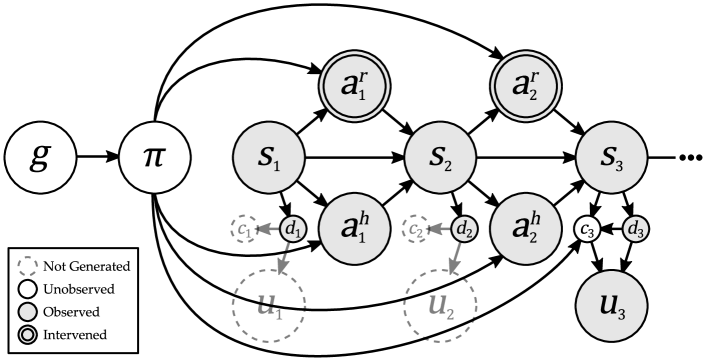
- CLIPS models the human as a cooperative planner who communicates joint plans through language, enabling shared goal reasoning.
- It performs multimodal Bayesian inference over the human’s goal using observed actions and linguistic utterances.
- A large language model (LLM) evaluates the likelihood of an instruction given a hypothesized plan, enabling pragmatic interpretation of ambiguous language.
- The system uses sequential inverse planning to compute a posterior distribution over goals based on multimodal observations.
- An assistive policy is derived by minimizing expected goal achievement cost under the posterior, enabling context-sensitive, cooperative actions.
- The architecture supports both online (dynamic) and offline (static) planning modes, with online adaptation improving performance under uncertainty.
Experimental results
Research questions
- RQ1How can an agent infer a human’s goal from ambiguous instructions and observed actions in a context-sensitive manner?
- RQ2To what extent can multimodal inference—combining language and action—improve goal accuracy and assistance quality compared to unimodal or literal interpretation?
- RQ3How does grounding language understanding in a Bayesian theory-of-mind framework enhance pragmatic instruction following in cooperative planning tasks?
- RQ4What is the impact of using expected cost minimization over goal posterior distributions on the safety and helpfulness of assistant behavior?
- RQ5How does CLIPS compare to LLM-based baselines and unimodal inverse planning in real-world cooperative planning environments?
Key findings
- CLIPS achieved 100% goal accuracy in the Doors, Keys & Gems environment under online $Q_{\text{MDP}}$ assistance, significantly outperforming GPT-4V (97%), language-only inverse planning (90%), and action-only inverse planning (43%).
- In the VirtualHome domain, CLIPS achieved 90% accuracy with online $Q_{\text{MDP}}$ assistance, surpassing language-only (59%) and action-only (61%) inverse planning.
- CLIPS closely matched human raters’ judgments in both goal inference and assistance quality, indicating strong alignment with human cooperative reasoning.
- The use of online $Q_{\text{MDP}}$ assistance improved performance over offline methods, especially in early-stage ambiguity resolution.
- CLIPS with online $Q_{\text{MDP}}$ assistance was slightly more helpful than offline, but offline assistance remained highly effective once sufficient actions were observed to disambiguate goals.
- The $\bar{\pi}_{\text{MDP}}$ policy, while more graded in judgment, was less safe and less accurate than $Q_{\text{MDP}}$, highlighting the importance of cost-minimization under uncertainty.
Read this paper
Open the full text in the Nubint reader and ask about any passage as you read.
Read this paper on NubintThis review was generated by AI from the original paper. Please check the paper before citing it.