
[Paper Review] Precise radial velocities of giant stars VIII. Testing for the presence of planets with CRIRES Infrared Radial Velocities
This study tests the planetary origin of radial velocity (RV) signals in 20 bright G and K giant stars by comparing high-precision optical RVs from the Lick Observatory with near-infrared (H-band) RVs from the CRIRES spectrograph on the VLT. The consistent RV amplitudes across both wavelength domains across eight key systems confirm that the signals are most likely due to orbiting planets, not stellar activity or pulsations.
We have been monitoring 373 very bright (V < 6 mag) G and K giants with high precision optical Doppler spectroscopy for more than a decade at Lick Observatory. Our goal was to discover planetary companions around those stars and to better understand planet formation and evolution around intermediate-mass stars. However, in principle, long-term, g-mode nonradial stellar pulsations or rotating stellar features, such as spots, could effectively mimic a planetary signal in the radial velocity data. Our goal is to compare optical and infrared radial velocities for those stars with periodic radial velocity patterns and to test for consistency of their fitted radial velocity semiamplitudes. Thereby, we distinguish processes intrinsic to the star from orbiting companions as reason for the radial velocity periodicity observed in the optical. Stellar spectra with high spectral resolution have been taken in the H-band with the CRIRES near-infrared spectrograph at ESO's VLT for 20 stars of our Lick survey. Radial velocities are derived using many deep and stable telluric CO2 lines for precise wavelength calibration. We find that the optical and near-infrared radial velocities of the giant stars in our sample are consistent. We present detailed results for eight stars in our sample previously reported to have planets or brown dwarf companions. All eight stars passed the infrared test. We conclude that the planet hypothesis provides the best explanation for the periodic radial velocity patterns observed for these giant stars.
Motivation & Objective
- To distinguish between planetary companions and stellar activity (e.g., spots, pulsations) as the cause of periodic radial velocity variations in evolved G and K giants.
- To test whether the same radial velocity signal observed in the optical is consistent in the near-infrared, where stellar activity effects are expected to be weaker.
- To confirm or rule out planetary companions in stars previously identified with periodic RV signals using long-term optical monitoring.
- To improve confidence in exoplanet detections around evolved stars by applying a critical infrared consistency test.
- To validate the use of CRIRES for high-precision infrared radial velocity measurements on bright giant stars.
Proposed method
- Obtained high-resolution H-band spectra using the CRIRES spectrograph on the VLT for 20 G and K giant stars from the Lick Observatory survey.
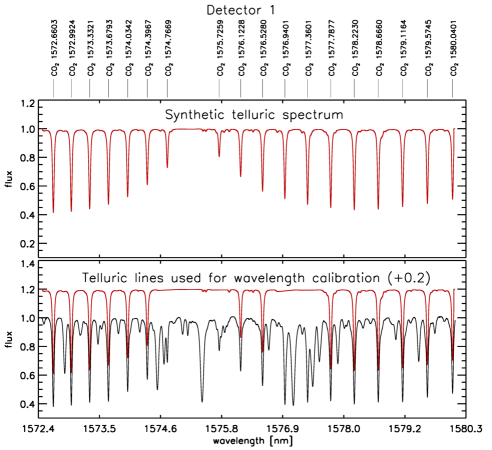
- Used deep, stable telluric CO2 absorption lines in the H-band to achieve precise wavelength calibration, minimizing instrumental and atmospheric systematics.
- Constructed synthetic telluric spectra using the LBLRTM code and the HITRAN database, incorporating real-time atmospheric conditions to model and remove telluric contamination.
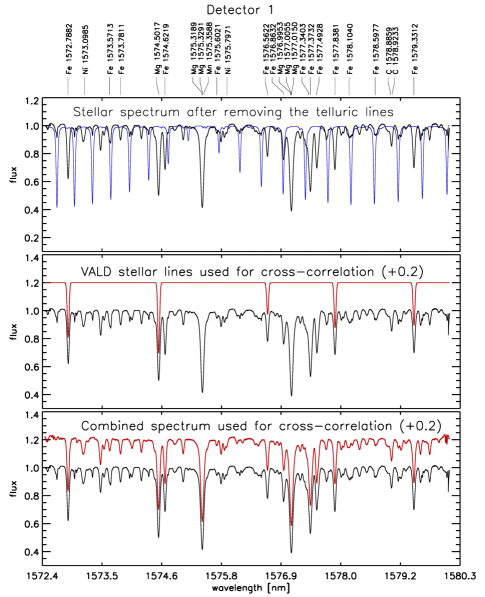
- Derived radial velocities via cross-correlation of observed spectra with noise-free stellar masks built from theoretical VALD wavelengths and observed line profiles.
- For late-type K giants, combined multiple epochs into a high signal-to-noise master stellar template to improve RV precision and reliability.
- Compared near-infrared RV amplitudes with optical RV amplitudes from the Lick survey to test consistency; a Keplerian model was fitted to both data sets.
Experimental results
Research questions
- RQ1Do radial velocity signals in G and K giant stars that show periodicity in optical data also exhibit consistent amplitudes in the near-infrared?
- RQ2Can near-infrared radial velocity measurements distinguish between planetary companions and stellar activity such as spots or g-mode pulsations?
- RQ3Is the amplitude of the radial velocity signal preserved between optical and near-infrared wavelengths for stars with suspected planetary companions?
- RQ4Can the CRIRES instrument achieve sufficient radial velocity precision (≤35 m s⁻¹) to perform a reliable consistency test on bright giant stars?
- RQ5For stars with ambiguous optical RV signals, does the infrared data support or refute the planetary hypothesis?
Key findings
- The near-infrared radial velocities derived from CRIRES data are in excellent agreement with the optical radial velocities from the Lick Observatory for all 20 observed stars.
- For eight stars previously reported to host planets or brown dwarfs—HIP 5364 (η Cet), HIP 20889 (ε Tau), HIP 31592 (7 CMa), HIP 34693 (τ Gem), HIP 37826 (β Gem), HIP 60202 (11 Com), HIP 88048 (ν Oph), and HIP 114855 (91 Aqr)—the near-infrared RV amplitudes are consistent with the optical amplitudes.
- The amplitude ratio (κ) between near-infrared and optical RVs is consistent with unity for all eight stars, with κ = 1.04 ± 0.24 for HIP 31592, indicating no significant difference in signal strength.
- No system showed a discrepancy between optical and infrared RV amplitudes, which would have indicated a stellar-activity origin for the signal.
- The method successfully recovered reliable RVs for G8 III–K1 III giants and, with the master template technique, also for later K giants (K2 III) where standard cross-correlation failed.
- The study concludes that the planetary hypothesis provides the best explanation for the periodic RV variations in these evolved stars, as stellar activity effects would not produce consistent signals across optical and infrared wavelengths.
Read this paper
Open the full text in the Nubint reader and ask about any passage as you read.
Read this paper on NubintThis review was generated by AI from the original paper. Please check the paper before citing it.