
[Paper Review] Precisely determining photon-number in real-time
This paper presents a real-time photon-number resolution system using a custom FPGA-based hardware processor that analyzes superconducting transition-edge sensor (TES) pulses on-the-fly, achieving parts-per-billion discrimination for low photon numbers and resolving up to 16 photons. The system enables immediate photon-number assignment without post-processing, transforming applications in quantum optics and astronomy.
Superconducting transition-edge sensors (TES) are extremely sensitive microcalorimeters used as photon detectors with unparalleled energy resolution. They have found application from measuring astronomical spectra through to determining the quantum property of photon-number, $\hat{n} {=} \hat{a}^† \hat{a}$, for energies from 0.6-2.33eV. However, achieving optimal energy resolution requires considerable data acquisition -- on the order of 1GB/min -- followed by post-processing, which does not allow access to energy information in real time. Here we use a custom hardware processor to process TES pulses while new detections are still being registered, allowing photon-number to be measured in real time as well as reducing data requirements by orders-of-magnitude. We resolve photon number up to n=16 -- achieving up to parts-per-billion discrimination for low photon numbers on the fly -- providing transformational capacity for applications of TES detectors from astronomy through to quantum technology.
Motivation & Objective
- Address the limitation of post-processing in TES-based photon-number resolution, which delays access to energy information.
- Overcome the bottleneck of data-intensive acquisition (up to 1 GB/min) required for optimal energy resolution in TES detectors.
- Enable real-time photon-number assignment by processing TES pulses during data acquisition, eliminating reliance on offline analysis.
- Achieve high-precision photon-number discrimination up to n = 16 with minimal error in assignment, particularly for low photon numbers.
- Develop a flexible, reconfigurable hardware platform for real-time pulse analysis that supports calibration and full-pulse recording when needed.
Proposed method
- Implement a Field-Programmable Gate Array (FPGA) to digitize TES analog voltage signals in real time.
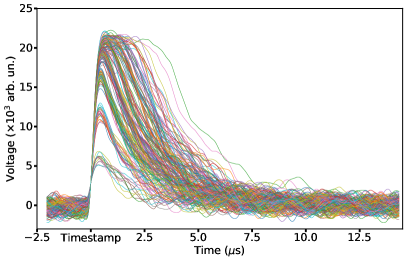
- Apply threshold-based detection: a pulse is registered only if both height and slope exceed user-defined thresholds.
- Extract key pulse characteristics (e.g., amplitude, decay time) for each detection event to assign photon number.
- Use a reconfigurable processor to store only physically significant pulse parameters, discarding raw data unless needed for calibration.
- Apply calibration using coherent states with known photon-number distributions to map pulse features to photon-number probabilities.
- Utilize a 600 ns coincidence window for tomographic analysis, rejecting events outside 100–700 ns after a pulse to reduce background noise.
Experimental results
Research questions
- RQ1Can photon-number resolution in TES detectors be achieved in real time without post-processing?
- RQ2What is the maximum photon number (n) that can be reliably resolved using real-time pulse analysis with TES?
- RQ3How precise is the photon-number assignment for low photon numbers (n ≤ 16) when using real-time hardware processing?
- RQ4What is the impact of detection thresholds and pulse characteristics on the accuracy of photon-number assignment?
- RQ5How does real-time processing compare to traditional post-processing in terms of data throughput and measurement latency?
Key findings
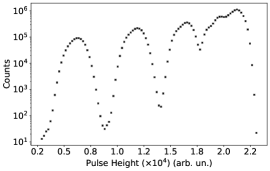
- The system resolves photon numbers up to n = 16 with a probability of correct assignment pⁿₘ₌ₙ > 0.90 for n = 16, decreasing to 0.90 at n = 16 and 0.936 at n = 15.
- For n = 1, the probability of correct assignment is 0.99999598734, with a standard deviation of 2×10⁻⁴, indicating parts-per-billion precision.
- The probability of misassigning n−1 or n+1 photons is negligible for n ≤ 10, with pⁿₘ₌ₙ₋₁ < 5×10⁻³ and pⁿₘ₌ₙ₊₁ < 5×10⁻³.
- Calibration using coherent states with α = 1.32 and α = 2.16 yields consistent α estimates within one standard deviation, confirming calibration reliability.
- Only 525 out of ~1.8×10⁷ detection events (0.003%) fell outside the 600 ns coincidence window, indicating effective background suppression.
- The system achieves real-time processing by analyzing pulses during acquisition, eliminating the need for 1 GB/min data logging and post-processing.
Read this paper
Open the full text in the Nubint reader and ask about any passage as you read.
Read this paper on NubintThis review was generated by AI from the original paper. Please check the paper before citing it.