
[Paper Review] PREDATOR: Registration of 3D Point Clouds with Low Overlap
Predator is a deep learning model for 3D point cloud registration that uses an overlap-attention mechanism to focus on overlapping regions between low-overlap scans, improving feature point selection and matching. It achieves a 90.6% registration recall on the 3DMatch benchmark and boosts success rates by over 15 percentage points in low-overlap scenarios.
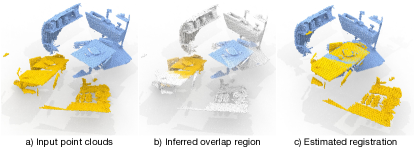
We introduce PREDATOR, a model for pairwise point-cloud registration with deep attention to the overlap region. Different from previous work, our model is specifically designed to handle (also) point-cloud pairs with low overlap. Its key novelty is an overlap-attention block for early information exchange between the latent encodings of the two point clouds. In this way the subsequent decoding of the latent representations into per-point features is conditioned on the respective other point cloud, and thus can predict which points are not only salient, but also lie in the overlap region between the two point clouds. The ability to focus on points that are relevant for matching greatly improves performance: PREDATOR raises the rate of successful registrations by more than 20% in the low-overlap scenario, and also sets a new state of the art for the 3DMatch benchmark with 89% registration recall.
Motivation & Objective
- Address the lack of robustness in existing 3D point cloud registration methods when overlap between scans falls below 30%.
- Investigate why current state-of-the-art methods fail in low-overlap regimes despite strong performance on standard benchmarks.
- Develop a neural architecture that explicitly models and focuses on the overlap region between two point clouds during feature learning.
- Improve feature point sampling by conditioning on cross-cloud context to prioritize salient, overlapping points.
- Introduce a novel loss function to train matchability scores that enhance the repeatability and discriminability of interest points.
Proposed method
- Employ a Siamese encoder to extract superpoint-level latent features from voxelized input point clouds.
- Introduce an overlap-attention block that applies self-attention and cross-attention between the two point clouds' latent representations.
- Use the overlap-attention module to generate overlap scores and cross-overlap scores, enabling early contextual exchange.
- Condition the decoder on both the latent features and the overlap-aware representations to produce per-point feature descriptors.
- Train the model with a novel loss function that optimizes matchability scores to guide interest point selection.
- Refine feature descriptors by conditioning them on the other point cloud’s representation, enhancing robustness to low overlap.
Experimental results
Research questions
- RQ1Why do state-of-the-art 3D point cloud registration methods fail in low-overlap scenarios despite high performance on standard benchmarks?
- RQ2Can early cross-attention between point cloud encodings improve registration robustness in low-overlap regimes?
- RQ3Does focusing feature point sampling on the overlap region significantly improve registration success rates?
- RQ4Can a learnable attention mechanism that models overlap improve feature descriptor quality and matchability?
- RQ5How does the proposed method compare to direct registration and feature-based methods in low-overlap and real-world settings?
Key findings
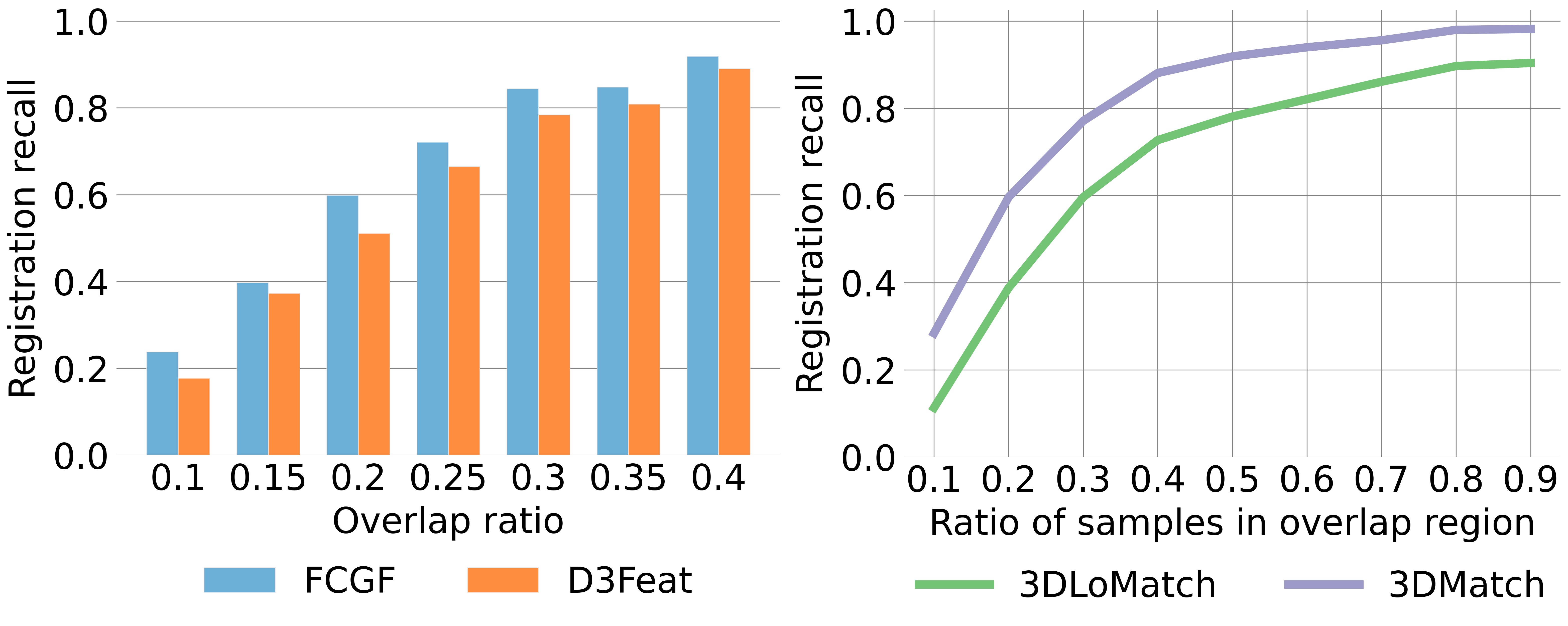
- Predator increases registration recall by over 15 percentage points in the low-overlap regime compared to existing methods.
- The model achieves a new state of the art on the 3DMatch benchmark with 90.6% registration recall.
- The overlap-attention mechanism significantly improves the fraction of points sampled from the overlap region, reducing failure rates by over 40 percentage points in low-overlap settings.
- Predator outperforms DCP-v2 and RPM-Net on the ModelNet and ModelLoNet datasets, especially in the low-overlap regime, with lower rotation and translation errors.
- Sampling points using the overlap attention (prob. (om)) yields significantly better results than random sampling, reducing RRE by approximately 8° at 40% completeness.
- On the KITTI odometry dataset, Predator achieves performance on par with state-of-the-art methods, with 99.8% registration recall and 6.8 cm mean translation error.
Read this paper
Open the full text in the Nubint reader and ask about any passage as you read.
Read this paper on NubintThis review was generated by AI from the original paper. Please check the paper before citing it.