
[Paper Review] Principled Instructions Are All You Need for Questioning LLaMA-1/2, GPT-3.5/4
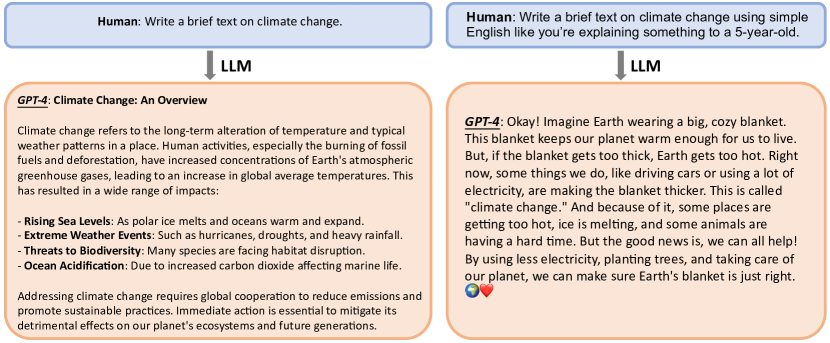
The paper proposes 26 principled instructions to guide prompting of LLMs, demonstrating that carefully crafted prompts can substantially boost response quality and correctness across LLaMA-1/2, GPT-3.5/4, with larger models gaining more benefit.
This paper introduces 26 guiding principles designed to streamline the process of querying and prompting large language models. Our goal is to simplify the underlying concepts of formulating questions for various scales of large language models, examining their abilities, and enhancing user comprehension on the behaviors of different scales of large language models when feeding into different prompts. Extensive experiments are conducted on LLaMA-1/2 (7B, 13B and 70B), GPT-3.5/4 to verify the effectiveness of the proposed principles on instructions and prompts design. We hope that this work can provide a better guide for researchers working on the prompting of large language models. Project page is available at https://github.com/VILA-Lab/ATLAS.
Motivation & Objective
- Demonstrate that principled prompting can steer LLMs toward higher-quality outputs across model scales.
- Systematically categorize and validate prompting principles that affect clarity, specificity, and task alignment.
- Quantify gains in response quality and correctness when applying principled prompts to diverse LLMs.
Proposed method
- Introduce 26 prompting principles grouped into five categories (Prompt Structure, Specificity, User Interaction, Content/Style, Complex Tasks).
- Evaluate principles with the ATLAS benchmark using LLaMA-1/2 (7B, 13B, 70B) and GPT-3.5/4 across Boosting (quality) and Correctness (accuracy) settings.
- Use manual human evaluation to compare responses with and without principled prompts.
- Analyze model-scale effects, showing larger models reap more gains.
- Provide a project page with ATLAS benchmark and principles for reproducibility.
Experimental results
Research questions
- RQ1Do principled prompts improve LLM response quality across model scales (7B, 13B, 70B, GPT-3.5/4)?
- RQ2How do the proposed 26 principles affect correctness and brevity of outputs across different models?
- RQ3Which principles yield the largest gains on larger models and complex reasoning tasks?
Key findings
- Principled prompts yield significant improvements in response quality across small, medium, and large LLMs.
- Large-scale models show the most improvement for several principles (2, 5, 15, 16, 25, 26).
- Principle 14 improves all questions it is applied to.
- Absolute correctness improves by roughly 20–40% on average; larger models can exceed 40% absolute accuracy gains and relative gains >20%.
- On average, a stable ~50% improvement in response quality across models is observed when applying principled prompts.
- GPT-4 benefits include an average improvement of 57.7% in quality and 36.4% in accuracy on the ATLAS benchmark with principled prompts.

Read this paper
Open the full text in the Nubint reader and ask about any passage as you read.
Read this paper on NubintThis review was generated by AI from the original paper. Please check the paper before citing it.