
[Paper Review] Privacy Amplification via Compression: Achieving the Optimal Privacy-Accuracy-Communication Trade-off in Distributed Mean Estimation
This paper proposes a compression-based privacy amplification technique for distributed mean estimation that achieves the optimal trade-off between privacy, communication, and accuracy under $(\varepsilon,\delta)$-differential privacy. By having clients communicate only partial, randomly selected parts of their data, the method amplifies privacy through client-side randomness, enabling significant communication reduction—down to $\Theta(n\min(\varepsilon,\varepsilon^2))$ bits in FL and $\Theta(\log(n\min(\varepsilon,\varepsilon^2)))$ bits in FA—while maintaining order-wise optimal $\ell_2$ error.
Privacy and communication constraints are two major bottlenecks in federated learning (FL) and analytics (FA). We study the optimal accuracy of mean and frequency estimation (canonical models for FL and FA respectively) under joint communication and $(\varepsilon, δ)$-differential privacy (DP) constraints. We show that in order to achieve the optimal error under $(\varepsilon, δ)$-DP, it is sufficient for each client to send $Θ\left( n \min\left(\varepsilon, \varepsilon^2 ight) ight)$ bits for FL and $Θ\left(\log\left( n\min\left(\varepsilon, \varepsilon^2 ight) ight) ight)$ bits for FA to the server, where $n$ is the number of participating clients. Without compression, each client needs $O(d)$ bits and $\log d$ bits for the mean and frequency estimation problems respectively (where $d$ corresponds to the number of trainable parameters in FL or the domain size in FA), which means that we can get significant savings in the regime $ n \min\left(\varepsilon, \varepsilon^2 ight) = o(d)$, which is often the relevant regime in practice. Our algorithms leverage compression for privacy amplification: when each client communicates only partial information about its sample, we show that privacy can be amplified by randomly selecting the part contributed by each client.
Motivation & Objective
- To close the gap in understanding the optimal trade-off between privacy, communication, and accuracy in distributed mean estimation under joint constraints.
- To investigate whether communication efficiency can be improved without sacrificing accuracy or privacy in federated learning and analytics.
- To develop a method that enables clients to send less information while still achieving optimal privacy-accuracy-communication trade-off.
- To extend privacy amplification via compression to both central and multi-message shuffling DP models, ensuring trustworthiness and efficiency.
Proposed method
- Clients communicate only a randomly selected subset of their data (e.g., a random subset of model parameters or histogram entries), reducing communication load.
- Privacy amplification is achieved by introducing randomness in the choice of data parts per client, so the server cannot link a specific part to a specific client.
- In the central DP model, the server receives and aggregates the compressed data, achieving optimal $\ell_2$ error with reduced communication.
- In the multi-message shuffling model, each client locally privatizes and anonymizes its selected data part via a secure shuffler, eliminating the need for a trusted server.
- The method uses a privacy budget splitting strategy across multiple rounds to maintain optimal privacy guarantees under shuffling.
- Theoretical analysis shows that the $\ell_2$ error is order-wise optimal, achieving $O\left(\frac{C^2 d}{n^2 \min(\varepsilon^2, \varepsilon)}\right)$ error up to logarithmic factors.

Experimental results
Research questions
- RQ1Can communication load be reduced in distributed mean estimation without degrading privacy or accuracy?
- RQ2Does random compression of client data lead to privacy amplification, and if so, under what conditions?
- RQ3Can the optimal privacy-accuracy-communication trade-off be achieved in both central and multi-message shuffling DP models?
- RQ4What is the minimal communication cost required to achieve order-wise optimal $\ell_2$ error under $(\varepsilon,\delta)$-DP?
- RQ5How does the proposed method compare to existing local and shuffled DP mechanisms in terms of practical performance?
Key findings
- The proposed method achieves order-wise optimal $\ell_2$ error of $O\left(\frac{C^2 d}{n^2 \min(\varepsilon^2, \varepsilon)}\right)$ under $(\varepsilon,\delta)$-DP, up to logarithmic factors.
- Clients need only communicate $\Theta(n\min(\varepsilon,\varepsilon^2))$ bits in federated learning and $\Theta(\log(n\min(\varepsilon,\varepsilon^2)))$ bits in frequency estimation to achieve optimal accuracy.
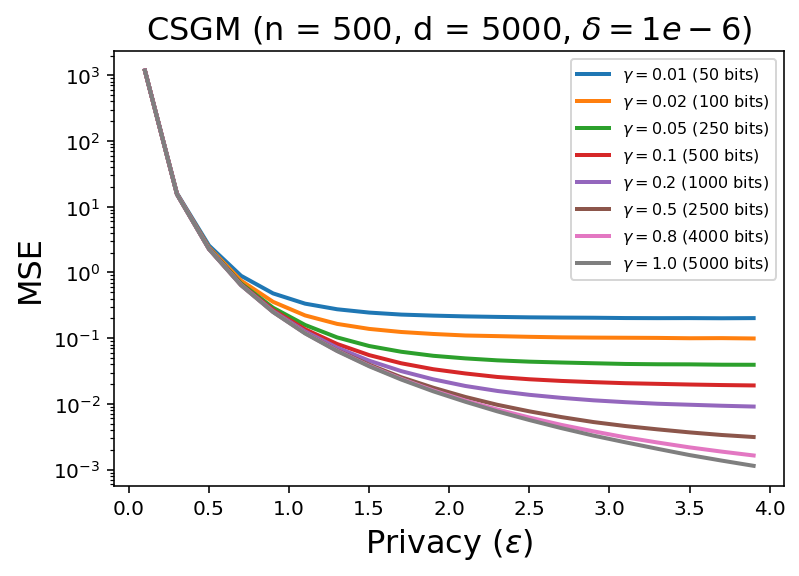
- In the high-privacy regime ($\varepsilon \leq 0.5$), CSGM with $b=50$ bits achieves 10x compression for $d=500$ and 100x for $d=5000$ without loss in mean squared error.
- For a fixed communication budget of 10 bits, CSGM outperforms both shuffled-DP and local-DP mechanisms in terms of mean squared error.
- The privacy amplification via compression is effective even when $n\min(\varepsilon,\varepsilon^2) = o(d)$, which is common in practice, enabling significant communication savings.
- The shuffling-based variant achieves the same optimal trade-off as the central model and eliminates the need for a trusted server, enabling deployment in untrusted environments.
Read this paper
Open the full text in the Nubint reader and ask about any passage as you read.
Read this paper on NubintThis review was generated by AI from the original paper. Please check the paper before citing it.