
[Paper Review] Privacy Distillation: Reducing Re-identification Risk of Multimodal Diffusion Models
This paper proposes Privacy Distillation, a two-stage framework that trains a text-to-image diffusion model on real medical images, generates synthetic data, filters out re-identifiable samples using a re-identification detector, and retrains a second diffusion model on the filtered data. The method reduces re-identification risk by 3x (from 4.24% to 1.34%) while maintaining strong downstream performance on classification tasks, demonstrating effective privacy preservation without sacrificing utility.
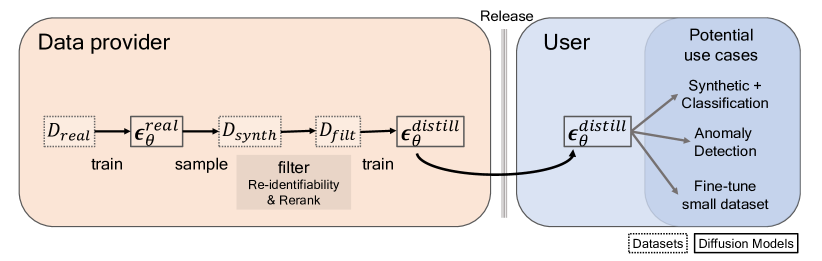
Knowledge distillation in neural networks refers to compressing a large model or dataset into a smaller version of itself. We introduce Privacy Distillation, a framework that allows a text-to-image generative model to teach another model without exposing it to identifiable data. Here, we are interested in the privacy issue faced by a data provider who wishes to share their data via a multimodal generative model. A question that immediately arises is ``How can a data provider ensure that the generative model is not leaking identifiable information about a patient?''. Our solution consists of (1) training a first diffusion model on real data (2) generating a synthetic dataset using this model and filtering it to exclude images with a re-identifiability risk (3) training a second diffusion model on the filtered synthetic data only. We showcase that datasets sampled from models trained with privacy distillation can effectively reduce re-identification risk whilst maintaining downstream performance.
Motivation & Objective
- To address the risk of patient re-identification in multimodal diffusion models trained on sensitive medical imaging data.
- To develop a privacy-preserving distillation framework that avoids memorization of identifiable patient features.
- To evaluate whether filtered synthetic data can maintain utility for downstream tasks like classification.
- To demonstrate that post-generation filtering of synthetic data can reduce re-identification risk without requiring model retraining from scratch.
- To provide a practical, post-hoc auditing method applicable to existing generative models.
Proposed method
- Train a first conditional latent diffusion model (LDM) on real chest X-ray images using text prompts.
- Generate a large synthetic dataset using the first LDM, conditioned on real training prompts.
- Apply a re-identification network to detect and filter out synthetic images that resemble real patients.
- Train a second LDM exclusively on the filtered synthetic dataset to produce a privacy-preserving generative model.
- Use the distilled model to sample 40,000 synthetic images for downstream evaluation.
- Evaluate privacy via re-identification ratio and model utility via classifier AUC and text-image alignment score.
Experimental results
Research questions
- RQ1Can a two-stage distillation process effectively reduce re-identification risk in text-to-image diffusion models trained on medical data?
- RQ2How does the re-identification risk vary between models trained from scratch versus fine-tuned on real data?
- RQ3To what extent does filtering synthetic data preserve downstream task performance in classification and alignment tasks?
- RQ4Can post-hoc filtering of synthetic data serve as a practical privacy audit mechanism for existing generative models?
- RQ5What is the trade-off between privacy and model utility in the distilled generation pipeline?
Key findings
- The re-identification risk of the distilled model was reduced to 1.34%, a 3.17-fold decrease from the original synthetic model’s 4.24%.
- The classifier trained on synthetic data from the distilled model achieved an AUC of 0.810, comparable to the real data baseline of 0.863.
- The text-image alignment score ($s_{align}$) for the distilled model was 0.611, slightly lower than the real data baseline of 0.698 but still within acceptable range.
- Filtering reduced memorization of unique phenotypes, which may explain the slight performance drop but significantly improved privacy.
- The method enables safe sharing of generative models without exposing original training data, even when retraining is not feasible.
- The approach is generalizable to other imaging modalities and conditioning types, provided a suitable re-identification metric is used.
Read this paper
Open the full text in the Nubint reader and ask about any passage as you read.
Read this paper on NubintThis review was generated by AI from the original paper. Please check the paper before citing it.