
[Paper Review] Privacy Measurement in Tabular Synthetic Data: State of the Art and Future Research Directions
This paper provides a comprehensive survey of privacy measurement techniques for tabular synthetic data, evaluating existing methods across threat models, metrics, and attack types. It identifies critical gaps in standardization and proposes a framework to guide researchers in selecting appropriate privacy assessments, advancing the development of robust, auditable synthetic data systems.
Synthetic data (SD) have garnered attention as a privacy enhancing technology. Unfortunately, there is no standard for quantifying their degree of privacy protection. In this paper, we discuss proposed quantification approaches. This contributes to the development of SD privacy standards; stimulates multi-disciplinary discussion; and helps SD researchers make informed modeling and evaluation decisions.
Motivation & Objective
- To address the lack of standardized, quantitative methods for assessing privacy protection in synthetic tabular data.
- To systematize existing privacy measurement approaches across threat models, metrics, and attack techniques.
- To stimulate interdisciplinary discussion and support informed design and evaluation choices for synthetic data generators.
- To identify research gaps in current privacy assessment frameworks, particularly in legal, technical, and empirical validation domains.
- To establish a foundation for future development of privacy standards in synthetic data generation and evaluation.
Proposed method
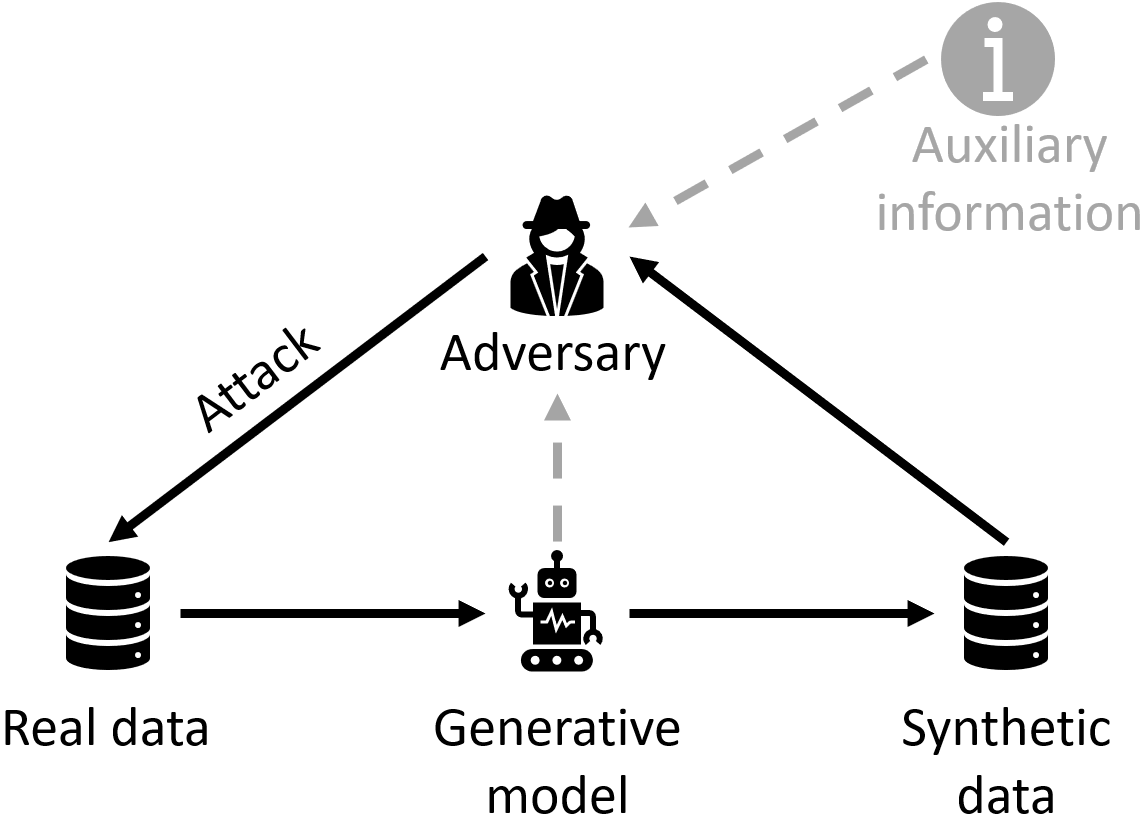
- Categorizes and evaluates 29 existing privacy assessment frameworks based on threat models (no box, black box, white box, uncertain box, with auxiliary information).
- Classifies privacy metrics into three categories: distance-based (e.g., Euclidean, Hamming), distributional (e.g., Kolmogorov-Smirnov, KLD), and inferential (e.g., membership inference, attribute inference).
- Maps attack techniques to the three core privacy risks defined by WP29: singling out, linkability, and inference.
- Proposes a structured framework for evaluating synthetic data using attack-based validation, including nearest neighbor, shadow modeling, and membership inference attacks.
- Introduces a taxonomy of indicators used in practice, distinguishing between those that assess data utility and those that measure privacy leakage.
- Analyzes the use of supervised learning metrics (e.g., AUC, F1, precision-recall) as privacy estimators in membership inference and vulnerability detection.
Experimental results
Research questions
- RQ1What are the dominant threat models used in empirical privacy assessments of synthetic tabular data?
- RQ2Which privacy metrics and attack techniques are most frequently applied in current research, and how do they align with the three core privacy risks (singling out, linkability, inference)?
- RQ3How do different data synthesis methods (e.g., GANs, VAEs, seed-based generators) affect the susceptibility to privacy attacks?
- RQ4To what extent do existing frameworks incorporate auxiliary information, and how does this impact the validity of privacy assessments?
- RQ5What are the key gaps in current privacy measurement practices, particularly in legal, technical, and standardization domains?
Key findings
- No standardized, universally accepted method exists for quantifying privacy protection in synthetic tabular data, creating a major barrier to adoption.
- Distance-based metrics (e.g., Euclidean, Hamming) and distributional comparisons (e.g., KLD, KS test) are the most commonly used privacy assessment techniques.
- Membership inference attacks (MIA) and shadow modeling are frequently used to evaluate privacy leakage, especially under black-box and white-box threat models.
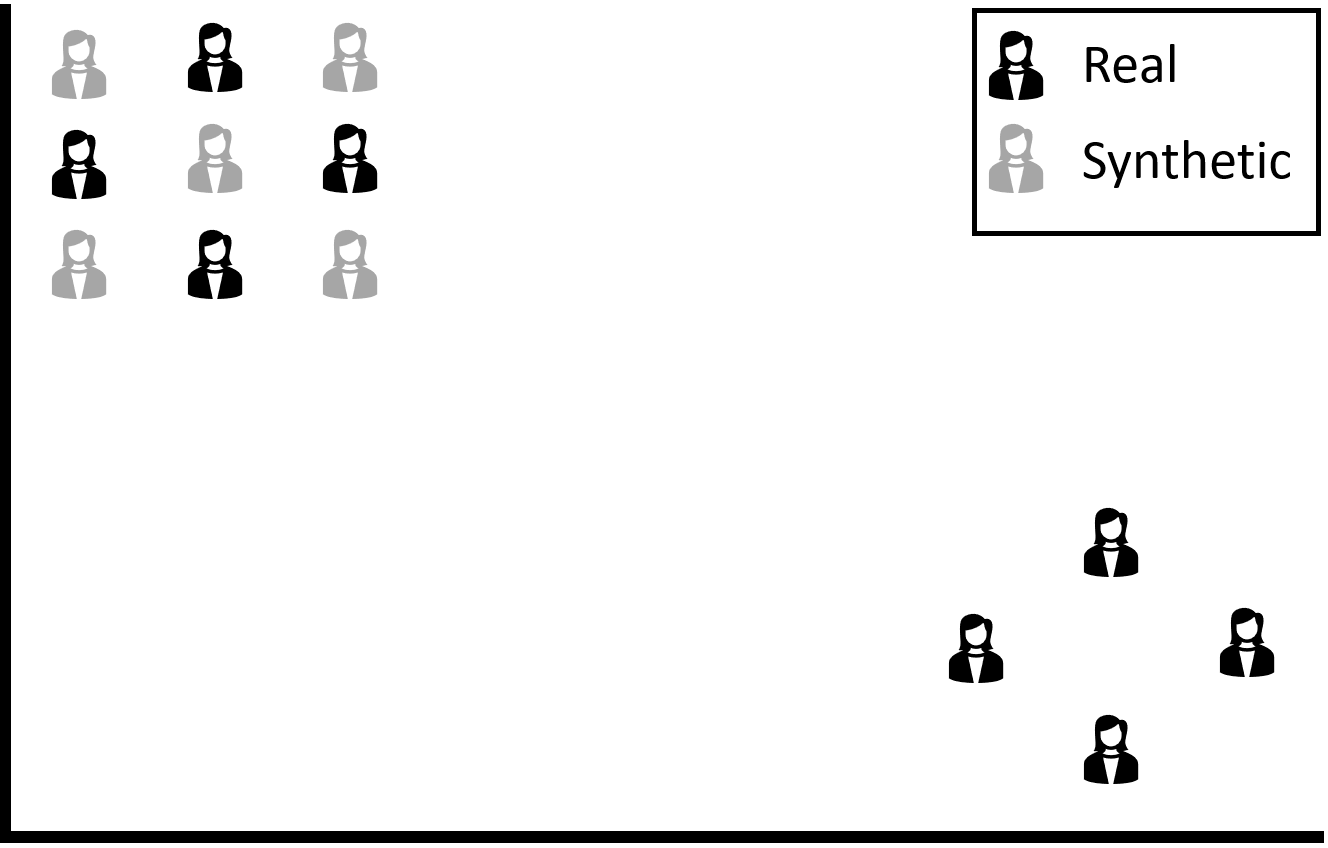
- Seed-based generators pose higher privacy risks due to one-to-one correspondence between real and synthetic records, increasing vulnerability to singling-out attacks.
- Only 11 out of 29 surveyed frameworks explicitly use auxiliary information, and most do not validate results against control baselines, limiting reliability.
- There is a significant lack of integration between technical privacy metrics and legal compliance frameworks, especially regarding GDPR and anonymization standards.
Read this paper
Open the full text in the Nubint reader and ask about any passage as you read.
Read this paper on NubintThis review was generated by AI from the original paper. Please check the paper before citing it.